Просмотр новости
Найдите то, что Вас интересует
 Спутники
 РН
 SpaceX
 Роскосмос
 NASA
СпутникиРНSpaceXРоскосмосNASABackground The integration of artificial intelligence (AI) into mathematics education has advanced rapidly; however, systematic AI-based chatbot frameworks that integrate computational thinking (CT) and self-regulated learning (SRL) scaffolding within university calculus remain limited. This study developed and formatively evaluated Calcyon, an AI-based chatbot framework designed to integrate CT processes and SRL scaffolding within university differential calculus learning. Methods A Design and Development Research (DDR) approach guided by the ADDIE model was employed, focusing on the design, development, and formative evaluation stages. Expert evaluation (n = 3) was conducted across five design dimensions using Aiken’s V to examine content and design validity. A formative student pilot study (n = 11) was conducted to evaluate prototype readability and feasibility across six dimensions. Results Expert evaluation indicated strong expert-rated design and content validity across content, instructional, technical, linguistic, and media design dimensions (Aiken’s V = 0.92). Most items met the predefined criterion, while several revisions were incorporated based on expert feedback. The student pilot indicated good readability and feasibility of the prototype. Conclusions Calcyon provides an empirically evaluated AI-based chatbot framework that integrates AI-mediated interaction, CT-oriented scaffolding, and multidimensional SRL design principles within university calculus learning. The findings provide evidence of framework quality and feasibility; however, they do not establish the effectiveness of Calcyon in improving CT, SRL, or calculus learning outcomes. Further empirical studies are required to examine its instructional effectiveness.
Corresponding author: Yaya Sukjaya Kusumah Competing interests: No competing interests were disclosed.
Grant information: This research was supported by the Indonesian Education Scholarship (BPI), the Center for Higher Education Funding and Assessment (PPAPT), and the Indonesian Endowment Fund for Education (LPDP). The funders had no role in study design, data collection, analysis, or preparation of this manuscript.
The funders had no role in study design, data collection and analysis, decision to publish, or preparation of the manuscript.
Copyright: © 2026 Rizki LM et al. This is an open access article distributed under the terms of the Creative Commons Attribution License, which permits unrestricted use, distribution, and reproduction in any medium, provided the original work is properly cited. The author(s) is/are employees of the US Government and therefore domestic copyright protection in USA does not apply to this work. The work may be protected under the copyright laws of other jurisdictions when used in those jurisdictions. How to cite: Rizki LM, Kusumah YS, Jupri A et al. Calcyon: Design and Validation of an AI-Based Chatbot Framework Integrating Computational Thinking and Self-Regulated Learning in University Calculus Learning [version 2; peer review: 2 approved, 1 approved with reservations]. F1000Research 2026, 15:1478 (https://doi.org/10.12688/f1000research.180626.2) First published: 03 Sep 2026, 15:1478 (https://doi.org/10.12688/f1000research.180626.1) Latest published: 06 Oct 2026, 15:1478 (https://doi.org/10.12688/f1000research.180626.2)
The rapid advancement of artificial intelligence is reshaping educational paradigms, demanding a reimagination of how learning is designed and delivered. Two foundational competencies have emerged as indispensable: Computational Thinking (CT) skill, defined as the cognitive processes of problem formulation, decomposition, pattern recognition, abstraction, and algorithmic solution design (Tikva & Tambouris, 2021; Wing, 2006); and Self-Regulated Learning (SRL), conceptualized by Teng and Zhang (2016) as a multidimensional construct encompassing four interdependent components namely: cognition, metacognition, social behavior, and motivation regulation. Despite their recognized importance, CT and SRL are not always explicitly scaffolded within undergraduate calculus learning, particularly in learning environments that require students to engage independently with complex mathematical problems. The significance of SRL for academic achievement in higher education has been consistently demonstrated across technology-enhanced learning environments (Broadbent, 2016).
The majority of educational chatbots function primarily as information retrieval tools, lacking the pedagogical architecture necessary to scaffold complex problem-solving or promote metacognitive development (Hwang & Chang, 2021). Furthermore, systematic, framework-based chatbot systems for university-level calculus that explicitly integrate CT skill and SRL remain largely absent from the literature (Smutny & Schreiberova, 2020; Wollny et al., 2021; Perez et al., 2020).
To supplement the narrative literature review, an exploratory bibliometric mapping was conducted using VOSviewer to identify thematic relationships among research on chatbots, artificial intelligence, and blended learning. The mapping was used to describe the research landscape rather than to establish the absence of prior studies. The literature search was performed in the Scopus database on November 27, 2024, using the keywords “chatbot,” “artificial intelligence,” and “blended learning.” The results, presented in Figure 1, reveal a highly interconnected research landscape in which artificial intelligence occupies a central position, surrounded by dominant themes such as blended learning, electronic learning, chatbots, and students.
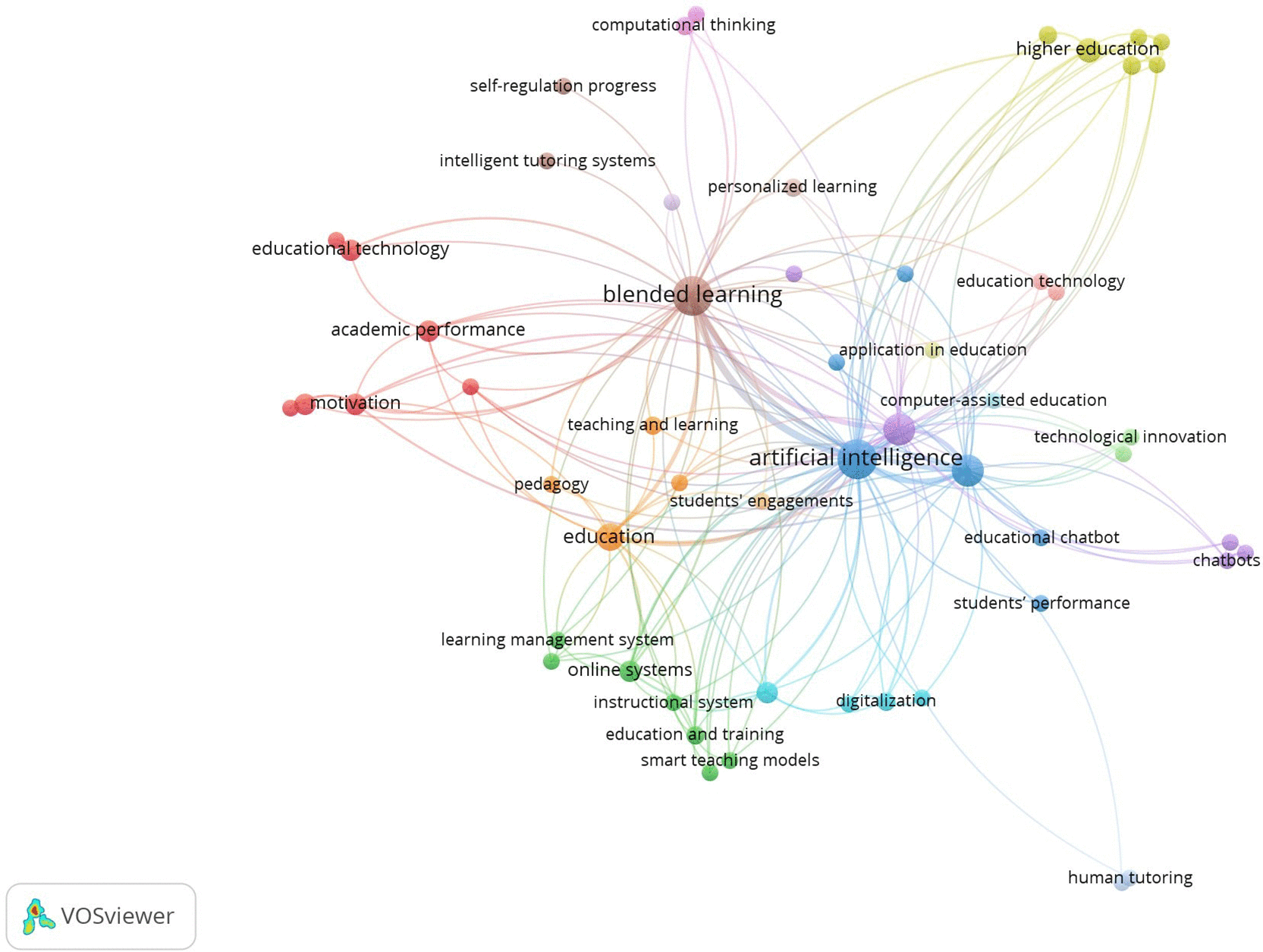
Blended learning emerges as a significant theme closely associated with SRL, motivation, and learning adaptability, highlighting its role in fostering learner autonomy and flexible engagement. Notably, CT skill and chatbots appear as recent and rapidly growing topics, indicating increasing scholarly attention toward integrating computational competencies with intelligent technologies in educational settings. Strong linkages between students, university education, and educational chatbots further demonstrate a growing focus on higher education as a primary context for technological innovation in learning.
Despite these developments, several critical research gaps remain. First, the relationship between CT processes and SRL requires further investigation, particularly regarding how cognitive, metacognitive, and motivational regulation processes can be integrated into computational problem-solving environments. Second, the use of AI-based chatbots to systematically integrate CT processes and SRL scaffolding remains limited, particularly in providing adaptive feedback, facilitating reflection, and supporting problem-based learning activities. Third, the integration of chatbot technologies within blended learning frameworks that incorporate both CT and SRL principles remains insufficiently explored. Finally, the implementation of CT within AI-enhanced blended learning environments has not yet been systematically operationalized through a coherent instructional design framework.
Addressing these gaps, this study proposes Calcyon, an artificial intelligence-based chatbot framework designed to operationalize CT processes and SRL scaffolding principles within university calculus learning interactions. The framework was developed to embed theoretically informed learning mechanisms, including CT-oriented problem structuring, SRL-related regulation prompts, and AI-mediated feedback processes. The framework consists of three interdependent subsystems: an adaptive CT skill problem-solving interface; a SRL regulation engine incorporating cognitive, metacognitive, social, and motivational scaffolding; and an artificial intelligence-driven adaptive feedback mechanism. Accordingly, this study aims to design and develop the Calcyon framework, examine its design and content validity through expert evaluation, and investigate its preliminary readability and feasibility through student pilot testing.
The significance of this study lies in its theoretical, practical, and innovative contributions. Theoretically, it extends artificial intelligence-based learning paradigms into calculus education while operationalizing SRL within an integrated instructional framework. Practically, it offers a replicable model for developing intelligent learning systems in higher education. Innovatively, this study contributes an AI-based chatbot framework that integrates CT processes and multidimensional SRL scaffolding principles within university calculus learning. The contribution lies in the design and operationalization of these components rather than in demonstrating their effectiveness on student learning outcomes. Thereby advancing the development of adaptive, learner-centered educational environments aligned with the demands of twenty-first century learning.
Ouyang and Jiao (2021) characterize AI’s evolution through three paradigms: AI-directed, AI-supported, and AI-empowered learning. Contemporary scholarship on generative AI in higher education further identifies personalized learning, metacognitive scaffolding, and adaptive feedback as the primary mechanisms through which AI tools can transform instructional practice and support learner autonomy (Chiu, 2024). Mousavinasab et al. (2021) confirmed that well-designed Intelligent Tutoring Systems improve learning outcomes through personalized instructional sequences and targeted feedback. However, most existing systems address lower-level mathematics, leaving a gap at the university calculus level. A systematic review of ITS trends in mathematics education confirms that adaptive feedback, user modeling, and personalized learning pathways are the defining characteristics of effective systems, yet their application to university-level calculus remains limited (Niño & Gómez, 2024).
Wollny et al. (2021), reviewing 74 publications, identify teaching, peer, and motivational roles for educational chatbots. A subsequent systematic review by Kuhail et al. (2023), examining 36 chatbot-learner interaction studies, confirms that more than half of educational chatbots function as teaching agents, with design principles centred on personalisation and goal-oriented interaction. Hwang and Chang (2021) note challenges in learning strategy integration and higher-order thinking support. Empirical evidence suggests that chatbots designed with explicit goal-setting prompts and social presence features can enhance learner engagement and self-regulatory behaviour in online settings (Hew et al., 2023). Smutny and Schreiberova (2020) observe that mathematics-oriented chatbots are predominantly limited to procedural assistance. A systematic review of AI chatbot roles in higher education by Labadze et al. (2023) corroborates this finding, confirming that chatbots predominantly serve as content delivery agents, with limited integration of higher-order pedagogical functions. Perez et al. (2020) confirm that teaching-oriented chatbots rarely embed structured metacognitive scaffolding, a gap directly addressed by Calcyon through its SRL metacognition component. A systematic review of 27 studies confirms that while educational chatbots have begun to scaffold SRL processes, their coverage remains predominantly restricted to metacognitive strategies, with cognitive, social behavior, and motivational regulation dimensions insufficiently addressed (Shkul et al., 2024).
Wing (2006) defined CT as thought processes for formulating problems for information-processing solutions. Four core components are identified: decomposition, pattern recognition, abstraction, and algorithmic thinking (Tikva & Tambouris, 2021). Recent evidence from higher education confirms that these CT components are learnable and transferable across disciplines including mathematics, supporting their integration as explicit instructional targets in university curricula (Mouza et al., 2025). Barcelos et al. (2018), reviewing 42 empirical studies, demonstrate that CT-structured engagement produces measurable improvements in mathematical problem-solving performance. More recently, Looi et al. (2024) found that students’ CT dispositions and engagement in mathematics learning are positively associated with learning performance, underscoring the dual cognitive and motivational dimensions of CT integration in mathematics education. Notably, algorithmic thinking has been identified as a productive vehicle for developing mathematical reasoning through systematic solution design (Lehmann, 2024). The natural alignment between CT and calculus reasoning, where multi-step derivative problems require exactly the decomposition, abstraction, and algorithmic planning that CT specifies, makes CT an ideal scaffolding framework for calculus learning.
Self-Regulated Learning (SRL) is conceptualized as a multidimensional process through which learners regulate cognitive, metacognitive, social, and motivational aspects of learning to achieve specific goals. This study adopts the four-component SRL framework proposed by Teng and Zhang (2016) as a theoretical structure for designing SRL-related interaction mechanisms within Calcyon.
It should be noted that Teng and Zhang’s (2016) framework was originally developed and psychometrically validated through the Writing Strategies for Self-Regulated Learning Questionnaire (WSSRLQ) in the context of EFL writing. Therefore, the present study does not assume that writing-specific SRL indicators can be directly transferred to calculus learning. Instead, the framework dimensions are interpreted as general regulatory processes that require contextual adaptation according to the cognitive demands of mathematical reasoning.
Accordingly, the four SRL components were operationalized specifically for university calculus learning. Cognitive regulation was represented through mathematical information processing, concept organization, and systematic application of derivative procedures. Metacognitive regulation was represented through planning solution strategies, monitoring understanding, and evaluating mathematical problem-solving processes. Social behavior regulation was represented through help-seeking and utilization of feedback during mathematical tasks. Motivation regulation was represented through maintaining engagement, managing learning difficulties, and sustaining effort during challenging calculus activities.
Thus, Teng and Zhang’s (2016) framework functions as a structural template, while the operational indicators embedded in Calcyon were adapted specifically to mathematical reasoning and calculus problem-solving contexts.
The Cognition component refers to the strategies learners use to process information and knowledge when completing learning tasks. Although the original cognition dimension was developed in the context of writing strategy use, its underlying regulatory principle concerns how learners organize, encode, retrieve, and apply knowledge during complex tasks. In calculus learning, this principle was adapted to mathematical information processing, including organizing derivative concepts, identifying relevant procedures, and applying mathematical rules systematically. Calcyon supports cognitive regulation by presenting content in a structured, sequenced format, breaking complex derivative application problems into manageable information units, and providing worked examples that model effective cognitive processing strategies.
The Metacognition component encompasses learners’ ability to control and regulate their own cognitive processes, including planning (goal-setting and strategy selection before task engagement), monitoring (self-assessment of understanding and strategy effectiveness during problem-solving), and evaluation (post-task reflection on performance and identification of areas for improvement). Within calculus problem-solving, metacognitive regulation does not refer to writing-specific planning or monitoring behaviors, but rather to students’ regulation of mathematical reasoning processes. These include selecting appropriate solution strategies, monitoring conceptual understanding, checking procedural accuracy, and evaluating the effectiveness of solution approaches. This three-phase regulatory cycle such as forethought, performance, and self-reflection, mirrors the foundational SRL model articulated by Zimmerman (2000) and operationalized in Calcyon’s interaction architecture. Metacognitive regulation is the most extensively studied SRL component in mathematics education, as it governs the quality of strategic engagement with mathematical problem-solving (Teng & Zhang, 2016). Calcyon embeds metacognitive scaffolding through structured planning prompts before each learning session, real-time monitoring checkpoints during problem-solving interactions, and post-task reflection sequences following exercise completion.
The Social Behavior component refers to individuals’ efforts to regulate their learning behavior within social contexts, particularly including help-seeking behavior and the active use of feedback to improve performance. In educational settings, effective social behavior regulation is associated with greater willingness to seek assistance when encountering difficulty, more productive use of instructor and peer feedback, and reduced learning anxiety in challenging task contexts (Teng & Zhang, 2016). In mathematical learning contexts, social behavior regulation is expressed through strategic help-seeking and feedback utilization rather than interpersonal communication associated with writing activities. Within Calcyon’s architecture, this component is represented through AI-mediated assistance and feedback mechanisms that allow learners to request clarification and revise their mathematical understanding. Calcyon operationalizes social behavior regulation through its distinctive Instant Help feature (the lamp icon, accessible at any point during the learning session), which enables on-demand AI-assisted scaffolding that functions as responsive, non-judgmental tutoring support, together with constructive and elaborated feedback provided by the Auto-Scoring System.
The Motivation Regulation component encompasses the strategies learners deploy to maintain or enhance their motivation, sustaining engagement with the learning process even when encountering difficulty. Motivation regulation strategies include interest enhancement (finding personal relevance in learning content), motivational self-talk (positive self-directed internal dialogue), and emotional control (managing affective responses to academic challenges) (Teng & Zhang, 2016). In calculus learning, motivation regulation concerns students’ ability to maintain engagement with cognitively demanding mathematical tasks. Therefore, the implementation within Calcyon emphasizes sustaining effort, managing difficulty, and maintaining interest during calculus problem-solving activities. Calcyon supports motivation regulation through contextual anchoring of derivative application concepts in real-world scenarios, motivational acknowledgment messages following successful task completion, and growth mindset-oriented prompts that reframe errors as learning opportunities rather than failures. Empirical evidence indicates that AI-based chatbots incorporating scaffolded SRL prompts, including motivational and metacognitive guidance, can enhance learning engagement and science achievement compared with conventional digital learning tools. (Ng et al., 2024).
The adoption of Teng and Zhang’s (2016) framework in Calcyon should therefore be understood as a theoretically guided adaptation rather than a direct transfer of a writing-specific measurement model. Its multidimensional structure provides a useful foundation for identifying different regulatory processes involved in calculus learning, including information processing, strategic monitoring, feedback utilization, and motivational maintenance. However, the applicability of these adapted SRL dimensions as measurement constructs in mathematics learning requires further psychometric investigation. These demands include cognitive processing of abstract derivative procedures, metacognitive monitoring of mathematical understanding, social regulation through effective help seeking, and motivational regulation required to sustain engagement with challenging mathematical content. The relevance of these four SRL components is further supported by systematic review evidence indicating that resource management, motivational beliefs, and metacognitive strategies are important determinants of learning success in technology-enhanced blended learning environments (Luo & Zhou, 2024).
The theoretical case for integrating AI, CT, and SRL within a unified instructional framework rests on a set of productive convergences. CT provides the structural decomposition of mathematical problems, SRL provides the regulatory architecture for managing problem-solving strategies across all four of Teng and Zhang’s (2016) components, and AI provides the adaptive scaffolding infrastructure supporting both processes dynamically (Ouyang & Jiao, 2021). Specifically: AI-directed features support the SRL Cognition component by presenting structured content; AI-supported features scaffold Metacognition through monitoring prompts and adaptive feedback; the Instant Help feature operationalizes Social Behavior regulation; and motivational messaging features address Motivation Regulation. The Calcyon framework represents an attempt to systematically integrate CT processes, the Teng and Zhang (2016) SRL framework, and AI-mediated interaction within a chatbot-based architecture for university calculus learning.
Conceptual structure
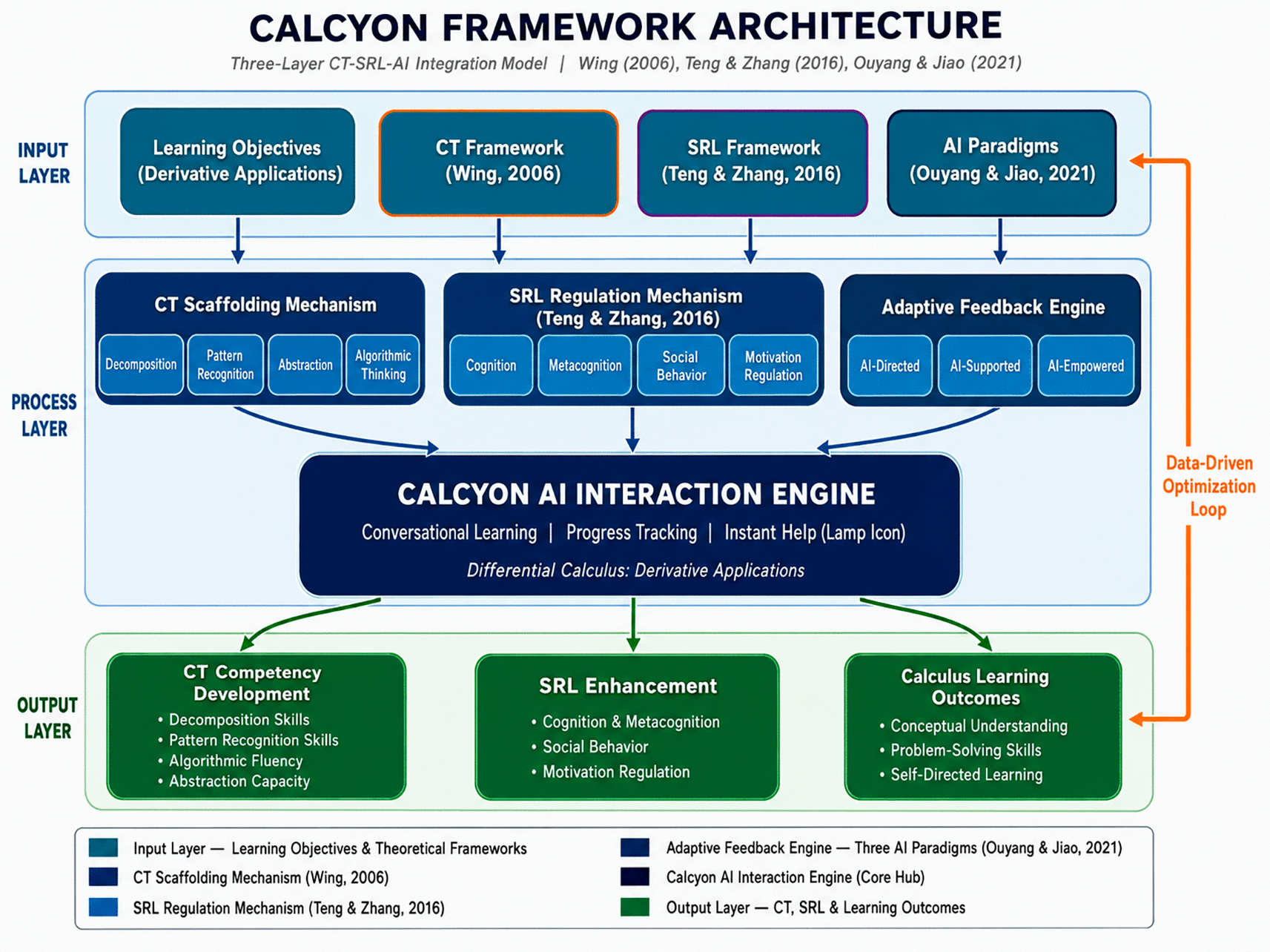
The Calcyon model operates through three layers. The Input Layer anchors learning objectives aligned with derivative application content and integrates the CT framework (Wing, 2006), the four-component SRL model (Teng & Zhang, 2016), and the three AI paradigms (Ouyang & Jiao, 2021). The Process Layer integrates three interlocking mechanisms within the Calcyon AI Interaction Engine: the CT Scaffolding Mechanism structures every interaction around the four CT components; the SRL Regulation Mechanism embeds all four SRL components — cognitive strategy support, metacognitive prompts, social behavior scaffolding, and motivation regulation — at appropriate interaction checkpoints; and the Adaptive Feedback Engine dynamically adjusts response scaffolding based on learner input. The Output Layer represents the intended learning processes and design objectives of the framework, including CT-oriented problem-solving processes, SRL-related regulatory mechanisms, and calculus learning activities. These intended outcomes require further empirical investigation through controlled implementation studies. This architecture is illustrated in Figure 2.
Key features of Calcyon
Four operational features characterize the Calcyon framework, each aligned with specific SRL components of Teng and Zhang (2016). These alignments represent instructional design mappings between framework features and SRL dimensions. They should not be interpreted as direct evidence that Calcyon improves students’ SRL abilities. First, adaptive CT-structured questioning guides learners through the CT components and supports the Cognition component through structured information processing. Second, SRL-embedded metacognitive prompts are provided at planning, monitoring, and evaluation checkpoints to support the Metacognition component. Third, the Instant Help feature, represented by a lamp icon, provides on-demand AI assistance and was designed to support the Social Behavior component through timely help seeking. Fourth, motivational acknowledgment messages, growth mindset prompts, and interest-anchoring contexts were incorporated to support the Motivation Regulation component by sustaining learner engagement.
Theoretical alignment
The Calcyon model draws its theoretical coherence from three integrated frameworks. Constructivist learning theory (Vygotsky, 1978) underpins the scaffolding architecture, with Calcyon functioning as a more knowledgeable other that provides Zone of Proximal Development support. Teng and Zhang’s (2016) four-component SRL model provides the structural template for the SRL Regulation Mechanism. In this study, the framework was adapted to calculus learning by translating the general regulatory dimensions into mathematics-specific interaction features rather than adopting the original writing-based indicators directly. Wing’s (2006) CT framework provides the problem-solving architecture structuring the CT Scaffolding Mechanism.
This study employed a Design and Development Research (DDR) approach (Richey & Klein, 2007), guided procedurally by the ADDIE model (Branch, 2009). The research focused on the design, development, and formative evaluation stages of the framework. The formative evaluation was conducted to examine framework design quality, expert evaluation, readability, and prototype feasibility rather than to establish instructional effectiveness.
Phase 1 (Analysis) conducted literature review, learner profile analysis, and contextual analysis, including analysis of the four SRL components identified by Teng and Zhang (2016) and their specific expression in calculus learning contexts. Phase 2 (Design) produced the interaction design specification with CT-structured questioning sequences and SRL regulation protocols mapping each of the four SRL components to specific interaction features. Phase 3 (Development) built the Calcyon chatbot interface, content modules, and adaptive feedback algorithm. Phase 4 (Implementation) deployed the prototype in a pilot with 11 students over three sessions. Phase 5 (Evaluation) consisted of formative evaluation through expert validation and student pilot testing. Expert evaluation was conducted to examine the design and content quality of the framework, while student pilot testing examined readability and feasibility of the prototype. Full-scale implementation and effectiveness evaluation were beyond the scope of this study.
Expert validation involved three mathematics education experts who evaluated the theoretical, instructional, technical, linguistic, and media design aspects of Calcyon. The formative student pilot involved 11 undergraduate students enrolled in Differential Calculus. All participants were female and were drawn from a single institution. The pilot was conducted to examine readability and feasibility rather than learning effectiveness. Therefore, the student pilot findings should be interpreted as evidence of preliminary usability characteristics rather than evidence of changes in students’ CT, SRL, or calculus achievement.
Expert validation used rating forms comprising 54 items organized into five dimensions: content, instructional, technical, linguistic, and media design validity. Each item was rated using a four point scale ranging from 1 (Poor) to 4 (Very Good). Expert validation used rating forms comprising 54 items organized into five dimensions: content, instructional, technical, linguistic, and media design validity. Each item was rated using a four point scale ranging from 1 (Poor) to 4 (Very Good). The Instructional Validity dimension assessed the degree to which the adapted SRL design components derived from Teng and Zhang (2016) conceptual framework were appropriately represented within Calcyon’s interaction architecture. These indicators were used to evaluate framework design alignment and were not intended to measure students’ SRL outcomes. Items with Aiken’s V values of 0.75 or higher were considered acceptable. Items with values from 0.60 to below 0.75 were identified for revision (Aiken, 1985). The Student Pilot Questionnaire comprised 27 items across six dimensions.
Expert validation data were collected through independent instrument completion within two weeks, accompanied by open-ended feedback forms. Student pilot data were collected through three structured sessions, questionnaire completion, and semi-structured interviews.
Quantitative analysis computed mean scores interpreted against a criterion-referenced scale (Very Good: M > 3.25; Good: 2.50 < M <= 3.25). Aiken’s V was computed for all items. In this study, Aiken’s V values were interpreted as indicators of expert agreement regarding content and design relevance rather than as evidence of construct validity or learning effectiveness. Open response comments from experts and student interview feedback were summarized descriptively and used to identify formative revision priorities.
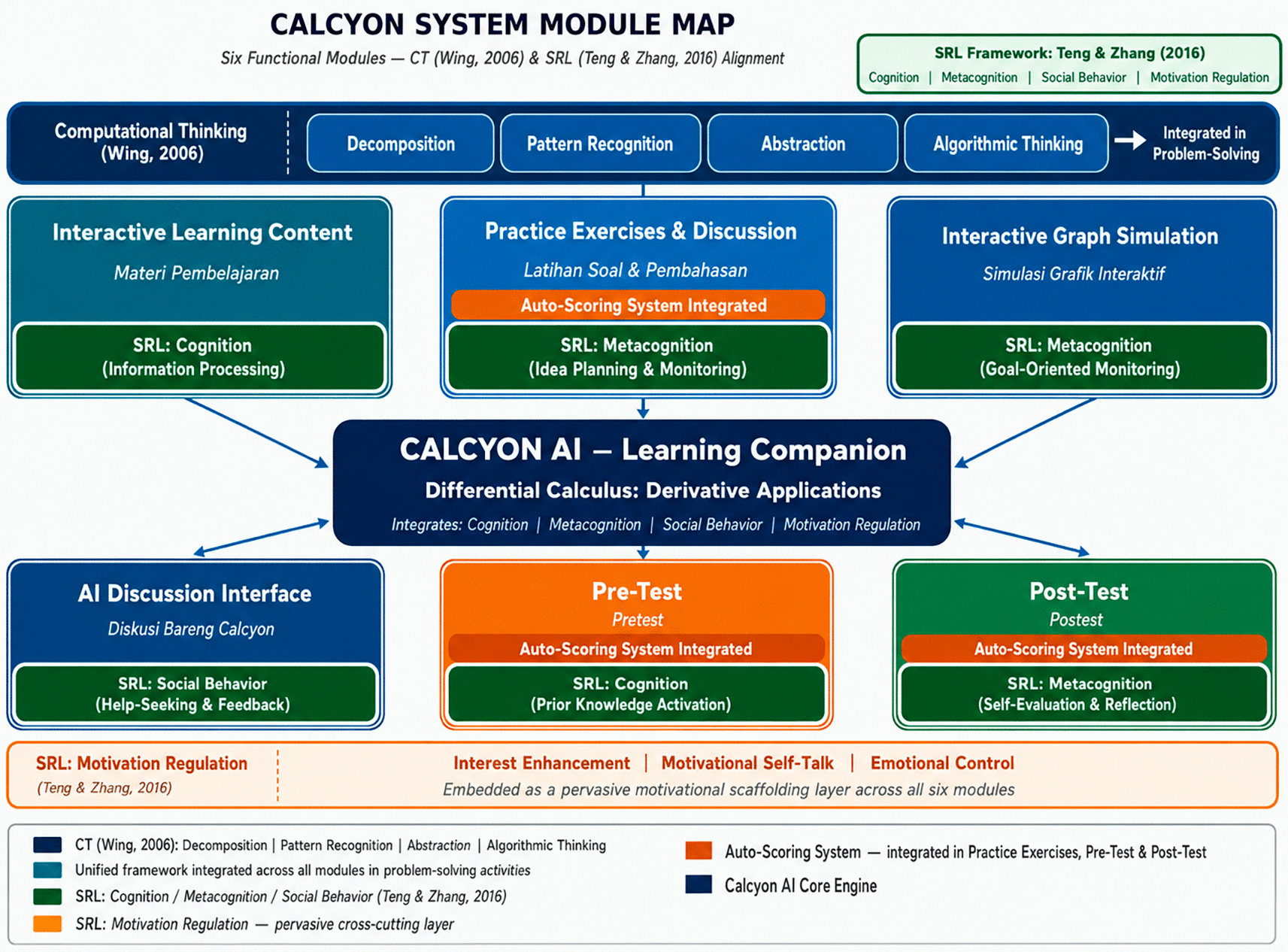
Calcyon is a web-accessible AI-based chatbot platform for differential calculus instruction, specifically targeting derivative applications. The interface presents six color-coded modules: (1) Materi Pembelajaran — content organized in four sub-topics by difficulty level (Maksimum dan Minimum: Foundational; Kemonotonan dan Kecekungan: Intermediate; Ekstrim Lokal dan Interval: Intermediate; Aplikasi Soal Praktis: Advanced); (2) Latihan Soal dan Pembahasan; (3) Simulasi Grafik Interaktif with GeoGebra integration; (4) Diskusi Bareng Calcyon — AI Discussion Interface; (5) Pretest; and (6) Posttest. The choice of GeoGebra as the visualization engine is supported by meta-analytic evidence demonstrating a positive medium-to-large effect (Hedges’s g = 0.653) of GeoGebra-based dynamic visualization on students’ mathematics achievement, with particularly strong effects in calculus topics (Zhang et al., 2023). At the student experience level, research confirms that learners engaging with GeoGebra-supported calculus instruction report improved conceptual understanding and more positive perceptions of mathematical learning compared to conventional approaches (Bedada & Machaba, 2022). A distinctive instant help button, represented by a lamp icon in the top-right corner, activates on-demand AI assistance and was designed to support the Social Behavior component of Teng and Zhang’s (2016) SRL model without disrupting the learning sequence. The system module map is presented in Figure 3.
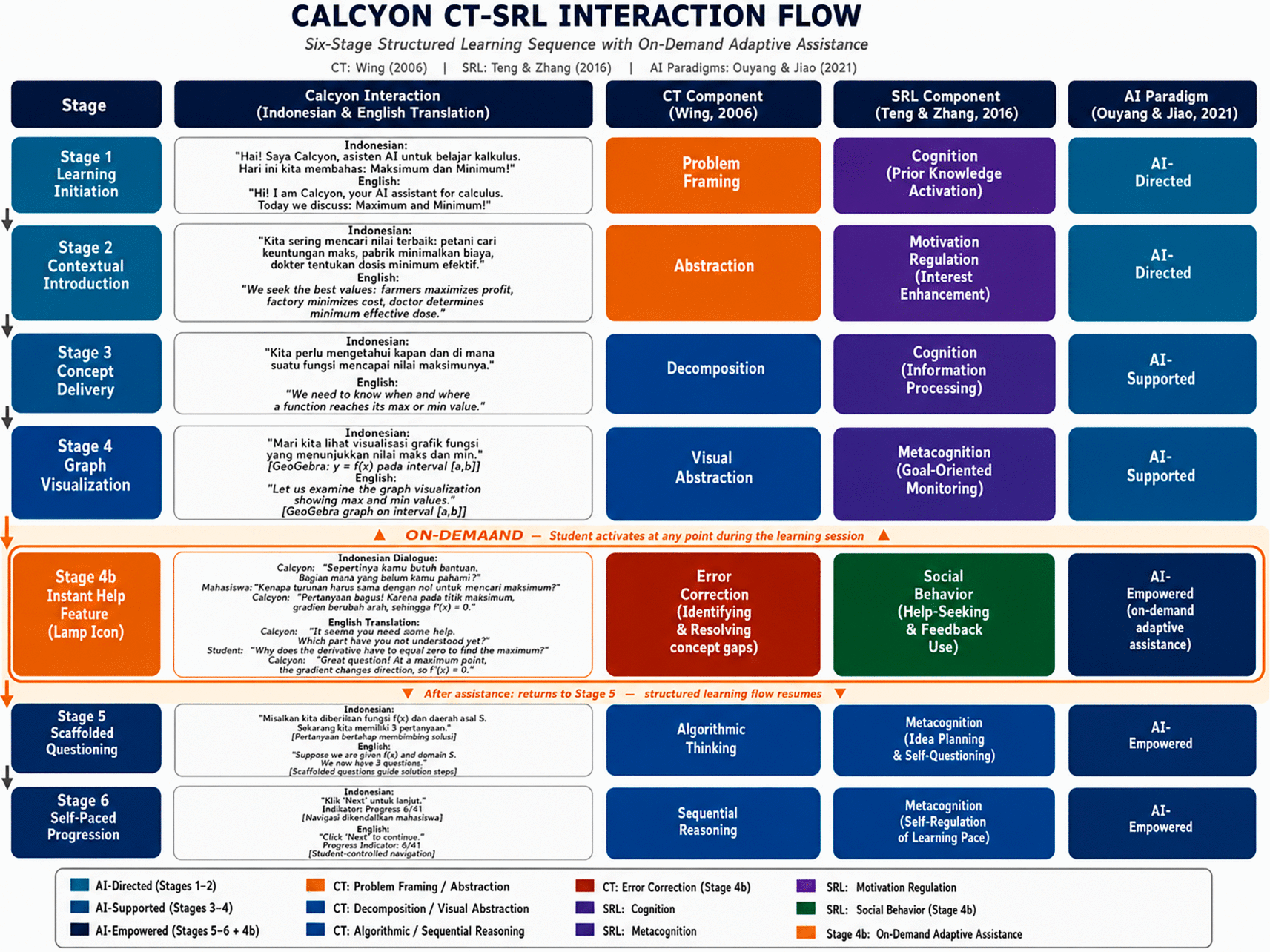
The CT-SRL annotated interaction flow within Calcyon’s Maksimum dan Minimum session demonstrates the framework’s theoretical operationalization. Each stage is annotated with both the corresponding CT component (Wing, 2006) and the corresponding SRL component (Teng & Zhang, 2016). All chatbot utterances are presented in original Indonesian with English translations. The complete six-stage interaction flow is illustrated in Figure 4.
Stage 1: Learning Initiation (CT: Problem Framing|SRL Cognition: Prior Knowledge Activation)
Indonesian: “Hai! Saya Calcyon, asisten AI untuk belajar kalkulus. Hari ini kita akan membahas topik yang sangat penting: Maksimum dan Minimum!”
English: “Hi! I am Calcyon, your AI assistant for learning calculus. Today we will discuss a very important topic: Maximum and Minimum!”
This opening activates prior knowledge of calculus concepts (SRL Cognition) and frames the problem domain for the session (CT: Problem Framing). By explicitly naming the topic at the outset, the system supports the cognitive strategy of knowledge organization that initiates effective information processing (Teng & Zhang, 2016).
Stage 2: Contextual Introduction (CT: Abstraction|SRL Motivation Regulation: Interest Enhancement)
Indonesian: “Dalam kehidupan sehari-hari, kita sering mencari nilai terbaik: petani mencari keuntungan maksimum, pabrik meminimalkan harga produksi, dokter menentukan dosis minimum obat yang tetap efektif.”
English: “In everyday life, we often seek the best value: a farmer maximizes profit, a factory minimizes production costs, a doctor determines the minimum effective drug dose.”
Connecting mathematical abstraction to real-world contexts (CT: Abstraction) simultaneously activates the Motivation Regulation component of SRL through interest enhancement (Teng & Zhang, 2016) — demonstrating the personal and professional relevance of calculus knowledge and motivating continued engagement with the learning content.
Stage 3: Concept Delivery (CT: Decomposition|SRL Cognition: Information Processing)
Indonesian: “Untuk itu, kita perlu mengetahui kapan dan di mana suatu fungsi mencapai nilai maksimum atau minimum.”
English: “To achieve this, we need to know when and where a function reaches its maximum or minimum value.”
Decomposing the mathematical problem into two sub-questions, when (f’(x) = 0) and where (the critical point x-value), scaffolds CT Decomposition while supporting the Cognition component of SRL (Teng & Zhang, 2016) by structuring the information processing task into manageable units aligned with effective knowledge construction.
Stage 4: Graph Visualization (CT: Visual Abstraction|SRL Metacognition: Goal-Oriented Monitoring)
Indonesian: “Mari kita lihat visualisasi grafik fungsi yang menunjukkan nilai maksimum dan minimum.”
English: “Let us examine the graph visualization of a function showing maximum and minimum values.”
The GeoGebra-integrated graph supports CT Visual Abstraction by allowing students to read structural patterns before engaging with algebraic procedures, while simultaneously activating the Metacognition component of SRL (Teng & Zhang, 2016) through goal-oriented monitoring: students can compare their developing understanding against the visible graphical representation, identifying gaps between their current comprehension and the target conceptual state.
Stage 4b: Instant Help Feature (CT: Error Correction|SRL Social Behavior: Help-Seeking)
Indonesian: Calcyon: “Sepertinya kamu butuh bantuan. Bagian mana yang belum kamu pahami?”|Student: “Kenapa turunan harus sama dengan nol untuk mencari maksimum?”|Calcyon: “Pertanyaan bagus! Karena pada titik maksimum atau minimum, gradien fungsi berubah arah, sehingga nilai turunannya sama dengan nol.”
English: Calcyon: “It seems you need some help. Which part have you not understood yet?”|Student: “Why does the derivative have to equal zero to find the maximum?”|Calcyon: “Great question! Because at a maximum or minimum point, the gradient changes direction, so the derivative equals zero.”
This stage most directly operationalizes the Social Behavior component of Teng and Zhang’s (2016) SRL model. The Instant Help feature removes the social barriers associated with help-seeking (e.g., fear of judgment or embarrassment), creating a psychologically safe environment in which students can request clarification and use AI-generated feedback to improve their understanding — both core functions of Social Behavior regulation. Simultaneously, the chatbot’s error diagnosis supports CT Error Correction.
Stage 5: Scaffolded Questioning (CT: Algorithmic Thinking|SRL Metacognition: Idea Planning)
Indonesian: “Misalkan kita diberikan suatu fungsi f(x) dan daerah asal S. Sekarang kita memiliki 3 pertanyaan:”
English: “Suppose we are given a function f(x) and its domain S. We now have 3 questions:”
Directive questions requiring students to articulate each step of the solution algorithm before executing it scaffold CT Algorithmic Thinking and activate the Metacognition component of SRL through idea planning (Teng & Zhang, 2016) — guiding students to pre-organize their solution approach, a metacognitive behavior consistently associated with improved mathematical problem-solving outcomes.
Stage 6: Self-Paced Progression (CT: Sequential Reasoning|SRL Metacognition: Self-Regulation of Learning Pace)
Indonesian: “Klik Next untuk lanjut .”|Progress: 6/41
English: “Click Next to continue .”|Progress: 6/41
Student-controlled navigation with visible progress tracking operationalizes CT Sequential Reasoning while supporting two Metacognition sub-components identified by Teng and Zhang (2016): self-regulation of learning pace (students control when to advance) and goal-oriented monitoring (the progress indicator provides continuous information about position within the overall learning sequence, enabling students to calibrate their remaining effort).
Expert design and content validity evaluation results
The expert evaluation was interpreted as evidence of design and content validity of the Calcyon framework. Expert validation yielded a grand mean of 3.75 (93.81%) and a mean item level Aiken’s V of 0.92. All five dimensions received mean ratings within the Very Good category. Linguistic Validity achieved the highest score (M = 3.93, 98.33%), confirming clarity and appropriateness of language. Technical Validity received the lowest dimension score (M = 3.64, 90.97%). Of 54 items, 50 (92.6%) achieved Aiken’s V >= 0.75. Four borderline items (V = 0.67) requiring revision were identified. Results are presented in Tables 1 and 2.
Student pilot results
The student pilot evaluation was conducted to examine prototype readability and feasibility. The student pilot grand mean of 3.19 (79.67%) falls in the Good category, with ratings of 3 or 4 accounted for 98% of the 297 item responses. Ethics & Safety achieved the highest dimension score (M = 3.24, 80.91%). Results are presented in Table 3.
Four revision priorities were addressed: (1) auto-scoring algorithm refinement to accept mathematically equivalent expressions; (2) LMS integration framework and user guide development responding to Technical Validity Items 10 and 12 (Aiken’s V = 0.67); (3) GeoGebra visualization enhancement responding to Media Design Validity Item 6 (Aiken’s V = 0.67); and (4) motivational feature enrichment responding to Instructional Validity Item 9 (Aiken’s V = 0.67) — specifically aligning the motivational design features with the Motivation Regulation dimension described by Teng and Zhang’s (2016) SRL framework by adding diversified motivational message templates including interest enhancement prompts, motivational self-talk reinforcement, and growth mindset reframing of errors.
The findings provide evidence for the design validity and preliminary feasibility of Calcyon rather than evidence of its effectiveness in improving learning outcomes. Within this scope, the study demonstrates how CT and multidimensional SRL principles can be operationalized as explicit components of an AI mediated calculus learning architecture. The Calcyon framework makes a two-part theoretical contribution. First, it extends Ouyang and Jiao’s (2021) three-paradigm model by operationalizing all three AI paradigms within a single system. Second, the study demonstrates an attempt to operationalize Teng and Zhang’s (2016) four-component SRL model as an explicit instructional design framework within an AI-mediated mathematics learning environment. This contribution extends previous chatbot designs that have predominantly focused on limited SRL dimensions, particularly metacognitive support, by providing a structured mapping between AI interaction features and multiple SRL-related design principles.
Additionally, the framework advances the CT-mathematics intersection by embedding Wing’s (2006) CT components as structural interaction principles within a conversational AI system, addressing the gap documented by Barcelos et al. (2018) where CT integration focused on programming activities rather than mathematical reasoning processes.
The expert validation results (grand mean 3.75, Aiken’s V = 0.92) compare favorably with the CAFE-AI model validated by Suartama et al. (2026). Compared to existing chatbot applications in mathematics education, Calcyon addresses the limitations documented by Smutny and Schreiberova (2020) and Perez et al. (2020), embedding structured metacognitive scaffolding and CT sequences within a coherent system. The explicit design mapping of all four Teng and Zhang (2016) SRL components differentiates Calcyon from several previously reported educational chatbot frameworks that have primarily emphasized selected SRL aspects, particularly metacognitive or motivational support. The importance of comprehensive SRL support is underscored by meta-analytic evidence demonstrating that combined cognitive, metacognitive, and motivational SRL interventions produce the largest positive effects on learning outcomes in technology-enhanced environments (Guntur & Purnomo, 2024).
Pedagogically, Calcyon demonstrates a practical model for integrating Teng and Zhang’s (2016) four-component SRL framework within digital learning tools. Educators using Calcyon can map each system feature to a specific SRL component, enabling theoretically informed evaluation of the framework’s pedagogical design characteristics. This modular, theoretically transparent design mirrors emerging models of AI-enhanced learning environment development in which the separation of content layers from platform infrastructure enables both educators and technologists to contribute independently to system improvement (Li & Yang, 2026). Technologically, the GeoGebra integration bridges symbolic and visual-geometric understanding (Tikva & Tambouris, 2021), a finding corroborated by meta-analytic evidence showing a medium effect (g = 0.504) of visualization interventions on mathematics learning outcomes, with dynamic technology-based visualizations producing the strongest effects (Schoenherr et al., 2024), and the Instant Help feature provides a concrete implementation of Social Behavior regulation that could be replicated in other AI-enhanced learning environments.
Limitations include: the small expert validation sample (n = 3); the demographically homogeneous pilot group (n = 11, all female, single institution); the absence of effectiveness data on CT and SRL outcomes requiring experimental research designs; and auto-scoring inconsistency. Additionally, while this study adopts Teng and Zhang’s (2016) four-component SRL framework as a conceptual design structure, it should be acknowledged that the original WSSRLQ was developed and psychometrically validated in the context of EFL writing education. Therefore, the adapted SRL dimensions used in Calcyon should not be interpreted as a validated measurement model for calculus learning. Future research should examine the psychometric properties of mathematics-specific SRL instruments and evaluate whether the adapted dimensions adequately represent SRL processes in mathematical reasoning contexts.
This study designed, developed, and formatively evaluated Calcyon, an AI-based chatbot framework for university-level differential calculus learning that integrates CT processes and the four-component SRL framework of Teng and Zhang (2016) within a coherent instructional architecture. Three conclusions emerge: (1) Calcyon demonstrated strong expert-rated design and content validity across the evaluated framework dimensions (grand mean 3.75, 93.81%, Aiken’s V = 0.92, all five dimensions Very Good); (2) the prototype demonstrates adequate readability and feasibility (grand mean 3.19, 79.67%, 98% positive responses), these findings represent preliminary evidence regarding prototype feasibility rather than evidence of effectiveness in improving student learning outcomes; and (3) Calcyon contributes an empirically evaluated AI-based chatbot framework that integrates AI-mediated interaction, CT-oriented scaffolding, and multidimensional SRL design principles within university calculus learning. The contribution of this study lies in the design and validation of the framework, while its effectiveness in influencing CT, SRL, and calculus learning outcomes requires further empirical investigation.
Future research should examine the effectiveness of Calcyon through empirical studies, including quasi-experimental evaluation of CT outcomes and mixed-methods investigation of SRL-related learning processes. Further studies should also explore the scalability of Calcyon across mathematics disciplines, develop LMS integration procedures, and validate mathematics-specific SRL instruments adapted from the Teng and Zhang’s (2016) SRL framework.
This study involved human participants, including expert validators and undergraduate students. Prior to participation, all participants were informed about the purpose of the study and provided voluntary written informed consent. Participation was entirely voluntary, and participants had the right to withdraw at any time without penalty. No sensitive personal data were collected, and all responses were anonymized to ensure confidentiality. Ethical approval or formal waiver from an institutional review board (IRB) was not obtained for this study. This is because the study falls under minimal-risk educational research conducted within standard instructional practices, without intervention, vulnerable populations, or collection of sensitive personal data. According to institutional research ethics practices at Universitas Pendidikan Indonesia, ethical review is primarily required for studies involving potential risk, medical or psychological intervention, or sensitive data. Non-interventional educational studies of this nature may not require full ethical approval. For transparency, information regarding institutional ethics practices and the role of the ethics committee can be accessed at: https://etikpenelitian.upi.edu/ and https://etikpenelitian.upi.edu/berita/pentingnya-persetujuan-etik-dalam-penelitian-yang-melibatkan-manusia-di-upi. To ensure adherence to ethical standards, this study was designed and conducted in accordance with established principles of research ethics, including informed consent, voluntary participation, confidentiality, and protection of participant wellbeing.
The datasets supporting the findings of this study are openly available in Zenodo as Calcyon Chatbot Data (Rizki, 2026) under a CC-BY 4.0 license.
The dataset includes:
(1) item-level expert validation data from three validators (54 items);
(2) aggregated validation results and Aiken’s V calculations;
(3) student pilot responses from 11 participants across 27 questionnaire items;
(4) readability and feasibility datasets in both Indonesian and English versions; and
(5) supporting documentation, including variable descriptions and coding schemes.
The dataset is accessible at:
https://doi.org/10.5281/zenodo.20304537.
This study reports an educational Design and Development Research (DDR) product validation study following Richey and Klein (2007). The ADDIE model (Branch, 2009) provided the procedural framework. Instrument development followed established standards using Aiken’s V formula (Aiken, 1985).
The authors would like to express their sincere gratitude to the Indonesian Education Scholarship (BPI), the Center for Higher Education Funding and Assessment (PPAPT), and the Indonesian Endowment Fund for Education (LPDP) for their generous financial support in sponsoring the publication of this research. Their commitment to advancing scholarly inquiry and fostering academic excellence in Indonesian higher education has been instrumental in enabling the development and dissemination of this work. The authors also extend their appreciation to the three expert validators for their invaluable contributions to the validation process, and to the student participants who generously gave their time to the pilot study.
This research was supported by the Indonesian Education Scholarship (BPI), the Center for Higher Education Funding and Assessment (PPAPT), and the Indonesian Endowment Fund for Education (LPDP). The funders had no role in study design, data collection, analysis, or preparation of this manuscript.
The funders had no role in study design, data collection and analysis, decision to publish, or preparation of the manuscript.
© 2026 Rizki LM et al. This is an open access article distributed under the terms of the Creative Commons Attribution License, which permits unrestricted use, distribution, and reproduction in any medium, provided the original work is properly cited. The author(s) is/are employees of the US Government and therefore domestic copyright protection in USA does not apply to this work. The work may be protected under the copyright laws of other jurisdictions when used in those jurisdictions.
Download
Export To
metrics
| Views | Downloads | |
|---|---|---|
| F1000Research | - | - |
| PubMed Central Data from PMC are received and updated monthly. | - | - |
Citations
CITE
how to cite this article
Rizki LM, Kusumah YS, Jupri A et al. Calcyon: Design and Validation of an AI-Based Chatbot Framework Integrating Computational Thinking and Self-Regulated Learning in University Calculus Learning [version 2; peer review: 2 approved, 1 approved with reservations]. F1000Research 2026, 15:1478 (https://doi.org/10.12688/f1000research.180626.2)
NOTE: If applicable, it is important to ensure the information in square brackets after the title is included in all citations of this article.
track
receive updates on this article
Track an article to receive email alerts on any updates to this article.
Current Reviewer Status: ?
Key to Reviewer Statuses VIEW HIDE
ApprovedThe paper is scientifically sound in its current form and only minor, if any, improvements are suggested
Approved with reservations A number of small changes, sometimes more significant revisions are required to address specific details and improve the papers academic merit.
Not approvedFundamental flaws in the paper seriously undermine the findings and conclusions
Version 2
VERSION 2
PUBLISHED 06 Oct 2026
Revised
Reviewer Report 20 Oct 2026
Sari Herlina, Universitas Islam Riau, Pekanbaru, Indonesia
Approved
VIEWS 0
Is the work clearly and accurately presented and does it cite the current literature?
Yes
Is the study design appropriate and is the work technically sound?
Yes
Are sufficient details of methods and analysis provided to allow replication by others?
Partly
If applicable, is the statistical analysis and its interpretation appropriate?
Yes
Are all the source data underlying the results available to ensure full reproducibility?
Yes
Are the conclusions drawn adequately supported by the results?
Yes
Competing Interests: No competing interests were disclosed.
Reviewer Expertise: Mathematics Education, Statistics Education, Artificial Intelligence in Education, Digital Learning Materials, and Statistical Literacy.
CloseVersion 1
VERSION 1
PUBLISHED 03 Sep 2026
Reviewer Report 23 Sep 2026
Nur Robiah Nofikusumawati Peni, Universitas Ahmad Dahlan, Yogyakarta, Special Region of Yogyakarta, Indonesia
Approved
VIEWS 0
Is the work clearly and accurately presented and does it cite the current literature?
Yes
Is the study design appropriate and is the work technically sound?
Partly
Are sufficient details of methods and analysis provided to allow replication by others?
Partly
If applicable, is the statistical analysis and its interpretation appropriate?
I cannot comment. A qualified statistician is required.
Are all the source data underlying the results available to ensure full reproducibility?
Yes
Are the conclusions drawn adequately supported by the results?
Yes
Competing Interests: No competing interests were disclosed.
Reviewer Expertise: mathematics education, realistic mathematics education, ethnomathematics, mathematics curriculum.
CloseReviewer Report 11 Sep 2026
Torang Siregar, Department of Education Sciences, Mathematics Education, State University of Padang, Padang, West Sumatra, Indonesia
Approved with Reservations
VIEWS 0
Is the work clearly and accurately presented and does it cite the current literature?
Partly
Is the study design appropriate and is the work technically sound?
Partly
Are sufficient details of methods and analysis provided to allow replication by others?
Partly
If applicable, is the statistical analysis and its interpretation appropriate?
Yes
Are all the source data underlying the results available to ensure full reproducibility?
Yes
Are the conclusions drawn adequately supported by the results?
Partly
Competing Interests: No competing interests were disclosed.
Reviewer Expertise: My areas of research and expertise encompass educational technology, instructional design, mathematics education, self-regulated learning, computational thinking, and artificial intelligence in education, positioning me well to assess the theoretical, methodological, and practical contributions of the Calcyon framework. I am able to provide a thorough evaluation covering theoretical coherence and literature grounding, methodological rigor and appropriateness, validity and feasibility evidence, clarity and reproducibility of methods, strength and accuracy of conclusions, and constructive suggestions for improvement and revision.
Close