Просмотр новости
Найдите то, что Вас интересует
 Спутники
 РН
РН SpaceX
 Роскосмос
 NASA
NASA
СпутникиРНSpaceXРоскосмосNASAMacworld
As widely expected, Apple announced an entirely new product as part of its “Welcome Home” launch experience on Tuesday October 13: a smart-home hub called HomeView.
Described by Apple as “central to the home and personal to everyone in it,” HomeView is available in two versions. Both feature a square 7-inch (1088 x 1088) Liquid Retina touchscreen display, but in one version, this is attached to a domed aluminum speaker base in a design that evokes the classic G4 iMac. This tabletop model’s two elements are connected by a stainless steel hinge, enabling the screen to be tilted to a convenient angle depending on the height of the horizontal surface it’s sitting on. It’s available in four colors: Silver, Space Gray, Rose Pink, and Starlight.
The second version comprises only the screen unit (only in Silver and Space Gray), and is designed to be hung on the wall using three purpose-built mounts. Perhaps surprisingly, this version isn’t cheaper than the model with a base; both cost $299/£299. What’s more, those mounts I mentioned cost extra, ranging from $59.95/£54.95 for the Power Mount USB‑C Wall Connector and $79.95/£69.95 for the Power Mount AC Wired to a whopping $129.95/£119.95 for the Power Mount PoE Wired. And if you pick the USB mount you’ll then have to buy a power adapter as well. It’s not a cheap option by any means.
“Apple HomeView is designed to be shared by everyone in the home yet feel completely personal to each user,” said Greg Joswiak in the product’s announcement. The idea is that it sits in a shared space and is open to all, but recognises up to six individual users by their faces and adapts its interface and preferences, including the Home Screen, apps, and widgets, to whoever is using it at a given time. Content marked as personal stays private from other users, Apple insists, but other content, such as photos and music, can be shared with other users and guests.
It’s a lot slimmer without the base, but no cheaper.Apple
The HomeView runs Siri AI, of course, and consequently gets the benefits of that AI assistant’s much improved capabilities compared to the error-prone version of Siri which ran on the older HomePods. It can answer questions and use natural, conversational language; if paired with a Siri AI-enabled iPhone or iPad, it can surface information from messages, emails, and calendar events. The device can also be used for FaceTime (it supports Center Stage), the Intercom feature known from previous HomePods, and reading out and replying to messages.
Apple talks up HomeView’s entertainment capabilities, pointing for example to the two custom full-range drivers in the display, and the down-firing woofer and two force-cancelling passive radiators in the base, all of which deliver “an exceptional listening experience through a custom-engineered acoustic system.” The speaker elements in the base make it sound like the wall-mounted model will be a weaker audio choice, but Apple assures us that it “delivers rich sound with two custom drivers and computational audio tuned specifically for on-wall placement.” We look forward to testing all of this out.
The interface is attuned to your individual needs.Apple
But what about controlling third-party smart-home accessories? Oddly, Apple doesn’t mention what most of us assumed would be the device’s main function until the 17th paragraph of the press release. But yes: you can control all your (compatible) home tech using the touchscreen or voice commands, and there’s a special Home Modular face for this purpose. If you have a supported iCloud+ subscription and compatible cameras, the device can recognise “people, familiar faces, pets, packages, and vehicles” when they appear, and notify the household. And, like the iPhone and more recently the Apple Watch, HomeView can identify the sound of smoke and carbon monoxide alarms and create an alert when it does so.
Pre-orders for both versions of HomeView have already opened for customers in Australia, Canada, India, New Zealand, the UK, and the U.S., but they won’t hit stores until Friday, November 13.
And there are further issues with availability. While the cheaper two mounts for the wall model can be pre-ordered now, the Power Mount AC Wired won’t become available until “early 2027.” And more seriously, the entire HomeView range is unavailable currently and for the foreseeable future in the European Union, “as Siri AI is currently unavailable in iOS in the EU. Apple is working constructively with the EU in an attempt to find a path forward.”
When you purchase through links in our articles, we may earn a small commission. This doesn't affect our editorial independence.

Editor, Macworld
News
Oct 13, 2026
As widely expected, Apple announced an entirely new product as part of its “Welcome Home” launch experience on Tuesday October 13: a smart-home hub called HomeView.
Described by Apple as “central to the home and personal to everyone in it,” HomeView is available in two versions. Both feature a square 7-inch (1088 x 1088) Liquid Retina touchscreen display, but in one version, this is attached to a domed aluminum speaker base in a design that evokes the classic G4 iMac. This tabletop model’s two elements are connected by a stainless steel hinge, enabling the screen to be tilted to a convenient angle depending on the height of the horizontal surface it’s sitting on. It’s available in four colors: Silver, Space Gray, Rose Pink, and Starlight.
The second version comprises only the screen unit (only in Silver and Space Gray), and is designed to be hung on the wall using three purpose-built mounts. Perhaps surprisingly, this version isn’t cheaper than the model with a base; both cost $299/£299. What’s more, those mounts I mentioned cost extra, ranging from $59.95/£54.95 for the Power Mount USB‑C Wall Connector and $79.95/£69.95 for the Power Mount AC Wired to a whopping $129.95/£119.95 for the Power Mount PoE Wired. And if you pick the USB mount you’ll then have to buy a power adapter as well. It’s not a cheap option by any means.
“Apple HomeView is designed to be shared by everyone in the home yet feel completely personal to each user,” said Greg Joswiak in the product’s announcement. The idea is that it sits in a shared space and is open to all, but recognises up to six individual users by their faces and adapts its interface and preferences, including the Home Screen, apps, and widgets, to whoever is using it at a given time. Content marked as personal stays private from other users, Apple insists, but other content, such as photos and music, can be shared with other users and guests.
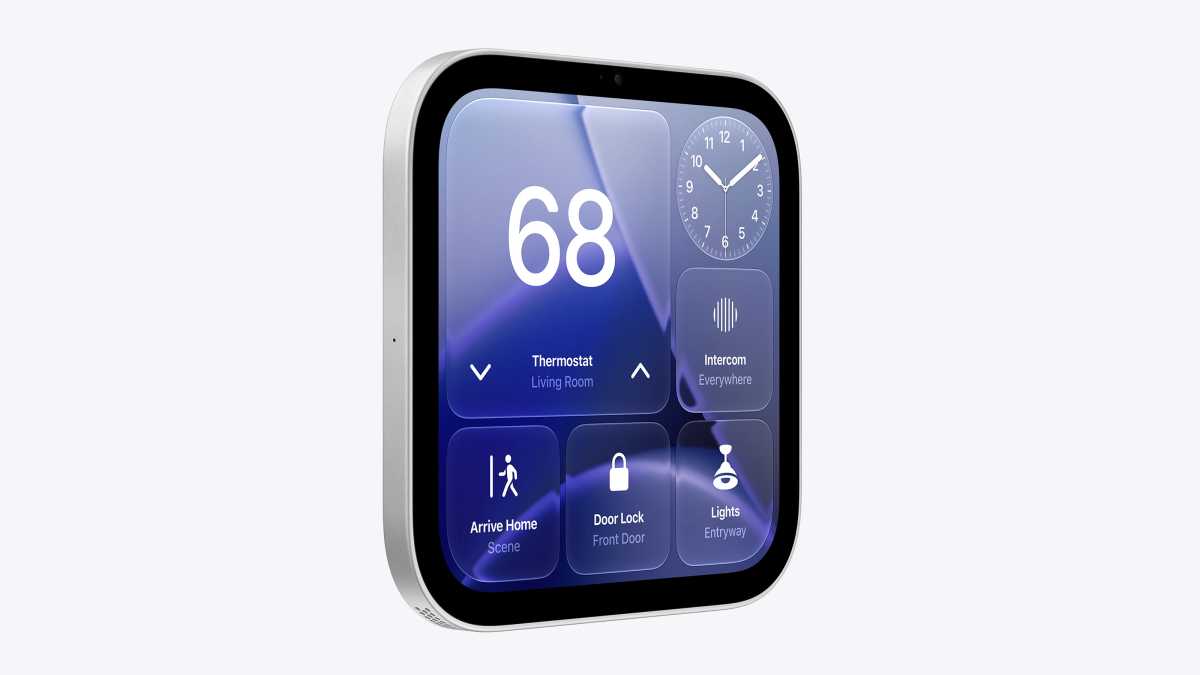 It’s a lot slimmer without the base, but no cheaper.
Apple
The HomeView runs Siri AI, of course, and consequently gets the benefits of that AI assistant’s much improved capabilities compared to the error-prone version of Siri which ran on the older HomePods. It can answer questions and use natural, conversational language; if paired with a Siri AI-enabled iPhone or iPad, it can surface information from messages, emails, and calendar events. The device can also be used for FaceTime (it supports Center Stage), the Intercom feature known from previous HomePods, and reading out and replying to messages.
Apple talks up HomeView’s entertainment capabilities, pointing for example to the two custom full-range drivers in the display, and the down-firing woofer and two force-cancelling passive radiators in the base, all of which deliver “an exceptional listening experience through a custom-engineered acoustic system.” The speaker elements in the base make it sound like the wall-mounted model will be a weaker audio choice, but Apple assures us that it “delivers rich sound with two custom drivers and computational audio tuned specifically for on-wall placement.” We look forward to testing all of this out.
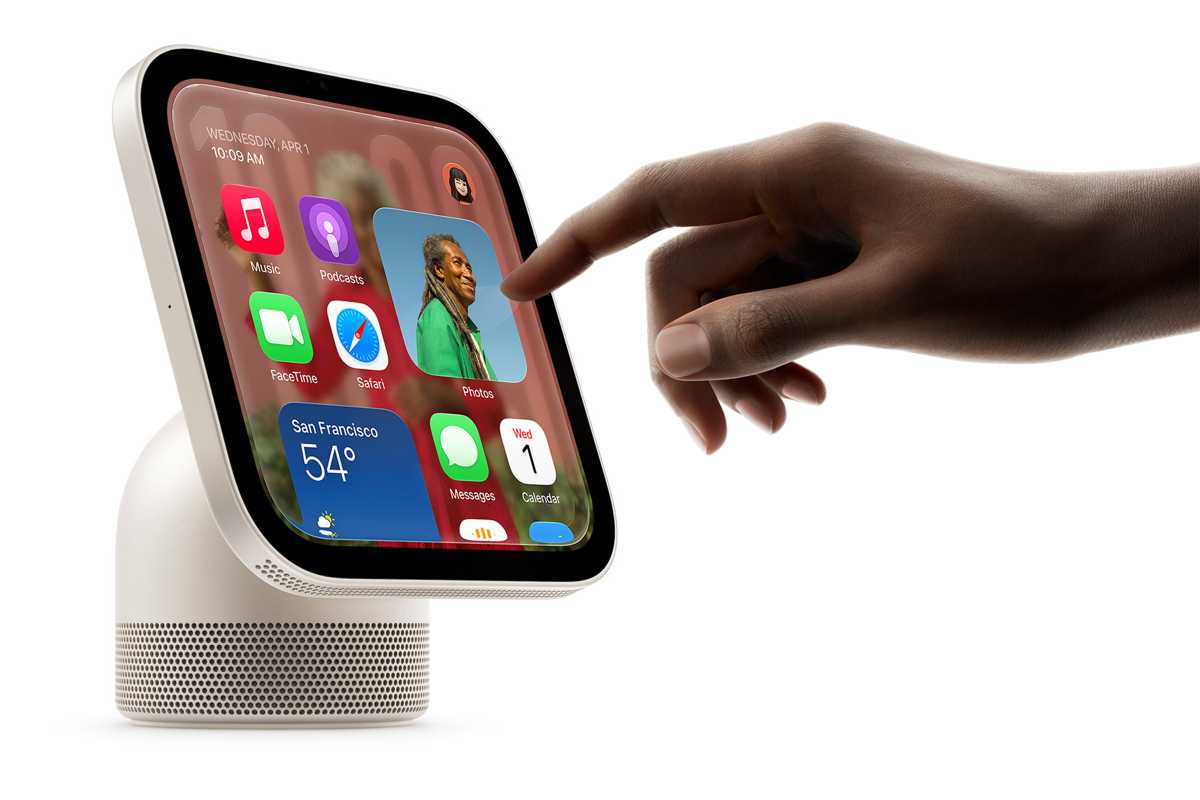 The interface is attuned to your individual needs.
Apple
But what about controlling third-party smart-home accessories? Oddly, Apple doesn’t mention what most of us assumed would be the device’s main function until the 17th paragraph of the press release. But yes: you can control all your (compatible) home tech using the touchscreen or voice commands, and there’s a special Home Modular face for this purpose. If you have a supported iCloud+ subscription and compatible cameras, the device can recognise “people, familiar faces, pets, packages, and vehicles” when they appear, and notify the household. And, like the iPhone and more recently the Apple Watch, HomeView can identify the sound of smoke and carbon monoxide alarms and create an alert when it does so.
Pre-orders for both versions of HomeView have already opened for customers in Australia, Canada, India, New Zealand, the UK, and the U.S., but they won’t hit stores until Friday, November 13.
And there are further issues with availability. While the cheaper two mounts for the wall model can be pre-ordered now, the Power Mount AC Wired won’t become available until “early 2027.” And more seriously, the entire HomeView range is unavailable currently and for the foreseeable future in the European Union, “as Siri AI is currently unavailable in iOS in the EU. Apple is working constructively with the EU in an attempt to find a path forward.”
| # | Наименование новости | Тональность | Информативность | Дата публикации |
|---|---|---|---|---|
| 1 | Apple HomeView: Everything you need to know about Apple’s smart-home display | 0 | 16 | 13-10-2026 |
| 2 | HomeView first look: Apple’s adorable new smart hub oozes personality | 0 | 9.5 | 13-10-2026 |
| 3 | Welcome Home live blog: HomeView hub, Apple TV 4K, HomePod mini, and more! | 0 | 15.2 | 13-10-2026 |
| 4 | 4 big announcements coming at Apple’s Welcome Home event | 0 | 14.66 | 08-10-2026 |
| 5 | Welcome Home: 4 big Apple announcements coming next week | 0 | 13.35 | 09-10-2026 |
| 6 | Apple представила HomeView – новый центр умного дома Главной новинкой ... | 0 | 8.1 | 13-10-2026 |
| 7 | Apple sets NYC ‘experience’ next week to showcase new smart home devices | 0 | 12.14 | 08-10-2026 |
| 8 | Apple’s next big thing may be even riskier than the iPhone Duo | 0 | 11.77 | 05-10-2026 |
| 9 | По данным источника, совершенно новый смарт-хаб Apple под названием HomeView ... | 0 | 9.79 | 12-10-2026 |
| 10 | Apple показала совершенно новое устройство — HomeView. По сути, это что-то среднее между iPhone и Apple Watch для управления умным домом | 0 | 12.6 | 13-10-2026 |