Просмотр новости
Найдите то, что Вас интересует
 Спутники
 РН
 SpaceX
 Роскосмос
 NASA
СпутникиРНSpaceXРоскосмосNASAWhich G7 country will go bankrupt first? It won’t be the one with the most debt. Japan might owe 199% of GDP but it still borrows more cheaply than anyone. France owes 118% and pays more than Italy, Spain or Greece. Eliminating five Japan has government debt of 199% of GDP, the highest in the ... Read more
Which G7 country will go bankrupt first? It won’t be the one with the most debt. Japan might owe 199% of GDP but it still borrows more cheaply than anyone. France owes 118% and pays more than Italy, Spain or Greece.
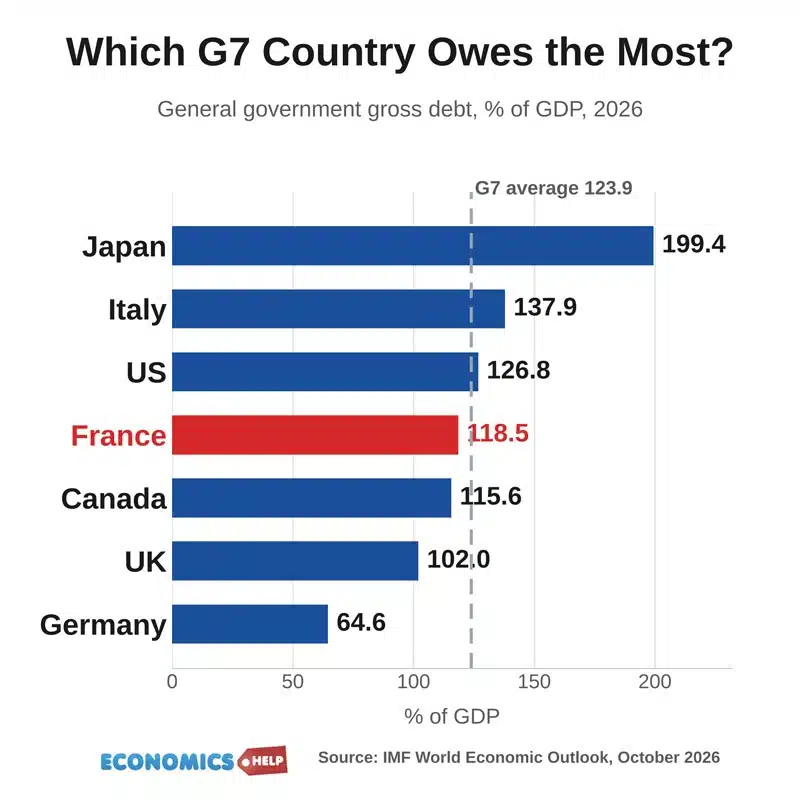
Japan has government debt of 199% of GDP, the highest in the G7 by a wide margin. But 87% of it is held by Japanese institutions and households, and it owes in yen — a currency the Bank of Japan prints. Japan’s 10-year bond yield is 2.90%, the lowest in the group. Most debt, cheapest borrowing costs (so far)
The United States owes 126% of GDP and the IMF expects that to reach 145% by 2031 — the steepest trajectory in the G7. But America owes dollars and prints dollars. The risk there is more inflation, not actual default. The only way the US defaults is if it chooses to inflated away debt) (which it may well choose to, but that’s another story.
Germany cannot print euros, which should make it vulnerable, but ot isn’t, because its debt is only 65% of GDP and it holds the strongest credit rating in the eurozone. In a European crisis Germany is where the money tends to flow to so its borrowing costs fall rather than rise.
Canada looks alarming on the headline measure at 115.6% of GDP. But Canada holds substantial financial assets, largely the Canada and Quebec Pension Plan funds, which take net debt down to around 10% — the lowest in the G7 by a distance. Germany is next at 47%.
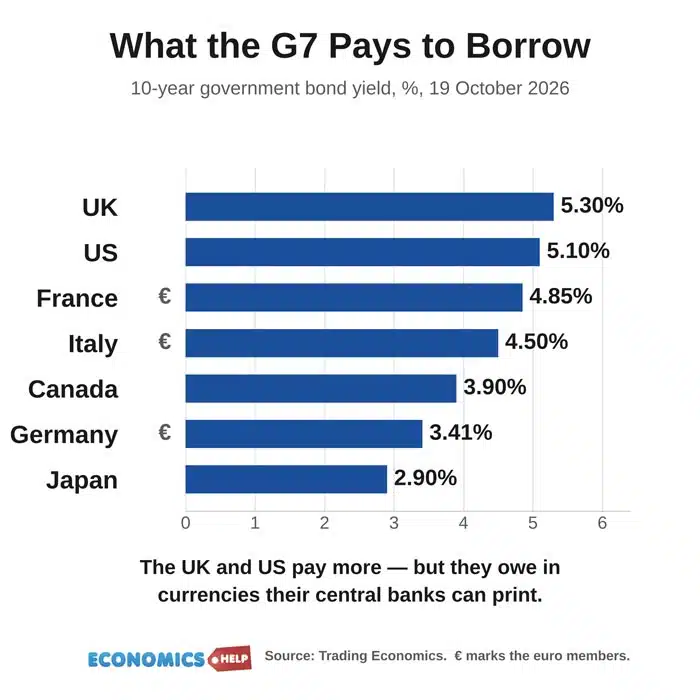
The United Kingdom has the most expensive borrowing costs in the G7 at 5.30%, above the United States and well above France. But that reflects more like inflation expectations, possibly also pace of AT (UK inflation has been above above countries in recent years) than than default risk, and in any case Britain owes sterling and the Bank of England can print it.
The final two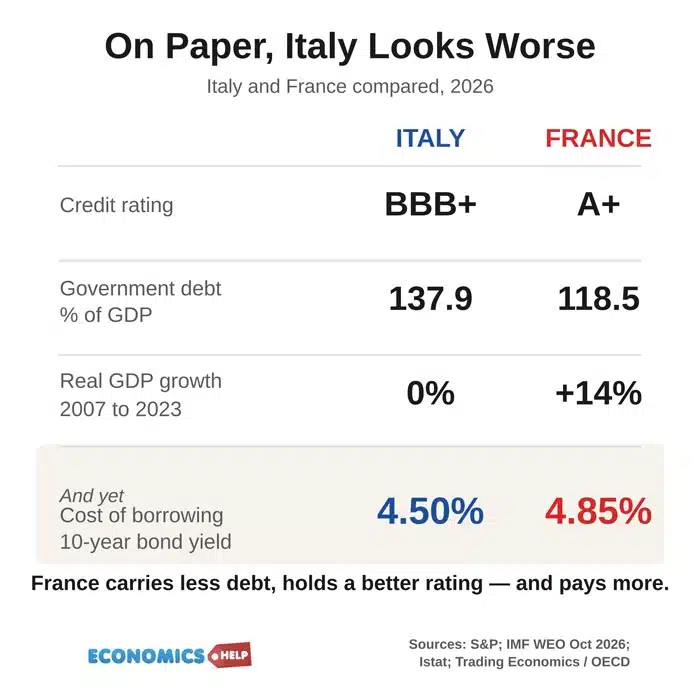
That leaves France and Italy. Neither can print the currency it owes, so the second question decides it.
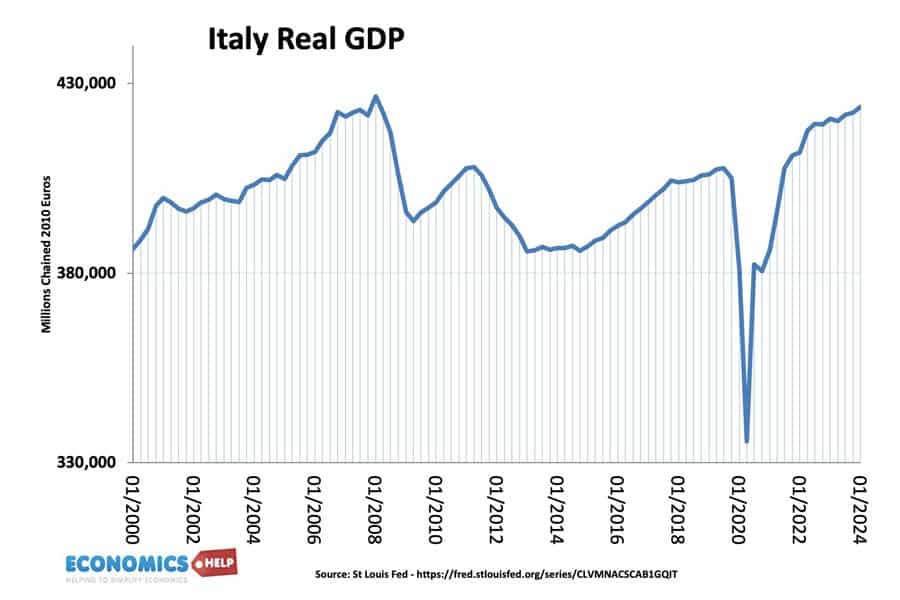
On paper Italy looks far worse. Standard & Poor’s rates it BBB+ against France’s A+. Its debt is 138% of GDP against France’s 118%. Its real GDP only regained its 2007 level in 2023, leaving it some fourteen points behind France over fifteen years.
And yet Italy borrows more cheaply. In October 2026 Italy paid 4.50% on its 10-year bonds. France paid 4.85%. Spain paid 3.63% and Greece 4.00%.
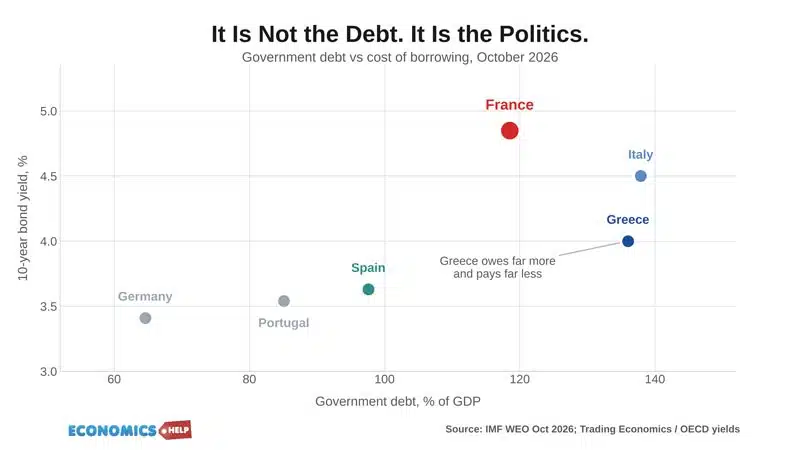
If high debt caused high interest rates, France would sit below all of them. It sits above.
Why France pays moreItaly has three things going for it. Its deficit is under control. It passed its budget. And 36% of its debt is held by non-residents — high, but look at France, where the figure is 56%. More than half of French government debt is held by overseas investors who can leave.
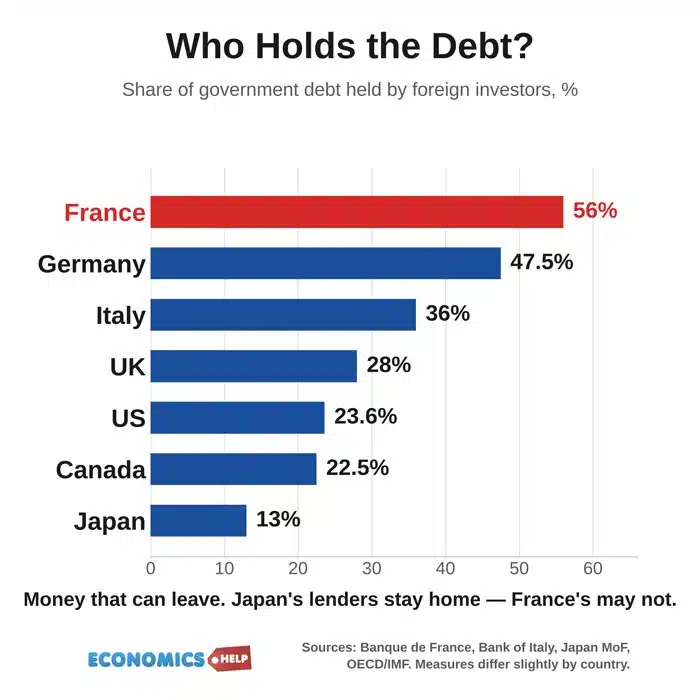
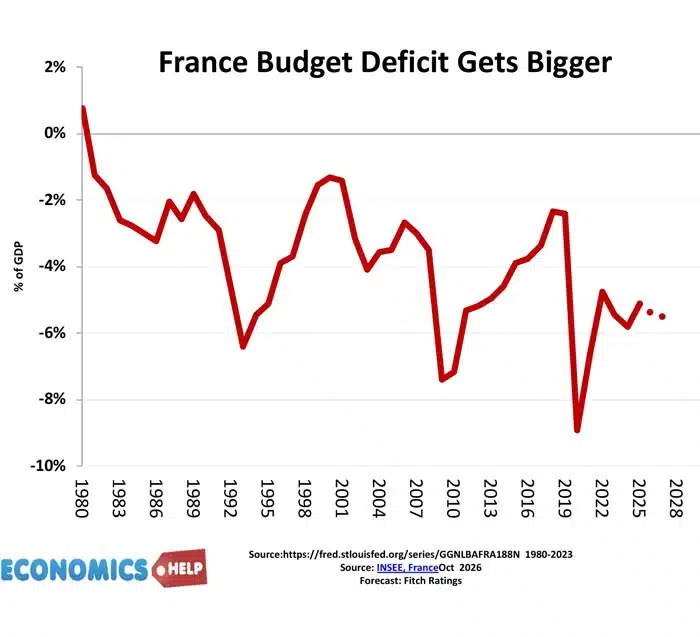
France, meanwhile, has not passed a budget through parliament since 2024 (A budget was passed by bypassing parliament). Its deficit is running at 5.4% of GDP.
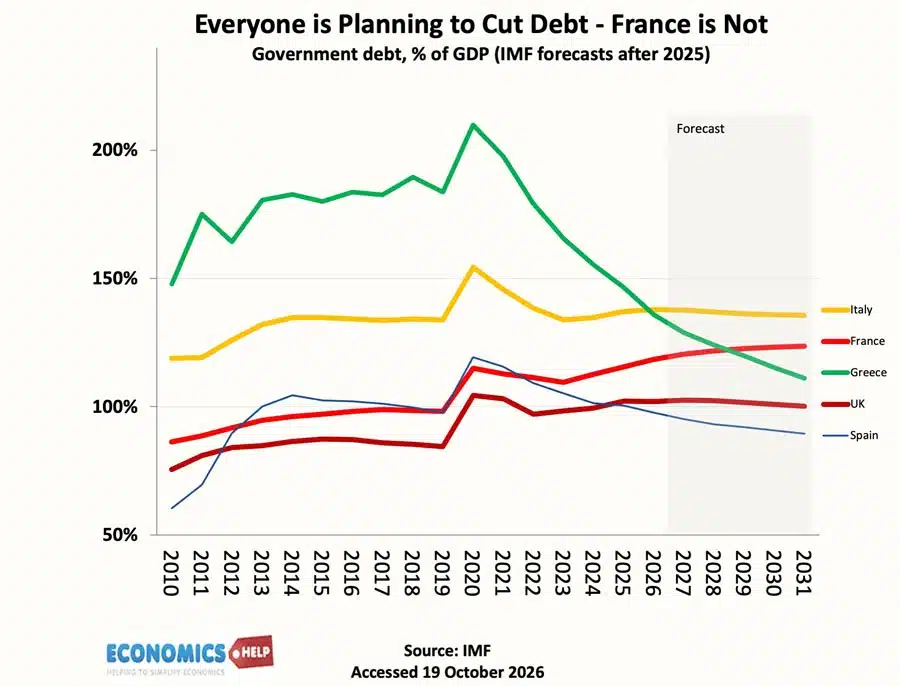
And while Italy, Spain, Portugal and Greece are all forecast to reduce their debt ratios over the next five years, France’s keeps climbing — from 118.5% in 2026 to 123.6% by 2031 on the IMF’s own projections. Greece overtakes France on the way down before the end of the decade.
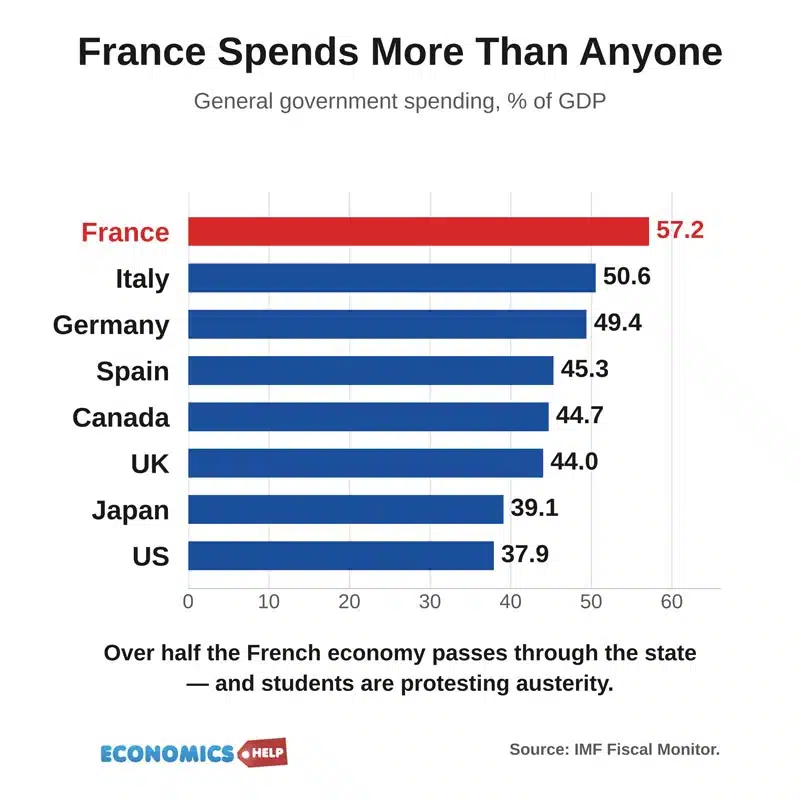
French students and others have been protesting against austerity. Yet French government spending is 57.2% of GDP, the highest of any major economy — more than six points above Italy and nearly twenty above the United States. So what is going on?
Recently a French professor noticed something odd on his payslip. The pension contribution paid by his employer came to €2,896. His own take-home pay was €2,662. The state was paying more into the civil service pension fund on his behalf than he received for doing the job. A further €352 came out of his own pay for pensions on top of that.
Then came more revelations The finance ministry published an annex showing, for the first time, pension spending by department. It revealed that 32% of the education ministry’s budget — €28.5 billion — goes straight back out to retired civil servants. The interior ministry spends 30% the same way, the justice ministry just over 20%. Across central government it is more than 11%, nearly €50 billion a year, of pension spending not recorded as pension spending.
France looks like a country that spends generously on schools. But a significant part of the budget goes to retired teachers and files it under education. However, it is worth pointing out, even if you strip away education-pension spending, the education budget is still quite high compared to other western economies.
Why the pension maths stopped workingRetired civil servants now outnumber the working ones paying in. Part of that is the birth rate. But part is policy: the state shifted to hiring on fixed-term contracts, who never become contributors, and privatised services such as France Telecom while keeping the pension liabilities.
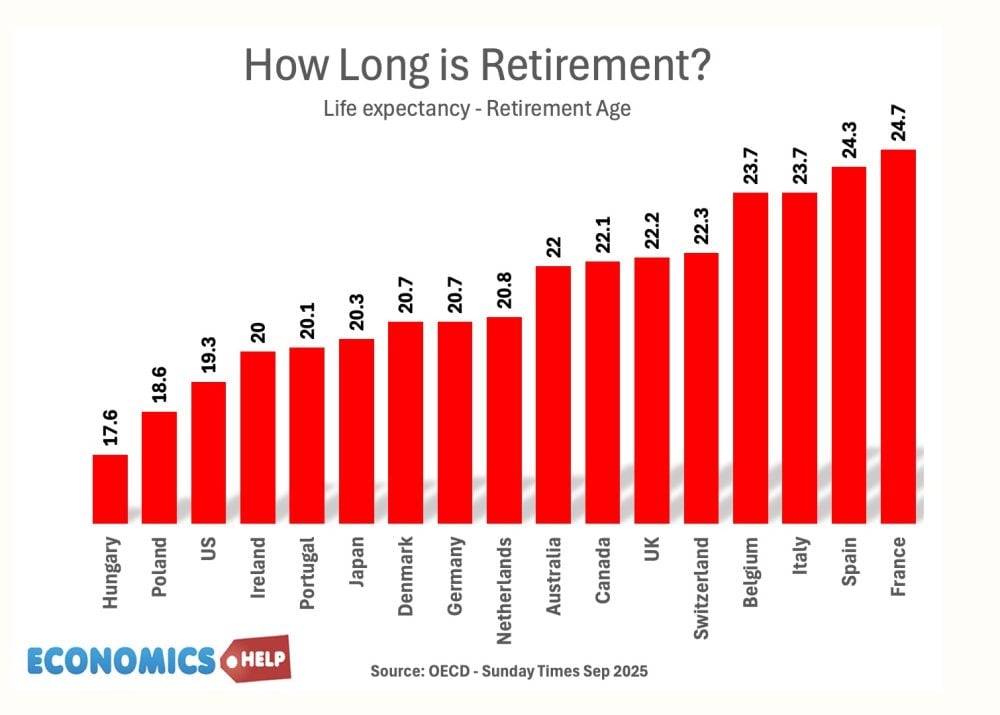
French workers also spend longer in retirement than anywhere else in the OECD — 24.7 years — and French pensioners have slightly higher incomes than the average French worker, the only country in the comparison where that is true. There were plans to raise the retirement age from 62. Prime Minister Sébastien Lecornu suspended them to survive a censure vote.
The doom loop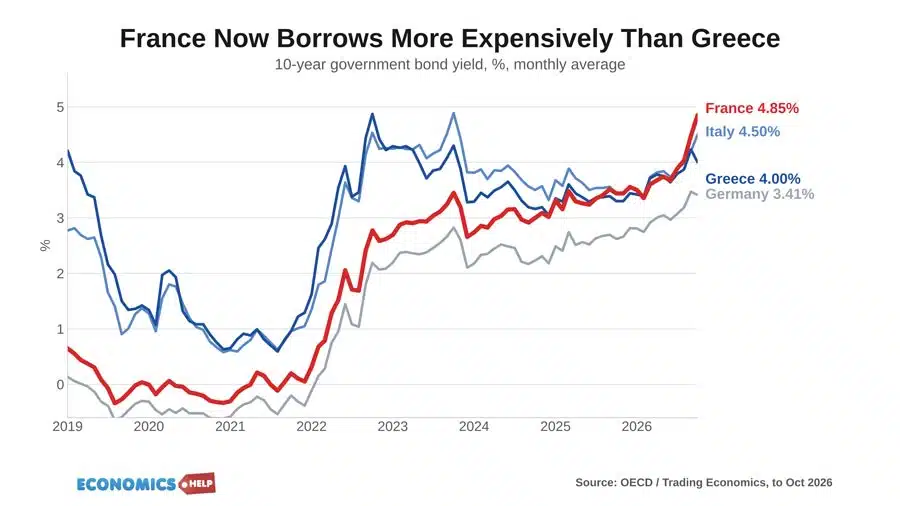
The average interest rate France pays across its existing stock of debt is 2.2%, locked in when money was cheap. It now borrows new money at close to 5%. Every bond that matures is refinanced at more than double the old rate — and next year France plans a record €340 billion of bond issuance.
The result is already visible in the budget. France’s debt interest bill rises from €62.6 billion in 2026 to €72.9 billion in 2027, an increase of €10.3 billion, or 16%, in a single year. That money buys no teachers, no hospitals and no defence. It services the past.
But, this is the poltical problem. To stop the debt growing, France must cut spending. It cannot pass a budget to cut spending. So every month the yields rise and the refinancing gets more expensive. That is a debt doom loop, and France has already been downgraded twice in 2026 — by Standard & Poor’s in May and Fitch in August.
What it means for Britain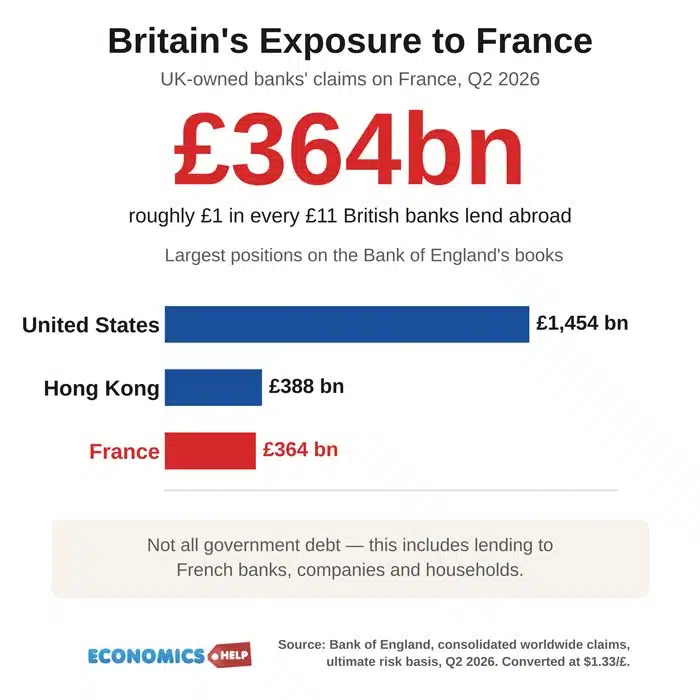
UK-owned banks held $484 billion of claims on France at the second quarter of 2026 — about £364 billion. That is not all government debt; it includes lending to French banks, companies and households. But roughly one pound in every eleven that British banks lend abroad is lent into France. France is also Britain’s fifth-largest trading partner, worth £105 billion a year.
Back in 2011, the eurozone crisis was good for Britain. Money fled the periphery and bought gilts, and UK 10-year yields fell from 3.7% at the start of the year to 1.6% by mid-2012. But that is not happening this time. UK Gilts are now the most expensive borrowing in the G7, so Britain cannot be the safe haven this time. Worse, the UK is competing for the same investors: France issuing €340 billion, alongside everyone else, pushes yields up globally, including ours.
So is France doomed?France’s five-year credit default swaps have risen to 81 basis points, the highest since 2013. But that still implies only a 1.2% chance of default over five years — roughly one chance in 83. Markets are pricing risk rather than immediate crisis.
There is also the European Central Bank. France cannot print euros, but the ECB can. Ever since Mario Draghi’s “whatever it takes” in July 2012, the ECB has shown it will intervene to cap sovereign yields. Some argue France is simply too big to be allowed to fail. But would Germany accept bailing out a fiscally profligate neighbour? Patience is wearing thin — and Robin Brooks makes the uncomfortable point that by capping yields the ECB does just enough to take the political pressure off, letting governments kick the can down the road rather than reform.

Look at Greece. Greece really did have a crisis, with yields above 30% and an economy that shrank by a quarter. But Greek debt has fallen from a peak of 209% of GDP to 136%, and on IMF forecasts it keeps falling. Everything is not lost. The French economy has real strengths, and bold pension reform could turn a doom loop into a sustainable path. The crisis is happening because markets do not believe France has the political will. All France need to do is make me finance minister, I would make them work longer, increase labour participation of people in the 50s and 60s, solve the fiscal crisis. Easy.
One more thing. A widely shared story claimed a Japanese bank had dumped its entire holding of French bonds and that Japan was about to crash the global bond market. Robin Brooks went through the Japanese balance of payments data and found the bulk of the selling happened in 2024, with no recent wave. The problem is French fiscal policy, not foreign investors looking for someone to blame.
Even Paul Krugman, who usually argues that debt fears are overblown, says 1.2% is too low. He thinks France has a genuine crisis and that, unlike the southern European countries in 2012 which were visibly cutting, France is planning to spend more. Which is why he suggests France may have crossed the line from too big to fail to too big to save.
Debt crises are usually overblown. This one has a real problem underneath it. France does not control its currency, and it has made promises it cannot afford. The riots on the streets of Paris really do have an economic cause.
Key figures| Country | Gross debt, % GDP (2026) | 10-year yield (Oct 2026) | Held by foreigners |
|---|---|---|---|
| Japan | 199.4 | 2.90% | ~13% |
| Italy | 137.9 | 4.50% | 36% |
| United States | 126.8 | 5.10% | ~24% |
| France | 118.5 | 4.85% | 56% |
| Canada | 115.6 | 3.90% | ~23% |
| United Kingdom | 102.0 | 5.30% | ~28% |
| Germany | 64.6 | 3.41% | ~48% |
Foreign-ownership figures are drawn from several national sources and the measures differ slightly between countries.
SourcesDebt and spendingTejvan Pettinger. Author of “Cracking Economics” “What Would Keynes Do?” – studied PPE Oxford University (1995-99) and works as an economics teacher and writer.
| # | Наименование новости | Тональность | Информативность | Дата публикации |
|---|---|---|---|---|
| 1 | Новый рекорд США по госдолгу на фоне мировых гигантов... | 0 | 18.65 | 19-03-2026 |
| 2 | UK Debt Interest Payments Threaten Budget | 0 | 11.32 | 22-10-2026 |
| 3 | Госдолг 16 стран Евросоюза побил исторический рекорд | 0 | 7 | 21-07-2026 |
| 4 | США, Європа і Японія живуть із боргом 100%+ ВВП | 0 | 7 | 09-05-2026 |
| 5 | On the Road to US Fiscal Ruin | 0 | 8.48 | 05-08-2026 |
| 6 | Politico: Долги США толкают Европу к финансовому кризису | 0 | 11.04 | 21-08-2026 |
| 7 | Госдолг США уже давно превысил $40 трлн. Когда его вернут? ... | 0 | 9.46 | 23-09-2026 |
| 8 | Japan’s borrowing costs soar to 30-year high on debt fears | 0 | 17.47 | 08-07-2026 |
| 9 | Активы центробанка Японии по стоимости превышают ВВП страны | 0 | 0 | 13-11-2018 |
