Просмотр новости
Найдите то, что Вас интересует
 Спутники
 РН
 SpaceX
 Роскосмос
 NASA
СпутникиРНSpaceXРоскосмосNASASome microbes common on Earth’s surface lead a secret double life. Soaring higher than jumbo jets, they carry clues about disease spread and alien life.
The stratosphere is both beautiful and deadly — a boundary between Earth and space, between life and death.
Hover within it, some 30 kilometers (almost 20 miles) above the ground, and you’d be nearly twice as high as any rain cloud. You would actually see the edges of Earth curve beneath you. And the sky above? It would look black — like outer space.
The air pressure here is just one percent of that at sea level. You’d never survive in such thin air. As you gasped for oxygen, this super-low pressure would cause your blood to boil inside you.
With temps as low as −60° Celsius (−76° Fahrenheit) and intense, DNA-damaging ultraviolet (UV) radiation, the conditions here would kill most life as we know it. Yet some living things persist in the stratosphere. A surprising number of one-celled microbes somehow survive its extremes.
“If you took a microbe from [Earth’s stratosphere] and you put them on the surface of Mars, they wouldn’t even know the difference.”
Brent Christner
“If you took a microbe from those altitudes and you put them on the surface of Mars, they wouldn’t even know the difference,” says Brent Christner. A microbiologist, he works at the University of Florida in Gainesville.
His team began looking for life in the atmosphere back in 2008. They were hunting for the upper limits of Earth’s habitable zone. This, they hoped, might reveal whether life could persist on the cold, near-airless, radiation-pummeled surface of Mars.
Noelle Bryan, Christner’s graduate student at the time, sent sampling balloons as high as 38 kilometers (24 miles) into the air. What she found utterly shocked her: “We did not hit an altitude where we couldn’t find something [alive].”
In 2025, Christner’s team reported something that proved even more surprising. These microbes weren’t ones we usually imagine living in extreme conditions, such as volcanic hot springs. In fact, they were some of the same microbes found living on our crops, in our gardens and even on our skin.
Normally Earth-dwellers, these microbes seem to live a secret double life — sailing around the world at up to two or three times the height of a passenger jet.
For them, Christner says, the atmosphere “is like a highway.” It allows them “to move globally in periods of weeks.” From there, they can cross oceans to find new homes.
These discoveries could reshape what we know about how pathogens spread across our planet. They also could transform where we look for life on other worlds — from Mars to exoplanets light-years away.
Hunting for microbes in the skyThere’s a long history of looking for high-flying life.
 This 1935 Explorer II balloon carried two pilots into the stratosphere above South Dakota. It set a world altitude record, reaching just over 22 kilometers (14 miles).Wikimedia Commons
In 1935, the U.S. Army Air Corps launched a helium balloon over the Black Hills in South Dakota. It reached 22 kilometers (14 miles) high, a world record. Two pilots went along in a pressurized gondola. They recorded air temperatures, magnetic fields, radiation levels and more. They also dropped a sterile sampling device designed to collect airborne microbes on its way down. After falling halfway, it closed and parachuted the rest of the way to Earth.
Scientists later grew 10 types of bacteria and fungi from that sample. But this was before scientists discovered DNA. So they never learned much more than the shapes of these mystery cells, the conditions they had survived and what nutrients they needed to grow.
Nearly four decades later, Soviet scientists launched rockets with sticky microbe collectors 48 to 77 kilometers (30 to 48 miles) into the mesosphere. It’s the layer just above the stratosphere. Those collectors parachuted back with a few living cells stuck on them. These, too, grew in the lab.
“But there’s just no way to know what [the Soviets had] sampled,” Christner says. The microbes could have been contamination from the ground. He doesn’t believe that the scientists actually found something alive at that altitude.
More recent U.S. studies started in the early 2000s.
NASA was flying a plane 20 kilometers (12 miles) up to collect cosmic dust. Its goal was to study the history of our solar system. Microbiologist Dale Griffin then worked for the U.S. Geological Survey in St. Petersburg, Fla. He arranged for sticky microbe-catchers to fly on several missions between 2003 and 2008.
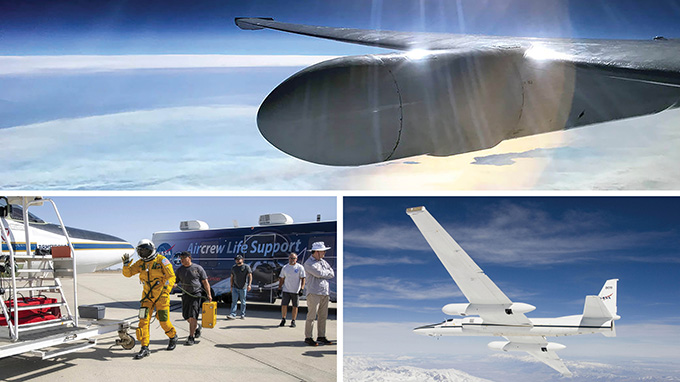 NASA uses the ER-2 research aircraft (bottom right) to conduct experiments at altitudes up to 21 kilometers, such as this flight above California (top). Pilots must wear pressure suits (bottom left) because a loss of cabin pressure could cause them to lose consciousness within seconds and quickly die. From top, clockwise: Stu Broce/NASA; Carla Thomas/NASA; NASA
Griffin grew several types of bacteria from those samples. He also performed a simple test on them, called genetic barcoding. It looks at a short part of a single gene. From this, biologists can get a general idea of a life form’s family or genus. And these microbes, he realized, were related to several known from remote islands and volcanic soils.
Perhaps, Griffin thought, eruptions lofted them high into the air.
The Russian and NASA findings were based on what they learned from growing sampled microbes in the lab. Yet scientists can’t grow 99 percent of the microbes that exist most places. They just can’t recreate the environments these cells need to grow.
As such, those early tests couldn’t measure how many living cells were in the stratosphere. They usually couldn’t identify the species. The scientists didn’t even test whether these microbes could survive stratosphere-like temps, dryness or UV radiation.
And they never learned the lifestyles of these microbes on Earth’s surface — whether they lived on plants, slurped raw sewage or grew in the armpits of NFL linebackers.
At last: Tallying living space microbesChristner was at Louisiana State University in Baton Rouge (LSU) when he and Bryan began their search for life in the stratosphere. They planned to start low and sample higher and higher. They would try to grow the cells they collected, as others had. But they would also do something new: count the total number of living cells at these altitudes.
They expected that at some height, the number of living cells would drop to zero. This would mark the outer limit of life on Earth.
Bryan built her first collectors from Styrofoam and balsa wood, purchased at hobby and hardware stores. She dangled these homemade gizmos from helium balloons launched in Texas and Louisiana. Each collector had a control chamber that didn’t open during the flight. This helped her estimate how much her samples were contaminated with ground-level germs. Eventually, she got that contamination down to almost zero.
Noelle Bryan (left) preparing to launch one of her early germ catchers on a balloon over Louisiana on October 30, 2011. She built this early device mostly with foam and balsa wood (middle), making it light enough that even small balloons could lift it as high as 24 kilometers (15 miles). The model boat was added for good luck (in case her package landed in a lake, as sometimes happened.) On this day, it landed in a tree (right), with its sample safe inside.
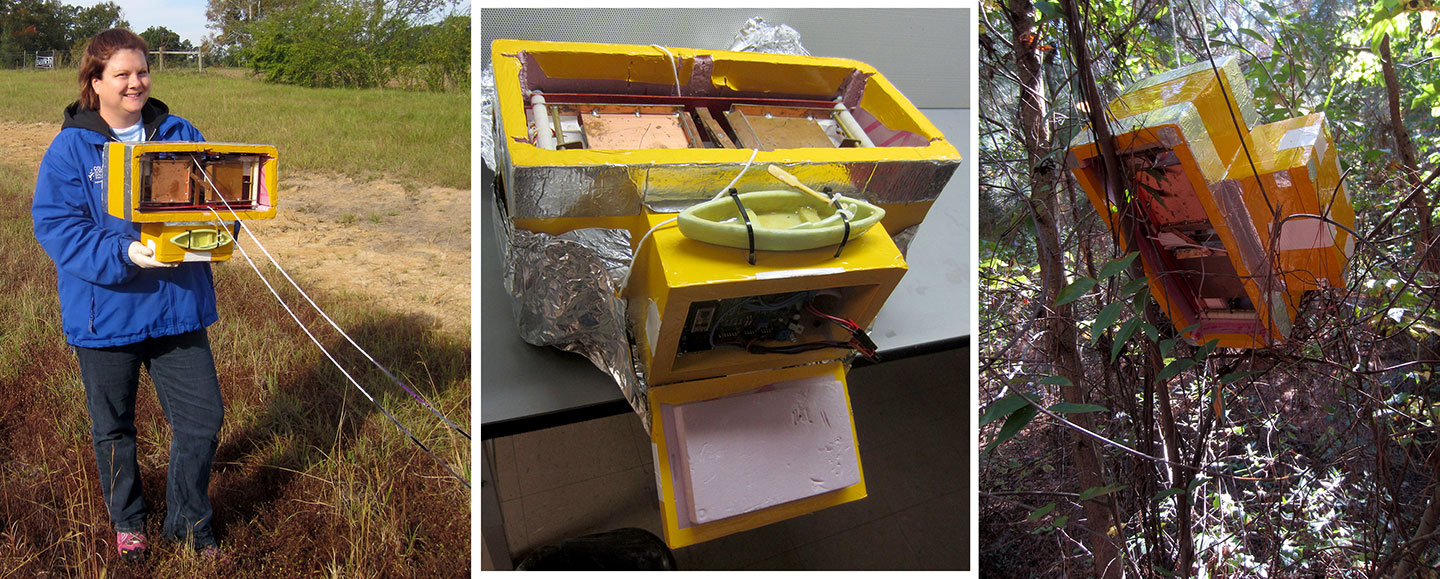 D. Fox
In 2013, Bryan started using a more advanced system. It was developed by LSU engineer T. Gregory Guzik. Its sturdy circuits allowed it to reach even greater heights. (In the mid-stratosphere, electricity can arc from one wire to another, damaging circuits.)
Bryan and Guzik used this system in a key series of balloon launches over Fort Sumner. This little town crouches amid a dry plain of grass and yucca in eastern New Mexico. The 19th-century gunslinger Billy the Kid is buried in a cemetery at one end of town.
The samples that Bryan collected here would be the final ones for her PhD research. They would also reveal some major surprises.
On the morning of August 21, 2013, Bryan, Guzik and several others wore hard hats as they emerged from a hangar at the local airport. They grasped the tether of a round, white helium balloon the size of a small elephant. It bobbed and tugged impatiently as they walked into an open field.
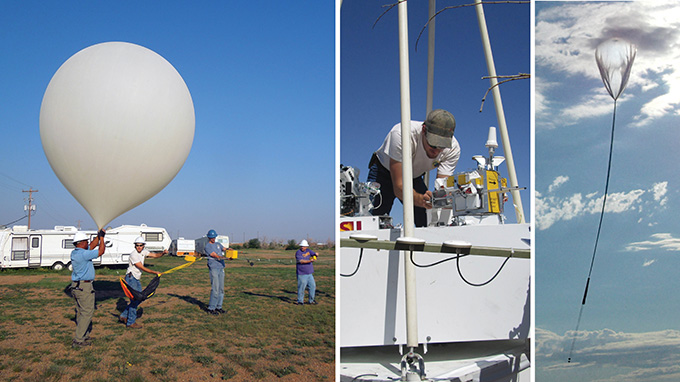 Noelle Bryan and her teammates launched a microbe collector up to 29 kilometers (18 miles) on this balloon (left). A much larger balloon (right) allowed her to sample airborne microbes up to 38 kilometers (24 miles). That larger NASA balloon carried her microbe catcher along with experiments from several other researchers (center).From left: LSU, NASA; N. Bryan; N. Bryan, Arizona State Univ., NASA
Then, they let it go.
A downward-pointing camera captured video as it surged upward.
At one point, a large jet streaked by far below, tiny and silent.
Later, the balloon was tossed by violent winds as it entered the stratosphere. At 18 kilometers (11 miles), an electric motor opened one of two collectors. It exposed a sticky surface to the air.
Left: A germ catcher Bryan used in 2013 (captured here by a downward-pointing camera during a flight over Fort Sumner, N.M.). The device has two identical sealed boxes, one on each side. One opens and closes at preset altitudes to collect microbes. The other doesn’t open. That way, scientists could later see if their boxes had any contamination before launch.
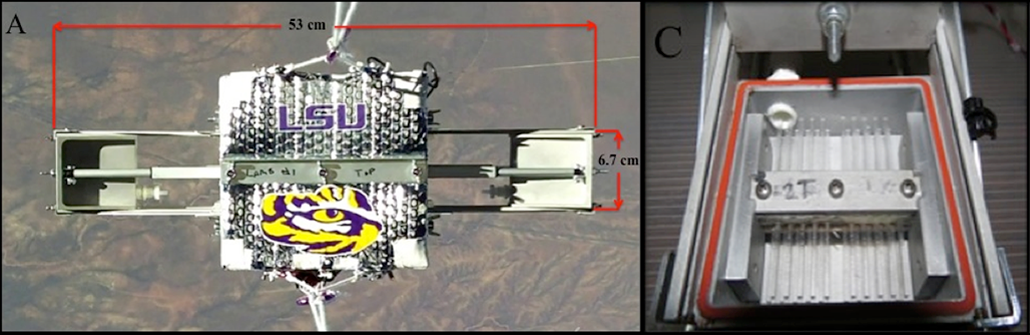 N. Bryan/LSU
Right: A view inside one of Bryan’s germ collectors shows two rows of small plastic rods coated in oil. That oil captures airborne cells that bump into it on its way down through the atmosphere.
Minutes later, as the balloon ascended past 23 kilometers (14 miles), the collector closed. An electric heating coil severed the tether. This sent the balloon’s payload parachuting back to Earth. Using a GPS tracker, Bryan drove to where the collector had landed between a yucca and a prickly pear cactus.
In all, the team launched six balloons over three weeks. Some reached as high as 29 kilometers (18 miles). A seventh launch, on a larger NASA balloon, reached 38 kilometers (24 miles).
Microbes in living colorBryan spent months growing her samples. The one from August 21 spawned a glistening orange colony of bacteria. She named it L6-1.
Samples from other launches grew into yellow, pink and black colonies. The colors likely came from protective pigments that shield the microbes against harmful UV light.
Bryan assumed that these still-unidentified cells would turn out to be tough cookies. For example, some bacteria can form dry spores that survive boiling. But as she isolated and barcoded the cells’ DNA, a very different picture emerged.
These cells “should have been nothing but spore-formers,” Bryan says. They “should have been nothing but extremophiles.” But only one out of a dozen or so bacteria were.
L6-1 and several others belonged to a genus often found on plants: Curtobacterium. Others belonged to groups that live in soil. The fact that these critters came from such everyday places posed a mystery that Bryan desperately wanted to solve.
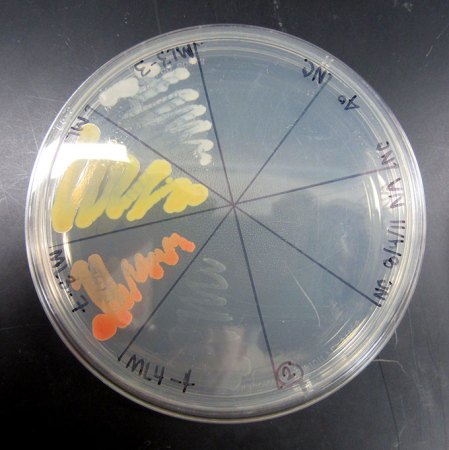
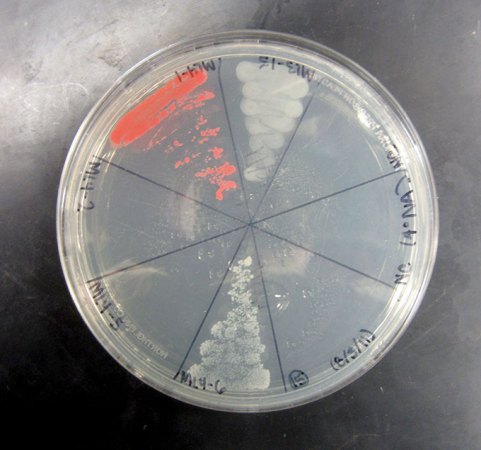
Petri dishes of bacteria that Bryan initially isolated from altitudes of 18 to 24 kilometers (11 to 15 miles). These colonies are often either brightly colored or dark colored. Their hues reveal pigments that the cells use to avoid harm from intense ultraviolet radiation, which is plentiful in Earth’s stratosphere.
Bryan spent most of 2014 and 2015 running lab experiments. From these, she estimated that at 24 kilometers (15 miles) up, each cubic meter (m3) of air held about 100,000 living cells. At 36 kilometers (22 miles), the air still held nearly 8,000 cells/m3.
In 2016, Bryan exposed her stratospheric cells to UV-C radiation to see how tough they were. These wavelengths of ultraviolet light kill cells better than the UV-A and UV-B types that cause sunburns. UV-C is absent at Earth’s surface, because the ozone layer blocks it. But this radiation is plentiful in the mid-stratosphere.
In these experiments, Bryan compared her stratospheric germs to a bacterium called Deinococcus radiodurans (Dye-noh-KOK-us Ray-dee-oh-DUR-uns). It is said to be the toughest organism on Earth. It can survive roughly 1,000 times the gamma radiation needed to kill a human. It’s also uniquely resistant to UV-C radiation.
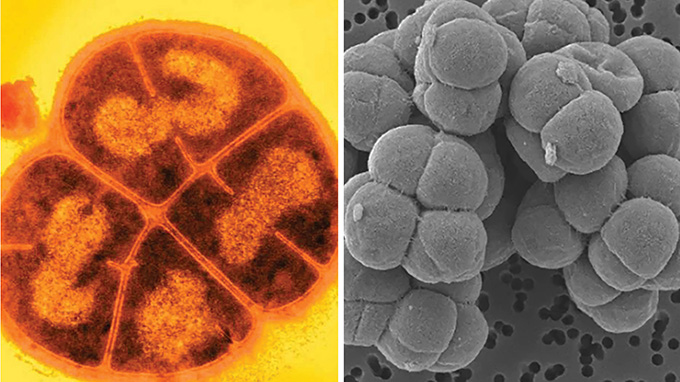
Some microbes found living in the stratosphere proved about as resistant to ultraviolet radiation as the hardy bacterium Deinococcus radiodurans (left).
 Michael Daly/USU/Scientific Reports 2025
None of the germs isolated from Earth’s stratosphere would likely survive on Mars. They need oxygen, which Mars’ atmosphere lacks. But Methanosarcina barkeri (right) might make it on the Red Planet. It thrives without oxygen in sewage and landfills. In the lab, it can tolerate extremely low-pressure and oxygen-free conditions, like those on Mars.
Surprisingly, her L6-1 cells tolerated UV-C just as well as D. radiodurans did. Some of her other plant and soil bacteria from the stratosphere weren’t far behind. Bryan was shocked to see this. “I [fudged] up,” she remembers thinking.
Bryan repeated the experiments over many months, looking for mistakes she might have made. But her results never changed.
As the team realized the results were actually correct, it “all sort of came together,” Christner recalls. These plant-dwelling bacteria had a secret talent: They could survive, at least briefly, on the edge of space.
Were these cells infectious?Bryan got her PhD in 2017. (She now works at Mass General Brigham in Boston, Mass.) Around that same time, Christner moved to the University of Florida. There, he began looking into a strange question.
Bryan’s DNA barcoding had showed that L6-1 and several of the other stratospheric bacteria were closely related to a germ that sickens crops. It’s called Curtobacterium flaccumfaciens. From the 1920s to the 1970s, it had browned and wilted Midwestern bean fields. After disappearing for a while, C. flaccumfaciens reemerged around 2003.
Christner and Bryan wondered: Did L6-1 also cause disease?
“Plant pathogens in the stratosphere — that was the furthest thing that
Brent Christner
we expected to run into.”
To find out, Christner teamed up with two plant pathologists. Brian Kvitko works at the University of Georgia in Athens. Robert Harveson is at the University of Nebraska in Scottsbluff. Last year, they reported that L6-1 really does cause bean plants to yellow and wilt. So do two other Curtobacterium microbes that Bryan collected from as high as 29 kilometers (18 miles).
Adam Ellington was a graduate student in Christner’s lab in Florida. In 2020, he sequenced the full genome of L6-1. This showed it to be a new species. It also was a genetic match for an unidentified germ that Harveson had isolated from diseased millet years earlier.
Christner’s group described it in Microbiology Spectrum in 2025. They named it C. aetherium.
“Plant pathogens in the stratosphere — that was the furthest thing that we expected to run into,” Christner says.
Harveson, a Curtobacterium expert, had long thought this germ spread through infected seeds. Learning that at least some members of its genus could survive high in the atmosphere stunned him. This discovery, he says, could “change our thought processes about movement of diseases.”
Submit your question here, and we might answer it an upcoming issue of Science News Explores
By flying through the atmosphere, a microbe could cross oceans and drop into new ecosystems. A pathogen like C. aetherium could escape regions where plants had become resistant to it and land on new hosts.
Leaf-dwelling bacteria are known to experience frequent drying. This can damage their DNA in a manner similar to radiation. So some of these microbes have evolved ways to repair their DNA fairly well. Such tricks might help them survive other harsh conditions, too.
Leaf bacteria can also enter the air with surprising ease.
One 1982 study showed that during each hour on a warm day, 20 billion or so cells per hectare (50 billion per acre) enter the air from an alfalfa field. Breezes and rising warm air may loft most of these. Bacteria may even encourage this by clumping onto tiny leaf hairs where air currents can more easily lift them.
Once microbes are aloft, big thunderstorms, dust storms, hurricanes and volcanic eruptions can lift them into the upper atmosphere. Smoke plumes from large wildfires can also ferry billions of live cells into the air.
Ellington’s work suggested that C. aetherium could have started as one of these leaf-squatters. Over time, as it got lofted higher, it could have evolved new traits to survive extreme altitudes.
He learned this by studying a Curtobacterium species that has never been found in the atmosphere. When exposed to UV-C, it quickly adapted. This indicates that some plant-dwelling bacteria already have a flair for evolving strong radiation resistance.
Ellington also found that UV-C radiation turns on several DNA-repair enzymes in C. aetherium. One of them repaired an unusual type of UV damage. This type occurs only when a cell is so dehydrated that its DNA folds into a somewhat different structure. Cells drifting in the stratosphere are very dried out. So their DNA might actually fold this way, Ellington notes. Having this enzyme might allow them to repair a type of DNA damage that often happens up there.
Still, many mysteries remain.
Bryan was able to grow only 12 or so species of bacteria from the stratosphere. For every type that did grow in the lab, 100 to 1,000 others might have also been present and alive. They might not have grown for Bryan simply because she didn’t provide them with the right conditions.
Burak Erkorkmaz wonders about these other microbes.
“The next question would be to understand the whole community” up there, he says. He’s a microbiologist at the University of Gothenburg in Sweden. He’d like to take those thousands of live cells per cubic meter of stratospheric air and sequence all of their genomes. It would provide a fuller picture of the diversity of species there. It also could hint at whether they, too, carry genes for surviving high altitudes.
Erkorkmaz and other scientists have already started doing this with airborne cells caught a few meters above the ground.
Most aerial microbes likely never reach the stratosphere. They probably travel at lower altitudes, where conditions are milder. But finding even a few microbes alive in the stratosphere has huge implications. It might hint at whether microbes can survive in other worlds (see sidebar).
Many years may pass before these lessons from Earth’s stratosphere are applied to the search for extraterrestrial life. But for Bryan, the excitement of it began years ago when she made her first shopping trips to buy materials for her germ catchers.
“It was space exploration,” she says. “It was uncharted territory.”
aerial: Of or taking place in the air.
air pressure: The force exerted by the weight of air molecules.
ancestor: A predecessor. It could be a family forebear, such as a parent, grandparent or great-great-great grandparent. Or it could be a species, genus, family or other order of organisms from which some later one evolved. For instance, ancient dinosaurs are the ancestors of today's birds. (antonym: descendant)
arid: A description of dry areas of the world, where the climate brings too little rainfall or other precipitation to support much plant growth.
atmosphere: The envelope of gases surrounding Earth, another planet or a moon.
bacteria: (singular: bacterium) Single-celled organisms. These dwell nearly everywhere on Earth, from the bottom of the sea to inside other living organisms (such as plants and animals). Bacteria are one of the three domains of life on Earth.
balsa: Trees of the Ochroma genus that grow in the tropical Americas. Their wood is extremely lightweight, easy to cut and buoyant. That’s why it’s often used to make rafts, model airplanes and other projects that may require light weight and the ability for someone to sculpt parts easily.
biologist: A scientist involved in the study of living things.
cell: (in biology) The smallest structural and functional unit of an organism. Typically too small to see with the unaided eye, it consists of a watery fluid surrounded by a membrane or wall. Depending on their size, animals are made of anywhere from thousands to trillions of cells. Most organisms, such as yeasts, molds, bacteria and some algae, are composed of only one cell.
circuit: A network that transmits electrical signals. In the body, nerve cells create circuits that relay electrical signals to the brain. In electronics, wires typically route those signals to activate some mechanical, computational or other function.
coil: Concentric rings or spirals formed by winding wire or some other fiber around and around a core; or the shape that such a wire would make.
control: (n.) A part of an experiment where there is no change from normal conditions. The control is essential to scientific experiments. It shows that any new effect is likely due only to the part of the test that a researcher has altered. For example, if scientists were testing different types of fertilizer in a garden, they would want one section of it to remain unfertilized, as the control. Its area would show how plants in this garden grow under normal conditions. And that gives scientists something against which they can compare their experimental data. (v.) To include some unchanged or unaffected conditions in an experiment so their results could later be contrasted with those from where changes had been made.
cosmic: An adjective that refers to the cosmos — the universe and everything within it.
crop: (in agriculture) A type of plant grown intentionally grown and nurtured by farmers, such as corn, coffee or tomatoes. Or the term could apply to the part of the plant harvested and sold by farmers.
current: A fluid — such as of water or air — that moves in a recognizable direction.
DNA: (short for deoxyribonucleic acid) A long, double-stranded and spiral-shaped molecule inside most living cells that carries genetic instructions. It is built on a backbone of phosphorus, oxygen, and carbon atoms. In all living things, from plants and animals to microbes, these instructions tell cells which molecules to make.
dust storm: A moving, blowing cloud of dust carried by the wind.
ecosystem: A group of interacting living organisms — including microorganisms, plants and animals — and their physical environment within a particular climate. Examples include tropical reefs, rainforests, alpine meadows and polar tundra. The term can also be applied to elements that make up some artificial environment, such as a company, classroom or the internet.
electricity: A flow of charge, usually from the movement of negatively charged particles, called electrons.
engineer: A person who uses science and math to solve problems. As a verb, to engineer means to design a device, material or process that will solve some problem or unmet need.
environment: The sum of all of the things that exist around some organism or the process and the condition those things create. Environment may refer to the weather and ecosystem in which some animal lives, or, perhaps, the temperature and humidity (or even the placement of things in the vicinity of an item of interest).
enzymes: Molecules made by living things to speed up chemical reactions.
eruption: (in geoscience) The sudden bursting or spraying of hot material from deep inside a planet or moon and out through its surface. Volcanic eruptions on Earth usually send hot lava, hot gases or ash into the air and across surrounding land. In colder parts of the solar system, eruptions often involve liquid water spraying out through cracks in an icy crust. This happens on Enceladus, a moon of Saturn that is covered in ice.
exoplanet: Short for extrasolar planet, it’s a planet that orbits a star outside our solar system.
family: A taxonomic group consisting of at least one genus of organisms.
fungi: (sing: fungus) Organisms with one or more cells that reproduce via spores and feed on living or decaying organic matter. Examples include mold, yeasts and mushrooms.
gene: (adj. genetic) A segment of DNA that codes, or holds instructions, for a cell’s production of a protein. Offspring inherit genes from their parents. Genes influence how an organism looks and behaves.
genetic: Having to do with chromosomes, DNA and the genes contained within DNA. The field of science dealing with these biological instructions is known as genetics. People who work in this field are geneticists.
genome: The complete set of genes or genetic material in a cell or an organism. The study of this genetic inheritance housed within cells is known as genomics.
genus: (plural: genera) A group of closely related species. For example, the genus Canis — which is Latin for “dog” — includes all domestic breeds of dog and their closest wild relatives, including wolves, coyotes, jackals and dingoes.
geological: Adjective to describe things related to Earth’s physical structure and substance, its history and the processes that act on it. People who work in this field are known as geologists.
germ: Any one-celled microorganism, such as a bacterium or fungal species, or a virus particle. Some germs cause disease. Others can promote the health of more complex organisms, including birds and mammals. The health effects of most germs, however, remain unknown.
gondola: (in flight) An enclosed, car-like structure to transport people that is attached to the underside of a balloon or suspended from cables running up the side of a mountain.
GPS: Abbreviation for global positioning system, which uses a device to calculate the position of individuals or things (in terms of latitude, longitude and elevation — or altitude) from any place on the ground or in the air. The device does this by comparing how long it takes signals from different satellites to reach it.
graduate student: Someone working toward an advanced degree by taking classes and performing research. This work is done after the student has already graduated from college (usually with a four-year degree).
habitable: A place suitable for humans or other living things to comfortably dwell.
habitat: The area or natural environment in which an animal or plant normally lives, such as a desert, coral reef or freshwater lake. A habitat can be home to thousands of different species.
helium: An inert gas that is the lightest member of the noble gas series. Helium can become a solid at −272° Celsius (−458° Fahrenheit).
host: (in biology and medicine) The organism (or environment) in which some other thing resides. Humans may be a temporary host for food-poisoning germs or other infective agents. (v.) The act of providing a home or environment for something. A website, for instance, could host photos, news or other types of information.
hurricane: A tropical cyclone that occurs in the Atlantic Ocean and has winds of 119 kilometers (74 miles) per hour or greater. When such a storm occurs in the Pacific Ocean, people refer to it as a typhoon.
infectious: An adjective that describes a type of microbe or virus that can be transmitted to people, animals or other living things.
lift: An upward force on an object. It may occur when an object (such as a balloon) is filled with a gas that weighs less than air; it can also result when a low-pressure area occurs above an object (such as an airplane wing).
light-year: The distance light travels in one year, about 9.46 trillion kilometers (almost 6 trillion miles). To get some idea of this length, imagine a rope long enough to wrap around the Earth. It would be a little over 40,000 kilometers (24,900 miles) long. Lay it out straight. Now lay another 236 million more that are the same length, end-to-end, right after the first. The total distance they now span would equal one light-year.
magnetic field: An area of influence created by certain materials, called magnets, or by the movement of electric charges.
Mars: The fourth planet from the sun, just one planet out from Earth. Like Earth, it has seasons and moisture. But its diameter is only about half as big as Earth’s.
mass: A number that shows how much an object resists speeding up or slowing down — basically a measure of how much matter that object is made from.
mesosphere: The highest part of Earth’s atmosphere where all of the gases are all still well-mixed, not merely layered on the basis of each gas’s mass. This layer is right above the stratosphere. It’s the uppermost layer of the atmosphere with enough gas to cause friction for incoming space rocks. That’s why this region is where most meteor’s burn up. It varies somewhat in height, but tends to span from 64 to 85 kilometers (31 to 53 miles) above Earth’s surface. The upper level of this part of the atmosphere is known as the mesopause, or Karman line.
microbiology: The study of microorganisms, principally bacteria, fungi and viruses. Scientists who study microbes and the infections they can cause or ways that they can interact with their environment are known as microbiologists.
molecule: A group of atoms that represents the smallest possible amount of a chemical compound. Molecules can be made of single types of atoms or of different types. For example, the oxygen in air is made of two bound oxygen atoms (O2). Water is made of two hydrogen atoms and one oxygen atom (H2O).
NASA: Short for the National Aeronautics and Space Administration. Created in 1958, this U.S. agency has become a leader in space research and in stimulating public interest in space exploration. It was through NASA that the United States sent people into orbit and ultimately to the moon. It also has sent research craft to study planets and other celestial objects in our solar system.
nutrient: A vitamin, mineral, fat, carbohydrate or protein that a plant, animal or other organism requires as part of its food in order to survive.
organism: Any living thing, from elephants and plants to bacteria and other types of single-celled life.
oxygen: A gas that makes up about 21 percent of Earth's atmosphere. All animals and many microorganisms need oxygen to fuel their growth (and metabolism).
ozone: A colorless gas made of molecules that contain three oxygen atoms. It can form high in the atmosphere or at ground level. When it forms at Earth’s surface, ozone is a pollutant that irritates eyes and lungs. It is also a major ingredient of smog.
ozone layer: A layer in Earth’s stratosphere. It contains a lot of ozone (a molecule made from three oxygen atoms), which helps block much of the sun’s biologically damaging ultraviolet radiation.
pathogen: Short for microorganism. A living thing that is too small to see with the unaided eye, including bacteria, some fungi and many other organisms such as amoebas. Most consist of a single cell.
pathologist: Someone who studies disease and how it affects people or other infected organisms.
payload: The weight that some vehicle (such as a truck or spacecraft) can carry, including people, scientific instruments and other equipment. It is usually important to keep the payload low. This will cut the amount of fuel needed to power the vehicle, maximizing how far it can travel.
PhD: (also known as a doctorate) A type of advanced degree offered by universities — typically after five or six years of study — for work that creates new knowledge. People qualify to begin this type of graduate study only after having first completed a college degree (a program that typically takes four years of study).
pigment: A material, like the natural colorings in skin, that alter the light reflected off of an object or transmitted through it. The overall color of a pigment typically depends on which wavelengths of visible light it absorbs and which ones it reflects. For example, a red pigment tends to reflect red wavelengths of light very well and typically absorbs other colors. Pigment also is the term for chemicals that manufacturers use to tint paint.
plume: (in environmental sciences) The movement of some gas or liquid, under the direction of gravity, winds or currents. It may be in air, soil or water. It gets its name from the fact that it tends to be long and relatively thin, shaped like a large feather. (in geology) Fluids (air, water or magma typically) that move, largely intact, in a feather-like shape over long distances.
pressure: Force applied uniformly over a surface, measured as force per unit of area.
radiation: (in physics) One of the three major ways that energy is transferred. (The other two are conduction and convection.) In radiation, electromagnetic waves carry energy from one place to another. Unlike conduction and convection, which need material to help transfer the energy, radiation can transfer energy across empty space.
recall: To remember.
resistance: (as in drug resistance) The reduction in the effectiveness of a drug to cure a disease, usually a microbial infection. (as in disease resistance) The ability of an organism to fight off disease.
sea level: The overall level of the ocean over the entire globe when all tides and other short-term changes are averaged out.
sequencing: (in genetics) Technologies that determine the order of nucleotides or letters in a DNA molecule that spell out an organism’s traits.
sewage: Wastes — primarily urine and feces — that are mixed with water and flushed away from homes through a system of pipes for disposal in the environment (sometimes after being treated in a big water-treatment plant).
solar system: The eight major planets and their moons in orbit around our sun, together with smaller bodies in the form of dwarf planets, asteroids, meteoroids and comets.
species: A group of similar organisms capable of producing offspring that can survive and reproduce.
spectrum: (plural: spectra) A range of related things that appear in some order. (in light and energy) The range of electromagnetic radiation types; they span from gamma rays to X rays, ultraviolet light, visible light, infrared energy, microwaves and radio waves.
spherical: Adjective for something that is round (as a sphere).
sterile: An adjective that means devoid of life — or at least of germs.
stratosphere: The second layer of the Earth’s atmosphere, just above the troposphere, or ground layer. The stratosphere stretches from roughly 14 to 64 kilometers (9 to about 31 miles) above sea level.
Styrofoam: A trademarked name for a type of rigid foam made from lightweight polystyrene plastic. It is used for everything from home craft projects to decorative ornaments and building insulation.
survey: To view, examine, measure or evaluate something, often land or broad aspects of a landscape.
system: A network of parts that together work to achieve some function. For instance, the blood, vessels and heart are primary components of the human body's circulatory system. Similarly, trains, platforms, tracks, roadway signals and overpasses are among the potential components of a nation's railway system. System can even be applied to the processes or ideas that are part of some method or ordered set of procedures for getting a task done.
tether: A tie or cord that loosely anchors some object to a semi-fixed position. Or the process of tying some object to a cord that will keep it loosely affixed to that position. (Consider the child’s game tether ball, whereby a cord it attached to a ball on one end and an anchoring pole on the other end.)
toxic: Poisonous or able to harm or kill cells, tissues or whole organisms. The measure of risk posed by such a poison is its toxicity.
trait: A characteristic feature of something. (in genetics) A quality or characteristic that can be inherited.
U.S. Geological Survey: (or USGS) This is the largest nonmilitary U.S. agency charged with mapping water, Earth and biological resources. It collects information to help monitor the health of ecosystems, natural resources and natural hazards. It also studies the impacts of climate and land-use changes. A part of the U.S. Department of the Interior, USGS is headquartered in Reston, Va.
ultraviolet: A portion of the light spectrum that is close to violet but invisible to the human eye.
Venus: The second planet out from the sun. Just as Earth does, it has an iron core and a rocky mantle and crust.
wavelength: The distance between one peak and the next in a series of waves, or the distance between one trough and the next. It’s also one of the “yardsticks” used to measure radiation. Visible light — which, like all electromagnetic radiation, travels in waves — includes wavelengths between about 380 nanometers (violet) and about 740 nanometers (red). Radiation with wavelengths shorter than visible light includes gamma rays, X-rays and ultraviolet light. Longer-wavelength radiation includes infrared light, microwaves and radio waves.
Douglas Fox is a freelance journalist who writes about life, earth and Antarctic sciences.
| # | Наименование новости | Тональность | Информативность | Дата публикации |
|---|---|---|---|---|
| 1 | These clues might point to life on other worlds | 0 | 11.07 | 08-10-2026 |
| 2 | Жизнь во вселенной или проблема жизни во вселенной. Путешествие в ... | -1 | 2.07 | 03-09-2026 |
| 3 | Earth may have been seeding Venus with life for billions of years | 0 | 6.14 | 26-06-2026 |
| 4 | Scientists think alien life might be hiding in patterns | 0 | 6.8 | 15-04-2026 |
| 5 | Мерзкий паразит из космоса! | 0 | 3.91 | 20-10-2026 |
| 6 | Космические соседи: где жизнь может прятаться в нескольких световых годах от Земли | 0 | 8.37 | 13-09-2026 |
| 7 | Развитие на земле и космосе | 0 | 0 | 02-07-2026 |
| 8 | 'Dark comet' discovery may explain strange interstellar visitor: Study | 0 | 10 | 10-07-2026 |
| 9 | Жуткие открытия в космосе. | 0 | 3.91 | 12-08-2026 |
| 10 | Астрономы искали следы инопланетян, но обнаружили другое | 0 | 10 | 14-09-2026 |