Просмотр новости
Найдите то, что Вас интересует
 Спутники
 РН
 SpaceX
 Роскосмос
 NASA
СпутникиРНSpaceXРоскосмосNASAMiddle-aged performers are taking on roles once reserved for men, challenging expectations about age and gender in Bali.
The post The Women Breaking the Rules of Balinese Dance appeared first on JSTOR Daily.
The icon indicates free access to the linked research on JSTOR.
If you were asked to picture Balinese dancers, the Luh Luwih troupe might not be what comes to mind. Founded in 1995 as an offshoot of a pioneering gamelan wanita (women’s orchestra), the thirty-member troupe is composed mostly of middle-aged women who have “set about performing the all-male genres one by one,” as scholar Catherine Diamond explains.


“The group presents something of a paradox in its choice of name,” she adds. “Luh means female and luwih is the quintessence of femaleness in the positive sense … but the group is demonstrating its ‘femaleness’ by appropriating the male forms.”
As increasing numbers of all-women troupes take on dance forms once reserved for men, Balinese performers are challenging traditional gender roles in the performing arts, Diamond argues. Dramatic dances such as wayang wong, based on the Hindu epic Ramayana, and kecak, or “monkey chant,” have traditionally been off-limits to women. In wayang wong, for example, performers enact fight scenes between monkeys and demons.
But far from shying away from such genres, Luh Luwih has introduced its own artistic innovations. In one kecak performance, for example, the troupe features an all-female chorus and middle-aged women dancers, rather than male vocalists accompanying young women. According to Diamond, Balinese women’s unprecedented participation in historically male performance traditions “has been generally empowering, both musically and socially, while at the same time raising questions about modernity in the context of Balinese cultural values.”
Beyond providing secular entertainment, the performing arts in Bali also have a deep spiritual dimension. Playing gamelan, for instance, can be seen as ngayah, or religious service. This form of ngayah was traditionally reserved for men, while women—who usually stopped dancing after marriage—performed ngayah by making offerings such as rice cakes.
August 7, 2026
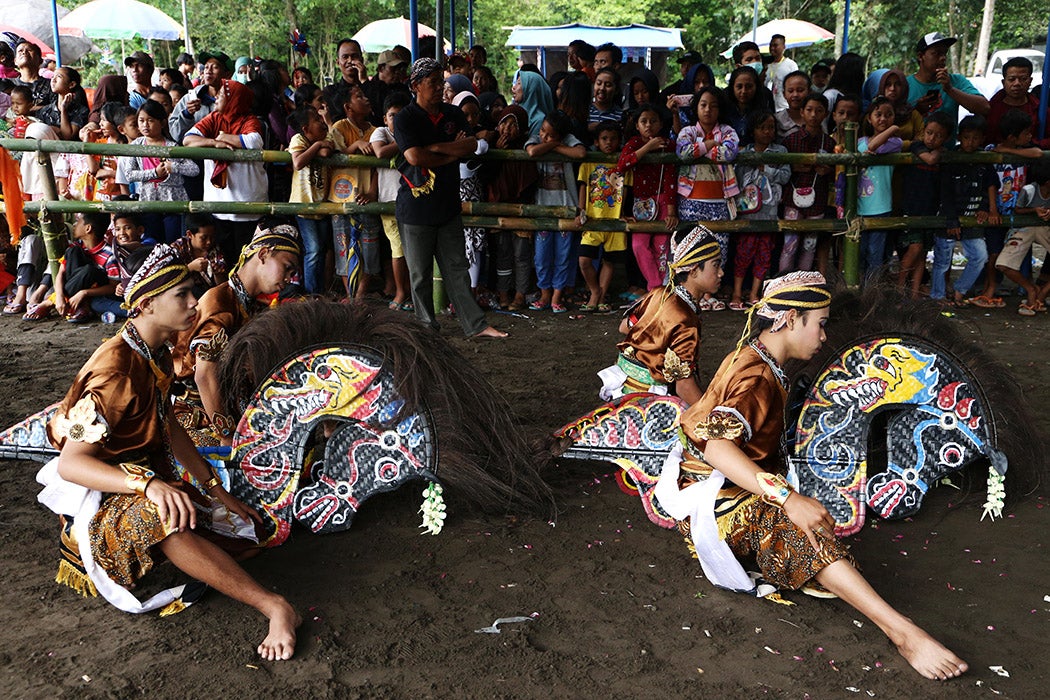
The history of kuda kepang, the Javanese horse dance whose trance rituals continue to spark religious debate.
Now, women musicians have embraced gamelan as ngayah too. As gamelan wanita has grown in popularity since the 1980s, “women are taking on an additional commitment and responsibility by appropriating areas of artistic expression that had been arbitrarily denied,” says Diamond.
Music isn’t the only arena in which older women are challenging traditional performance roles. Many now feel empowered to continue dancing—and aren’t content with being limited to the roles traditionally performed by younger women. “[T]he roles for young girls are not satisfying vehicles for some women who seek more suitable representations of their own life experience,” Diamond writes. “One of the ways in which they have attempted to expand their repertoire has been to appropriate male roles.”
Tourism has also reshaped Balinese performance traditions. The island’s economy has become increasingly reliant on visitors drawn to its cultural attractions. Tourists are eager to catch a glimpse of Balinese dance, but their expectations have also altered how gender is performed.
The growth of tourism in the 1960s “greatly stimulated the creation of ‘free dance’ performances” that are “detached from any tie of a dramatic or ritual nature, and just follow each other in a haphazard fashion,” reports Michel Picard. As a result, theatrical works have been adapted as solo dances, while some court dances have been simplified for tourist audiences.
"*" indicates required fields
This field is for validation purposes and should be left unchanged.
Get your fix of JSTOR Daily’s best stories in your inbox each Thursday.
First name*
Last name*
Email*
What best describes you?*
Tourists’ perception of Balinese dance as feminine may also be discouraging men from performing—potentially creating more opportunities for women to take on traditionally male roles.
Some women are pushing boundaries even further. They reinterpret traditional narratives to take on “coarse or aggressive roles” rather than playing only refined aristocrats. For instance, Cok Sawitiri—whom Diamond calls “one of Bali’s most innovative performance artists and an outspoken social activist”—reimagined the classic story of Panji Semirang in a 2003 solo performance piece, Aku Bukan Perempuan Lagi (I Am a Woman No More).
At the climax of the original narrative, Prince Panji reunites with his consort Candra Kirana after unmasking her male disguise. Cok Sawitiri’s version, in contrast, depicts Candra Kirana as a jilted princess—who, while disguised, seduces both the prince and his female lover. Although Bali has long been a destination for foreign artists and other tourists, Balinese women performers are asserting themselves as far more than models and muses for the orientalist gaze.
By taking on traditionally male roles and bringing new female perspectives to established performance traditions, Balinese women “are creating new fusions that … expand the aesthetic parameters of art identifiable as ‘Balinese,’” Diamond observes.

JSTOR is a digital library for scholars, researchers, and students. JSTOR Daily readers can access the original research behind our articles for free on JSTOR.
By: Catherine Diamond
Asian Theatre Journal, Vol. 25, No. 2 (Fall, 2008), pp. 231-271
University of Hawaii Press on behalf of Association for Asian Performance (AAP) of the Association for Theatre in Higher Education (ATHE)
By: Michel Picard
Indonesia, No. 49 (Apr., 1990), pp. 37-74
Cornell University Press
By: Liu Kang
Liu Kang: Essays on Art & Culture, pp. 57-62
National Gallery Singapore
By: ADRIAN VICKERS
Bijdragen tot de Taal-, Land- en Volkenkunde, Vol. 167, No. 4 (2011), pp. 459-481
Brill
"*" indicates required fields
This field is for validation purposes and should be left unchanged.
Get your fix of JSTOR Daily’s best stories in your inbox each Thursday.
First name*
Last name*
Email*
What best describes you?*
| # | Наименование новости | Тональность | Информативность | Дата публикации |
|---|---|---|---|---|
| 1 | Bali visa crackdown sees 342 deported in 6 months | 0 | 12.74 | 17-08-2026 |
| 2 | From Buffalo Bill to Balanchine: The Rise of Ballet Americana | 0 | 11.85 | 02-07-2026 |
| 3 | Bali Hotels Association says Australian media’s damning report about Bali is ‘far from the truth’ | 0 | 11.5 | 16-11-2020 |
| 4 | Directory of women's periodicals in Asia and the Pacific | 0 | 10.27 | 23-07-2026 |
| 5 | Two Dutch men banned from entering Bali after allegedly barring Indonesians from run club | 0 | 20.51 | 27-07-2026 |
| 6 | From Ralph Lauren to The Row, American luxury is booming | 5 | 7 | 13-04-2026 |
| 7 | From palava huts to TikTok: How Liberians are preserving their past | 0 | 6.29 | 25-07-2026 |
| 8 | Can We Change The Songs We Were Raised On?: Son Preference, Patriarchy, And The Folk Songs Of Punjabi Women | 0 | 3.52 | 11-09-2026 |
| 9 | May is Leave a Legacy Month: What Will Yours Be? | 0 | 5.37 | 06-05-2026 |