Просмотр новости
Найдите то, что Вас интересует
 Спутники
 РН
 SpaceX
 Роскосмос
 NASA
СпутникиРНSpaceXРоскосмосNASAChina is expanding its hydrogen ambitions beyond fuel-cell vehicle demonstrations to industrial applications and regional transport networks, as researchers and industry executives examine how to bring down costs and develop commercially viable markets.
The post China’s Hydrogen Push Shifts Focus to Costs, Infrastructure and Industrial Demand|Insights appeared first on iChongqing.
By RAN ZHENG|Oct 23,2026
Chongqing - China is expanding hydrogen use beyond fuel-cell vehicle demonstrations into industry and regional transport networks, tackling a challenge facing the sector worldwide: how to cut costs and make hydrogen commercially viable.
The shift was a key focus of the International Forum on New Energy System Development Powered by Hydrogen, held in Chongqing on October 23.

The International Forum on New Energy System Development Powered by Hydrogen was held at Chongqing Science Hall on October 23, 2026, as part of the 2026 World Science and Technology Development Forum. (Photo/Zheng Ran)
Participants discussed hydrogen production, long-distance transportation, infrastructure and commercial applications, with particular attention to the Chengdu-Chongqing Hydrogen Corridor linking two major industrial centers in western China.
From vehicle demonstrations to industrial demandChina's hydrogen policy is placing greater emphasis on commercial applications across the supply chain.
In March, the Ministry of Industry and Information Technology, the Ministry of Finance and the National Development and Reform Commission jointly launched a hydrogen application pilot program covering transportation, industrial production and emerging uses.
The program aims to reduce average end-user hydrogen prices in participating city clusters to below 25 yuan per kilogram by 2030, with some better-positioned regions targeting around 15 yuan. It also seeks to double China's fuel-cell vehicle fleet from its 2025 level to approximately 100,000 vehicles.
Liu Anmin, general manager of the China Automotive Engineering Research Institute, said the policy marks a shift from technology demonstrations to commercial applications that can be replicated and expanded.
The challenge, he explained, is to coordinate hydrogen production, storage, transportation and consumption while developing sufficient demand to support infrastructure investment.
The Chengdu-Chongqing region already has an industrial base for hydrogen development. Liu said Sichuan and Chongqing produce about 600,000 metric tons of industrial byproduct hydrogen annually, while hydrogen refueling prices are around 25 yuan per kilogram.
Chongqing has also developed manufacturing capabilities for fuel-cell vehicles and components. According to municipal government information released in March, the city had 12 operational hydrogen refueling stations and nearly 500 fuel-cell vehicles in use at that time.
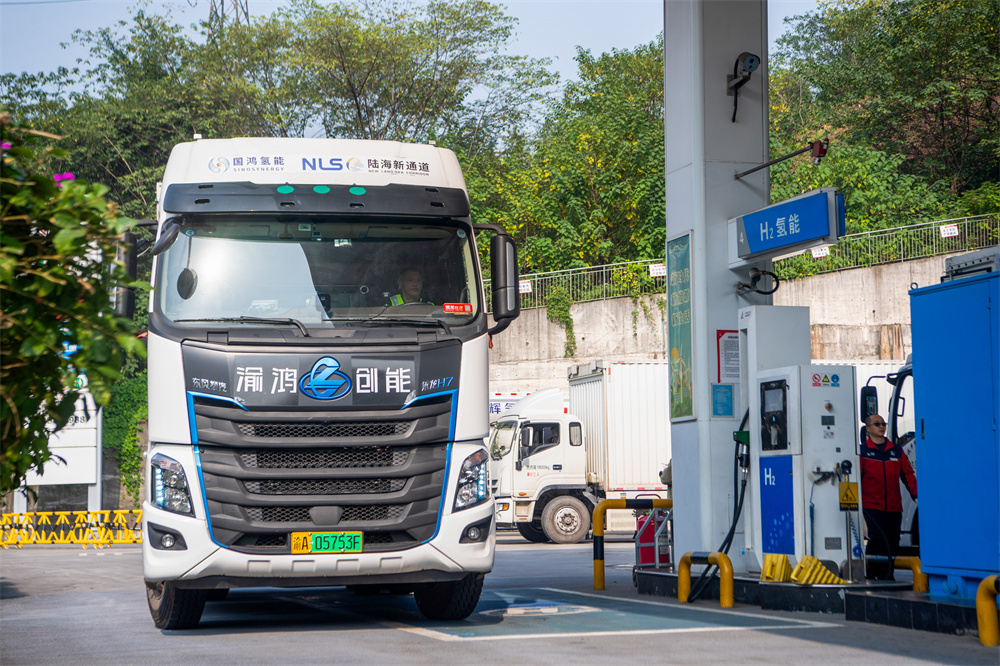
The hydrogen-powered logistics vehicle enters an integrated refueling station. (Photo/Chongqing Daily)
However, Liu acknowledged that the transport sector still faces difficulties in achieving large-scale commercial operations.
He said further reductions in fuel-cell system costs, vehicle prices and hydrogen supply costs would be important to improving the competitiveness of hydrogen-powered heavy trucks.
Hydrogen corridors could change the cost equationTransportation infrastructure was another focus of the forum.
Mikaa Blugeon-Mered, a hydrogen markets researcher affiliated with the University of Québec, said hydrogen corridors should connect producers with multiple sources of demand, including industry and transportation.

Mikaa Blugeon-Mered, a hydrogen markets researcher affiliated with the University of Québec. (Photo/Zheng Ran)
He cited a 195-kilometer hydrogen pipeline in Inner Mongolia linking renewable hydrogen production areas with industrial consumers around Baotou.
According to project estimates discussed at the forum, pipeline transportation could reduce hydrogen delivery costs from approximately 13 yuan to 3 yuan per kilogram, a reduction of about 77%.
The pipeline was approaching operation, but the projected cost savings had not yet been demonstrated through sustained commercial service.
Blugeon-Mered said such infrastructure could support industries including steelmaking and heavy-duty transportation rather than serving a single hydrogen consumer.
He also pointed to challenges in Europe, where large hydrogen pipeline networks have been proposed but implementation has been constrained by policy coordination and regulatory difficulties.
For Chongqing, he identified heavy-duty trucks, buses and other transportation applications as potential sources of demand. But he stressed that infrastructure development must be coordinated with production capacity and refueling facilities.
Hydrogen corridors, he argued, require integrated planning across supply, storage, transportation and end use.
New research examines hydrogen tradeA new research report released at the forum, Global Hydrogen Transportation Pathways Analysis: China's Medium- and Long-Term Hydrogen Supply–Demand Dynamics and Trade Outlook, examined how China could connect hydrogen production in resource-rich regions with growing demand from industrial and coastal markets.
The research report addressed a related challenge: China's hydrogen production and demand are not necessarily located in the same regions.
Zhao Kangning, a senior researcher at the International Hydrogen Fuel Cell Association, said China's existing hydrogen supply is concentrated around traditional industrial users, with production and consumption often located close together.
That pattern could change as renewable hydrogen production expands in resource-rich regions and demand grows in transportation, power generation, and other industries.
The report examined supply-and-demand scenarios for 2035 and 2060 and compared hydrogen pipelines with transportation using hydrogen-derived products such as ammonia and methanol.
Zhao said transportation choices must account for delivery scale, distance, infrastructure utilization, and final costs to consumers, rather than production costs alone.
The report also assessed international trade opportunities, including shipments of hydrogen-derived products from the Middle East to China, where production costs, financing and carbon-related requirements can influence competitiveness.
It recommended developing transportation infrastructure around established industrial demand and expanding networks gradually as commercial conditions improve.
International cooperation and the next phaseThe forum also featured research collaboration and partnership agreements involving international organizations, companies and Chongqing-based institutions.
Participants discussed how technology standards, testing capabilities and cross-border cooperation could support hydrogen production and distribution.
For Liu, the longer-term challenge is moving hydrogen development from reliance on policy incentives toward a market supported by stable demand and commercially sustainable infrastructure.
Internet illegal and undesirable information can be reported by calling this telephone number:+86-23-67158993
渝ICP备20009753号-2 互联网新闻信息服务许可证号:50120220004
| # | Наименование новости | Тональность | Информативность | Дата публикации |
|---|---|---|---|---|
| 1 | China’s Top Economic Planner Vows More Efforts to Expand Domestic Demand | 0 | 4.38 | 21-10-2026 |
| 2 | China’s New Energy Heavy-Duty Truck Fleet to Exceed 1.6 Million by 2030 | 0 | 14.22 | 23-07-2026 |
| 3 | China Makes Significant Progress in Climate Action, Charts Green Path | 0 | 5.75 | 22-10-2026 |
| 4 | China Moves To Convert Underused Airspace Into A New Industrial Growth Engine | 0 | 13.35 | 01-07-2026 |
| 5 | China Issues Revised Administrative Measures for Outbound Investment | 0 | 4.92 | 23-10-2026 |
| 6 | China Ends EV Battery Tax Breaks: Is the Industry Entering a New Innovation Era? | 0 | 4.26 | 23-07-2026 |
| 7 | Производство водорода должно быть экономически оправдано | 0 | 8.2 | 16-10-2026 |
| 8 | Водородные технологии к 2035 году планируют массово применять в отраслях производства | 0 | 0 | 23-08-2023 |
| 9 | A Car Every 30 Seconds: International Guests Explore Chongqing’s Automated Factory | 0 | 10.64 | 23-10-2026 |
| 10 | China Upgrades Digital Yuan System to Expand Payment, Smart Contract Services | 0 | 3.82 | 23-10-2026 |