Просмотр новости
Найдите то, что Вас интересует
 Спутники
 РН
 SpaceX
 Роскосмос
 NASA
СпутникиРНSpaceXРоскосмосNASACanada’s food banks deserve our gratitude. Increasingly, they also deserve an explanation
Canada’s food banks deserve our gratitude. Increasingly, they also deserve an explanation
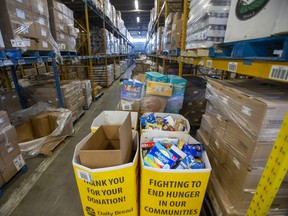 The warehouse at the Daily Bread Food Bank at the Etobicoke facility. Photo by Ernest Doroszuk/Toronto Sun/Postmedia
See more Toronto Sun on Google — save as a Preferred Source

Subscribe now to read the latest news in your city and across Canada.
Subscribe now to read the latest news in your city and across Canada.
Create an account or sign in to continue with your reading experience.
Create an account or sign in to continue with your reading experience.
Food Banks Canada’s HungerCount 2026 recorded 2.35 million visits in March, up 8.7 per cent from the previous year and nearly 117 per cent since 2019. Among food banks responding to its capacity survey, 51 per cent reported distributing less food than usual because supplies were running short, while 21 per cent ran out before meeting demand.
Recommended VideosBehind those numbers are volunteers stretching donations, employees managing impossible budgets and families hoping there will be something left when their turn comes. These organizations are absorbing the consequences of policy decisions they neither designed nor control.
We cannot keep congratulating them for meeting growing demand without asking why that demand keeps growing.
One uncomfortable question concerns immigration.
More newcomers relying on food banksThe report identifies people who have lived in Canada for ten years or less as nearly 31 per cent of food bank clients, compared with approximately 13 per cent in 2019. Their share declined from the previous year, even as total visits increased. This category spans a decade and does not establish how much current immigration policy contributed to rising demand. Nevertheless, the scale of newcomer reliance warrants serious attention.

Your noon-hour look at what's happening in Toronto and beyond.
By signing up you consent to receive the above newsletter from Postmedia Network Inc.
A welcome email is on its way. If you don't see it, please check your junk folder.
The next issue of Your Midday Sun will soon be in your inbox.
We encountered an issue signing you up. Please try again
What kind of welcome are we offering when people arrive hoping to build a future and end up depending on donated groceries?
Newcomers using food banks are more likely than other clients to rely on employment income and cite low wages or insufficient hours. The report also describes overqualification, precarious employment and barriers to accessing benefits. Many are working, yet struggling to become financially secure.
That should trouble anyone who believes in immigration.
An immigration policy carries responsibilities beyond issuing documents and counting arrivals. Governments must consider whether people can find housing, earn enough to support themselves and obtain the services necessary to establish their lives.
Employers have responsibilities, too. Recruiting internationally should come with credible working conditions and realistic expectations about earnings and living costs. Educational institutions recruiting foreign students should be accountable for the accuracy of what they promise about housing, employment and life after graduation.
A food bank should never become the unspoken final step in a recruitment strategy.
How governments can helpThe elephant in the room is the gap between Canada’s ambition to welcome people and its willingness to prepare for their arrival. Discussing that gap is essential to preserving public confidence in immigration and protecting newcomers themselves.
Provincial needs differ. Some communities need workers and have opportunities to offer. Others face severe housing shortages and strained services. A credible federal approach must accommodate those differences, with provinces and municipalities involved before commitments are made.
Where capacity is insufficient, admission plans should adjust. Where workers are needed, governments should help remove the obstacles preventing qualified newcomers from filling those positions. Faster credential recognition, relevant language training and better connections to employers would give more people a fair chance to use the skills Canada encouraged them to bring.
The broader affordability agenda matters just as much. Canadians already here, including immigrants who arrived years ago, need accessible housing, adequate disability supports and employment that pays reliably. Food policy must also address competition, productivity and avoidable costs throughout the supply chain.
Simply expanding food banks leaves these underlying pressures intact.
We should continue supporting emergency food assistance. People need to eat today, regardless of how long policy reform takes. But governments should measure success by fewer households needing that assistance, alongside declining food insecurity.
Food bank leaders should also feel free to question every policy contributing to demand, including immigration planning. Their commitment to helping vulnerable people gives them a compelling reason to demand better preparation and accountability.
Canada can remain welcoming while being honest about its capacity. In fact, honesty is part of a responsible welcome.
People who choose Canada deserve a credible opportunity to become secure and independent. The volunteers handing them groceries deserve governments willing to make that opportunity real.
– Sylvain Charlebois is director of the Agri-Food Analytics Lab at Dalhousie University, co-host of The Food Professor Podcast.
This website uses cookies to personalize your content (including ads), and allows us to analyze our traffic. Read more about cookies here. By continuing to use our site, you agree to our Terms of Use and Privacy Policy.
| # | Наименование новости | Тональность | Информативность | Дата публикации |
|---|---|---|---|---|
| 1 | Poilievre highlights need for 'utmost generosity' toward CFB Wainwright community after deadly fire | 0 | 9.22 | 19-10-2026 |
| 2 | Temporary migrant workers braved smoke to send money home. Then a B.C. wildfire took their jobs | 0 | 6.81 | 13-08-2026 |
| 3 | Expert: Rebuilding trust in health science | 0 | 6.57 | 21-01-2026 |
| 4 | Matthew Lau: Toronto bungles transit, now wants to sell groceries | 0 | 12.74 | 28-07-2026 |
| 5 | СВС: Канада боится помогать Кубе из-за США | 0 | 0 | 19-02-2026 |
| 6 | Jesse Kline: In the face of tough new tariffs, Carney doubles down on government spending | 0 | 9.32 | 25-08-2026 |
| 7 | Путин назвал гражданским героизмом помощь, которую волонтеры оказывают гражданам | 0 | 0 | 30-04-2020 |
| 8 | Premier Danielle Smith caught by tears during forum on Alberta referendum, grievances with Ottawa | 0 | 8.81 | 19-09-2026 |
| 9 | EDITORIAL: Feds waffling on ‘anti-Zionism’ | 0 | 13.45 | 19-10-2026 |