Просмотр новости
Найдите то, что Вас интересует
 Спутники
 РН
 SpaceX
 Роскосмос
 NASA
СпутникиРНSpaceXРоскосмосNASA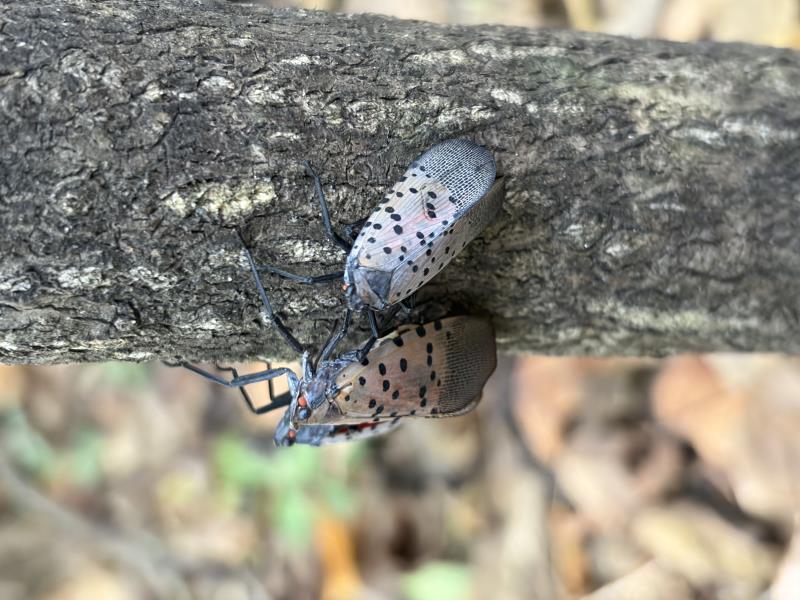
Here at Lookout Mountain Conservancy (LMC), we field a fair number of questions pretty frequently.
Is Rockmont Park open? (Yes, but not overnight.)
Does Rockmont Park really contain the South’s largest urban natural bouldering park? (Yes. Kinda cool, isn’t it?)
Will John C. Wilson Park reopen? (That’s our top goal.)
But one particularly timely question keeps popping up. It goes something like this:
We’ve seen some spotted lanternfly.
What do we do about them?
In 2014, the spotted lanternfly was first identified in the US. By 2025, the spotted lanternfly had reached Hamilton and five other Tennessee counties, according to the Tennessee Department of Agriculture (TDA). Its spread is concerning. The alluring moth — native to Asia, technically known as Lycorma delicatula — is invasive. Damaging to both hardwoods and fruit trees, the spotted lanternfly has earned the one-word distinction from TDA:
“Pest.”
The spotted lanternfly presents with black stripes and white dots. Their eggs are massed together, often looking like mud splats on trees, outdoor furniture, boats and more. Young spotted lanternflies “are black with small white dots,” TDA says. You can spot - ahem - older nymphs in early summer, with brighter red colors and black stripes and white dots.
Adults emerge in late summer or early fall.
“Adults have forewings which are tan with black spots at the front transitioning to a speckled band near the rear,” TDA says. “Hindwings have distinct bright red patches with black spots.”
Young spotted lanternflies often walk with the front of their bodies “elevated,” TDA says. With their front body lifted like East LA hydraulics, young nymphs party all summer, with adults emerging in early fall. (Party’s over, kids.)
They love to hang out together; when you see one, you normally see a bunch.
Back to our earlier question: when you see one, what should you do?
Easy, according to TDA.
Squash the heck out of ‘em.
The TDA published a five-point bulletin on how to respond to the spotted lanternfly.
“Scrape and smash egg masses.”
“Stomp the nymphs.”
“Squish the adults.”
“Eliminate hosts.”
“Scout pathways.”
The last one? It encourages us to keep a close eye on eggs laid outside in our yard, driveway or camper. Egg masses can hitchhike their way from our driveway across town, into state parks, our buddy’s home in Nashville, and so forth.
“From late fall through winter, egg masses may be present; these masses are often tan-colored and look like spattered mud and may be laid on trees trunks, branches, other plants, or even other outdoor surfaces like walls, patio furniture, recreational vehicles, trailers, and even on smaller vehicles,” TDA says.
The spotted lanternfly loves an orchard, as well as our backyard maple, walnut and poplar trees and ornamentals. The TDA calls it “a sapsucking insect” that leeches up the nutrients and water inside plants, leaving behind something called “honeydew.”
Honeydew can coat areas underneath infested plants with a sticky substrate, allowing for growth of sooty mold, TDA says.
These sap-sucking, mud-spattered moths love “host plants [like] apples, grape, and hops, and a variety of other fruit and ornamental trees, shrubs, and vines. This insect also feeds on maple, walnut, and poplar,” TDA says.
With an expansive, hungry-hippo diet, the spotted lanternfly poses a threat to several dozen species of Tennessee plants.
Our question to you: have you seen them?
David Cook is the Director of Communications and Storytelling for Lookout Mountain Conservancy, a 35-year-old land trust started by John Wilson in 1991. He can be reached at david@lookoutmountainconservancy.org
| # | Наименование новости | Тональность | Информативность | Дата публикации |
|---|---|---|---|---|
| 1 | El señor de las moscas | 0 | 0 | 16-05-2026 |
| 2 | Vagó lliure de gossos | 0 | 10 | 22-07-2026 |
| 3 | Комар-долгоножка в доме | 0 | 26.67 | 15-08-2026 |
| 4 | Майский жук под листом | 0 | 3.91 | 15-08-2026 |
| 5 | Танк | 0 | 10 | 20-08-2026 |
| 6 | Бабочка | 0 | 10 | 19-10-2026 |
| 7 | 0 | 0 | 05-05-2026 | |
| 8 | 0 | 0 | 05-05-2026 | |
| 9 | 0 | 0 | 29-04-2026 | |
| 10 | A tale of two possums | 0 | 8.34 | 12-10-2026 |