Просмотр новости
Найдите то, что Вас интересует
 Спутники
 РН
 SpaceX
 Роскосмос
 NASA
СпутникиРНSpaceXРоскосмосNASALula’s supporters suspect tech firm meddling on behalf of US president Donald Trump, who has close ties to Bolsonaro familyFive days after his defeat in the first round of the Brazilian presidential election, leftwing president Luiz Inácio Lula da Silva spent almost 24 hours unable to boost his Instagram posts, while his opponent, far-right senator Flávio Bolsonaro, could.Lula’s lawyers included the episode in a list of incidents that they submitted to the electoral court and international observers as “evidence” that Meta, Instagram’s owner, was actively trying to interfere in Brazil’s election in Bolsonaro’s favour. Continue reading...
Five days after his defeat in the first round of the Brazilian presidential election, leftwing president Luiz Inácio Lula da Silva spent almost 24 hours unable to boost his Instagram posts, while his opponent, far-right senator Flávio Bolsonaro, could.
Lula’s lawyers included the episode in a list of incidents that they submitted to the electoral court and international observers as “evidence” that Meta, Instagram’s owner, was actively trying to interfere in Brazil’s election in Bolsonaro’s favour.
Reports from Lula supporters saying their content had been removed or its reach restricted flooded social media in Brazil, while about a dozen watchdogs and research groups published reports describing what they called “indications” that Meta may have favoured the senator’s campaign.
Meta called Lula’s allegations “false and unfounded”, saying there had been “technical incidents” that affected campaigns from “different parts of the political spectrum”.
The controversy fuelled the electoral battle between Lula and Bolsonaro just days before next Sunday’s runoff and gained further traction after the electoral court ordered Meta not to give the candidates “unequal treatment”.
Late last week, justice Marco Aurélio Bellizze said he had found no evidence of deliberate action by the company, which would require further investigation, but he gave Meta 24 hours to prove that the problems affecting Lula had been fixed and would not happen again.
On Monday, after saying the company had failed to do so, Bellizze gave Meta a further 24 hours. The company responded on Tuesday, again denying any favouritism and saying it had introduced human review to prevent any automated restrictions.
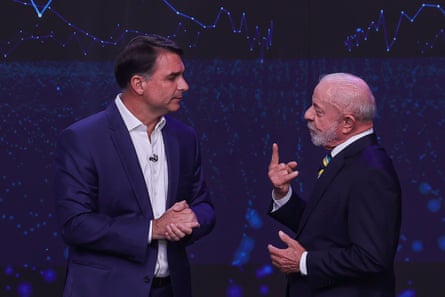
Meta’s oversight board, a quasi-independent body whose decisions are binding, issued a statement saying it was “concerned by recurring enforcement failures in Meta’s election integrity efforts”, citing both Brazil’s election and the suspension of the anti-Trump No Kings movement’s account in the US for several hours last Saturday, during demonstrations aimed at encouraging early voting in the midterm elections.
The company said it suspended the No Kings account after its anti-fraud systems wrongly flagged what they believed was bot traffic, and apologised.
The board said it had seen the same pattern in Brazil, where there had been an “over-enforcement of Meta’s fraud policies against Brazil’s President Luiz Inácio Lula da Silva’s ad accounts” on 23 September, when his campaign advertising account was disabled for more than an hour. Meta said this had happened “by mistake … and not for political reasons” after an anti-fraud review wrongly classified an ad as an attempt to impersonate a government social programme.
The board said: “From the removal of political activist accounts during protests in the US ahead of the midterm elections to technical restrictions that hit the accounts of a presidential candidate in Brazil leading to allegations of electoral interference, it’s clear that Meta must do more to ensure that its enforcement practices during elections are transparent and consistent, and that political speech is protected rather than stifled”.
João Victor Archegas, the coordinator at the thinktank Institute for Technology and Society, said it was “almost impossible” to prove any interference by Meta in Brazilian elections because only the company has access to its internal data, meaning there is no real external scrutiny, either from the electoral court or from the watchdogs producing reports on it.
“What we have so far is a collection of cases that perhaps one day we can piece together and reach some conclusion one way or the other. But today, because of the lack of information, unfortunately we cannot be certain,” he said.
Platforms such as Google and TikTok are not allowing political advertising in this election, leaving Meta’s services as the only large-scale channels for paid digital campaigning, which so far has earned the company £43m, 85% more than it made during the last presidential election.
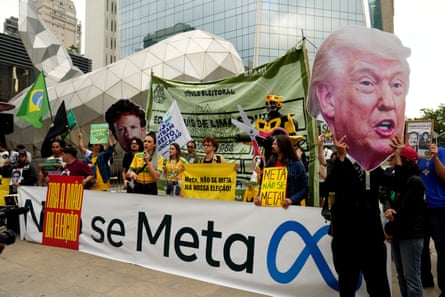
A report by the watchdog CTRL+Z, founded by a former executive at Meta’s WhatsApp, catalogued 1,121 reports of lost or suppressed reach, restrictions on reposting, and account bans and blocks affecting mostly leftwing profiles. Meta dismissed it as a catalogue of anecdotes and users’ perceptions.
Media outlets posted examples of an experiment in which WhatsApp’s AI assistant refused to generate artwork featuring “Lula” and his ballot number, but did so for “Flávio” – Brazilians widely refer to the senator by his first name, reserving the surname for his father, former president Jair Bolsonaro.
The company said this reflected “a specific gap in our safeguards, not political bias” and that AI artwork could be generated using Lula’s first name, Luiz, with his ballot number.
Many Lula supporters raised suspicions that Meta was allegedly acting on behalf of the US president, Donald Trump, who has close ties to the Bolsonaro family and whom Lula has accused of trying to interfere in Brazil’s election.
Lula’s lawyers appeared to embrace that argument, describing Meta in their filing to the electoral court as a “foreign company aligned with the Trump administration” that was acting as a “vector of external pressure on the [Brazilian] electorate”, without, however, offering any evidence of possible US involvement.
In the 9 October episode in which Lula’s campaign was temporarily unable to boost posts on Instagram, which 70% of Brazilian adults say they use as their primary source of information, his lawyers said that “silencing” the incumbent’s social media while his opponent’s continued operating normally created an unfair advantage for Bolsonaro.
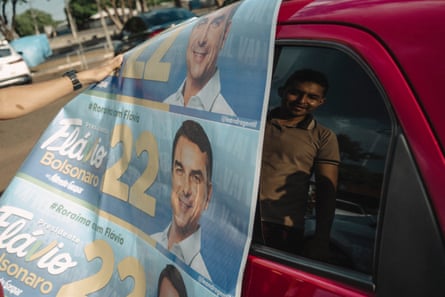
The company said the problem affected only new posts, while older ones could still be promoted, and that it had been a “global outage” affecting “thousands of advertisers in different countries”, though Bolsonaro’s campaign was not among them.
Meta added: “We apply the same rules to all candidates, parties and political viewpoints in Brazil, just as we do in elections around the world. We do not suppress content to harm one side or give preferential treatment to any side.”
NetLab, a research laboratory on the internet and social media at the Federal University of Rio de Janeiro, produced a report showing that Meta allowed at least 1,600 election ads to be boosted from outside Brazil, something prohibited under Brazilian law.
Débora Salles, NetLab’s general coordinator, said they had not identified political bias towards either side, but that the failure “shows how the company repeatedly fails to ensure safety and compliance with electoral law”.
On the eve of the vote, NetLab identified paid ads that posed as official posts from the electoral court and contained false information that encouraged abstention, claiming that if it was raining, voters could cast their ballots online, which is not possible in Brazil.
“Regardless of whether a candidacy is being helped or harmed, what we see is that the company has difficulty complying with Brazilian electoral law and ends up undermining the integrity of the electoral process,” said Salles.