Просмотр новости
Найдите то, что Вас интересует
 Спутники
 РН
РН SpaceX
 Роскосмос
 NASA
NASA
СпутникиРНSpaceXРоскосмосNASAThe European Research Council (ERC) today announced the winners of its latest Starting Grant competition. Kaustubh Hakim, researcher at both the Royal Observatory of Belgium and KU Leuven, has been awarded a grant for the ExoGeochem project, with the Observatory as host institution.
The ERC Starting Grants are awarded to early-career researchers across Europe. The grants will help researchers develop ambitious ideas, [...]
The post ERC Starting Grant Awarded to a Researcher at the Royal Observatory appeared first on Royal Observatory of Belgium.
The European Research Council (ERC) today announced the winners of its latest Starting Grant competition. Kaustubh Hakim, researcher at both the Royal Observatory of Belgium and KU Leuven, has been awarded a grant for the ExoGeochem project, with the Observatory as host institution.
The ERC Starting Grants are awarded to early-career researchers across Europe. The grants will help researchers develop ambitious ideas, build their own teams and establish their independence at a pivotal stage in their careers.
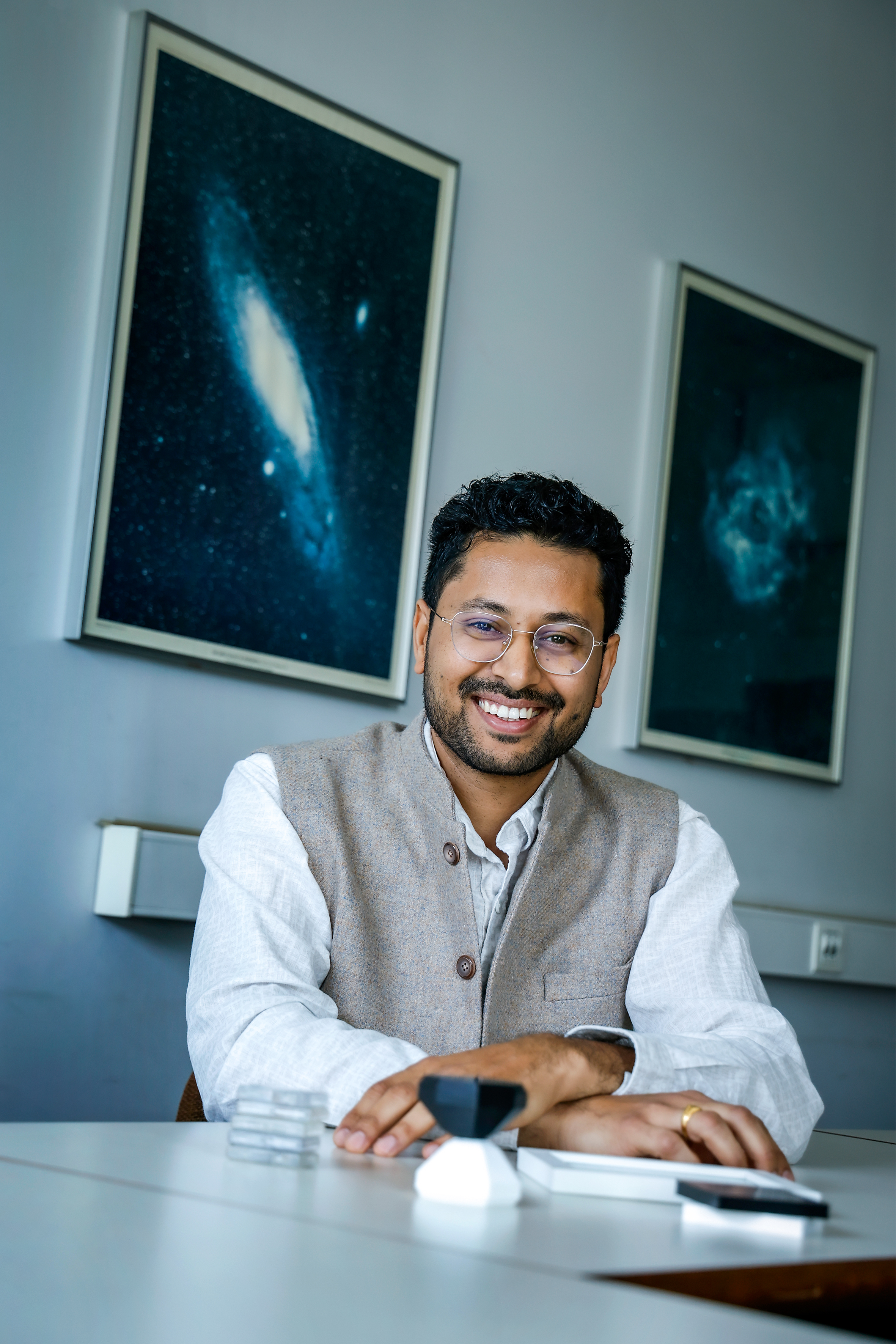
Kaustubh Hakim with 3D-printed models of diamond anvil cells (FabLab Leuven). Photo: Rob Stevens (KU Leuven)
Kaustubh Hakim is one of the 421 laureates of the ERC Starting Grant. The scientist holds a joint appointment between the Royal Observatory of Belgium and the Institute of Astronomy at KU Leuven through the BELSPO FED-tWIN programme. He is the first active researcher in the FED-tWIN programme to be awarded an ERC grant.
He trained first as an electronics engineer and worked in banking before turning to astronomy, for a master’s degree in Belgium, a PhD in the Netherlands and a long postdoctoral position in Switzerland before returning to Belgium. His research connects geochemistry and planetary science to work out what exoplanets are made of.
A grant for studying exoplanets through modelling, high-pressure experiments and observationsThe project ExoGeochem (Geochemical Atmospheric Signatures of Sub-Neptune Exoplanets) is hosted by the Royal Observatory of Belgium, with KU Leuven as a beneficiary partner. It aims to establish what sub-Neptune exoplanets are made of, and how their interiors shape the atmospheres we observe.
Roughly half of the exoplanets found so far belong to this class: worlds between twice the size of Earth and the size of Neptune. Our own solar system contains nothing like them, which leaves astronomers without a reference point for what lies beneath their thick atmospheres.
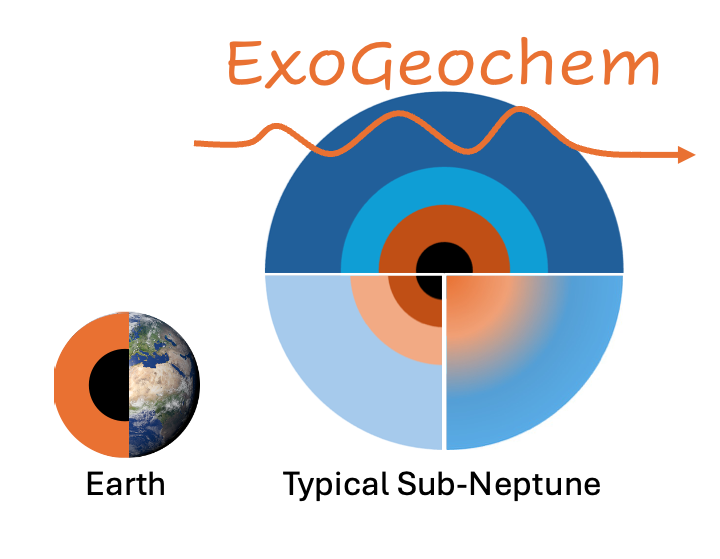
Earth and a typical sub-Neptune, shown to scale. While Earth’s interior is well constrained, sub-Neptune interiors are not well understood. ExoGeochem will work out what lies beneath the atmosphere of sub-Neptunes. Credit: Kaustubh Hakim.
ExoGeochem will supply the thermochemical data that are missing: how hydrogen, rock and iron behave when they meet at the pressures and temperatures found deep inside such planets. Laboratory experiments, quantum-mechanical simulations and atmospheric chemistry models will be brought together into a single framework, so that spectra recorded by the James Webb Space Telescope, and later by Ariel and the Extremely Large Telescope, can be read in terms of what a planet is actually made of.
The Starting Grant will provide about €1.5 million over a maximum period of five years. As the Principal Investigator, Kaustubh Hakim will recruit and supervise the team and take scientific responsibility for executing the project. Part of the budget will equip a laboratory with diamond anvil cells, in which sub-millimetre-sized samples are squeezed and heated to reproduce conditions deep inside a planet. His own scientific contribution centres on the interior–atmosphere interactions in rocky and sub-Neptune exoplanets, which is the thread tying the theoretical, experimental and observational parts of the project together.
“Planetary interiors have been studied at the Royal Observatory for decades, but mostly through models,” says Hakim. “What this grant makes possible is to recreate those conditions in the laboratory, measure what actually happens, and then take those numbers back to the telescope data. Closing that loop between experiment and observation is what has been missing for sub-Neptunes.”
The ERC press release: https://erc.europa.eu/news-events/news/erc-2026-starting-grants-results
| # | Наименование новости | Тональность | Информативность | Дата публикации |
|---|---|---|---|---|
| 1 | The Observatory Publishes Its Podcasts | 0 | 7.44 | 14-08-2026 |
| 2 | The Earth Climate Observatory (ECO) space mission candidate goes forward to Phase A | 0 | 5.42 | 30-09-2026 |
| 3 | Music, Sound & Imagination Exhibition at the Royal Palace | 0 | 9.22 | 08-07-2026 |
| 4 | The Space Pole opens its doors on 26 and 27 September 2026 | 0 | 8.55 | 17-09-2026 |
| 5 | Special Stamps on the Occasion of the Observatory’s 200th Anniversary | 0 | 5.58 | 09-09-2026 |
| 6 | 200 years of astronomy. 50 years of geography. A single coin. | 0 | 5.46 | 27-09-2026 |
| 7 | ‘Born-again’ star offers rare chance to watch stellar evolution in real time | 0 | 9.14 | 16-09-2026 |
| 8 | A new Observatory at Esrange to strengthen Arctic space research | 0 | 5.77 | 28-08-2026 |
| 9 | Apply for Space Technology and Commercialisation Workshop 2027 | 0 | 7.79 | 25-09-2026 |
| 10 | Royal Observatory Greenwich and ZWO Present the Astronomy Photographer of the Year | 0 | 4.68 | 18-09-2026 |