Просмотр новости
Найдите то, что Вас интересует
 Спутники
 РН
РН SpaceX
 Роскосмос
 NASA
NASA
СпутникиРНSpaceXРоскосмосNASANew York (VINNEWS) Footage of a private conversation held by HaGaon HaRav Dov Landau, shlit”a, Rosh Yeshivas Slabodka in Bnei Brak and the senior spiritual leader of the Lithuanian Torah world in Eretz Yisroel, was broadcast on Monday by Israel’s N12 news. The remarks were made during the war in the Rosh Yeshiva’s home, in […]
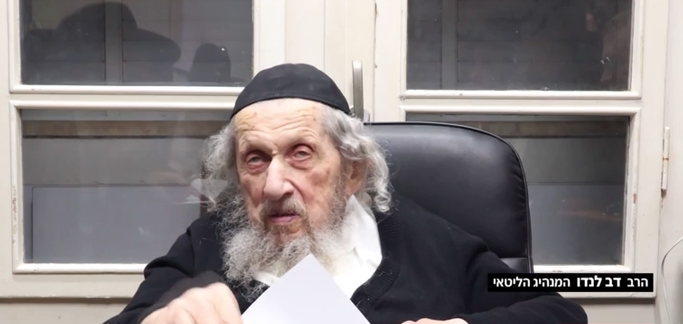
New York (VINNEWS) Footage of a private conversation held by HaGaon HaRav Dov Landau, shlit”a, Rosh Yeshivas Slabodka in Bnei Brak and the senior spiritual leader of the Lithuanian Torah world in Eretz Yisroel, was broadcast on Monday by Israel’s N12 news. The remarks were made during the war in the Rosh Yeshiva’s home, in a small, closed gathering of rabbonim, and were not intended for public release.
Subscribe to our Daily Roundup Email
The full context of the conversation is not known. Neither the length of the original discussion nor the questions that prompted the Rosh Yeshiva’s comments were made public.
A Long-Standing Hashkafah
In the footage, the Rosh Yeshiva, now 96, reflects on what might have been had the State not been established in its secular form. He suggests that under the United Nations, or even under Arab rule, the physical situation of the Jewish people in Eretz Yisroel might have been better. He also expresses the view that the Zionist movement contributed to Arab hostility toward Jews, and that it brought physical, not only spiritual, harm upon Klal Yisroel.
Those familiar with the history of the Torah world will recognize these themes. The concern that a secular national movement would provoke the nations, and would replace Torah with nationalism as the center of Jewish identity, was voiced by many of the leading gedolim of previous generations. Among them were the Brisker Rav and the Chazon Ish. Many trace this concern to the Gemara in Kesubos (111a), which speaks of the oaths that Klal Yisroel not ascend “as a wall” and not provoke the nations. Rav Landau’s remarks reflect that tradition. They should be understood as a hashkafic assessment, not as an expression of any warmth toward those who seek to harm Jews.
The Protective Power of Torah
The Rosh Yeshiva emphasized his conviction that the Torah learning of yeshiva students is what protects the land and its inhabitants. He noted that, in his view, there is otherwise no explanation for why enemy forces have not overrun the country. This is rooted in the Gemara in Sotah (21a), that Torah both shields and rescues, and in Bava Basra (7b–8a), which states that talmidei chachamim do not require guarding because their Torah protects them.
On Those Who Fall
The remark that drew the sharpest reaction concerned soldiers killed in battle. In the footage, the Rosh Yeshiva says that those who are killed fall “because we are not learning enough.” Read carefully, the statement is not an accusation against the fallen. It places the responsibility on the Torah community itself: “we.” This follows the teaching of Chazal (Berachos 5a) that when suffering comes, a person must first examine his own deeds. It is a call for greater Torah learning, not a judgment upon those who gave their lives.
The Rosh Yeshiva also expressed disagreement with the approach of the Religious Zionist rabbinic leadership. He suggested that some fight for the honor of the State rather than solely to save lives. This is a disagreement in hashkafah that has divided the Torah world and the Religious Zionist community for generations.
“If the Robbers Save Us”
The Rosh Yeshiva also addressed the relationship between the chareidi community and the State. He used a sharp metaphor, comparing it to living among robbers who nonetheless protect those around them, and asked, “What can we do?” The remark reflects the complex reality felt by many in the Torah world: deep reservations about the secular foundations of the State, alongside a recognition that its security forces are in fact protecting them. The Rosh Yeshiva also spoke with pain about secular Israelis’ distance from Yiddishkeit. He described the establishment of a state on a secular basis as a chillul Hashem.
Reaction
The broadcast drew criticism from Israeli politicians, including opposition figures. They objected to the Rosh Yeshiva’s characterization of Zionism and to his comments regarding Religious Zionist soldiers. The timing of the release, in the midst of election season, was noted by several observers.
Rav Landau serves as the spiritual leader of Degel HaTorah, a component of United Torah Judaism, which is part of Prime Minister Benjamin Netanyahu’s governing coalition. He became the senior leader of the Lithuanian Torah world after the petirah of HaGaon HaRav Gershon Edelstein, zt”l. He is revered by tens of thousands of talmidim and followers for his greatness in Torah, his humility, and his lifetime of devotion to the yeshiva world.