Просмотр новости
Найдите то, что Вас интересует
 Спутники
 РН
РН SpaceX
 Роскосмос
 NASA
NASA
СпутникиРНSpaceXРоскосмосNASAUrban, suburban and rural Americans engage in public life at similar rates but differ in some of the specific activities they do.
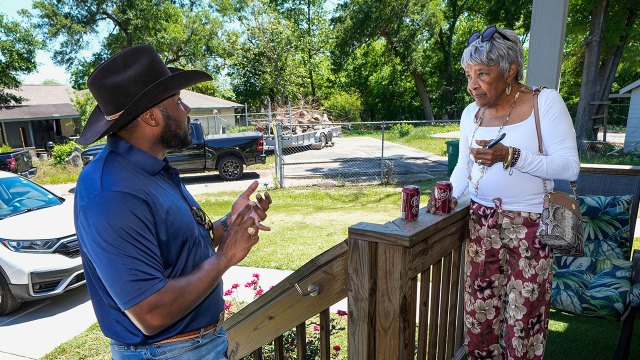 Two Houston residents talk about new flood maps in Harris County, Texas, on April 7, 2026. (Brett Coomer/Houston Chronicle via Getty Images)
The Pew-Knight Initiative supports new research on how Americans absorb civic information, form beliefs and identities, and engage in their communities.
Pew Research Center is a nonpartisan, nonadvocacy fact tank that informs the public about the issues, attitudes and trends shaping the world. Knight Foundation is a social investor committed to supporting informed and engaged communities. Learn more >
Urban, suburban and rural Americans engage with their communities at broadly similar rates. But they differ in some of the specific activities they do, from how they participate in politics to whether they are more likely to meet with people online or offline.
This data comes from a recent study from the Pew-Knight Initiative about how Americans engage with politics, civic life, religion and news. Pew Research Center sorted adults into four groups that reflect different patterns of participation: Mobilizers, Connectors, Spectators and Outsiders.
Americans in urban, suburban, and rural communities engage in society in slightly different ways
% of U.S. adults in each engagement group, by community type
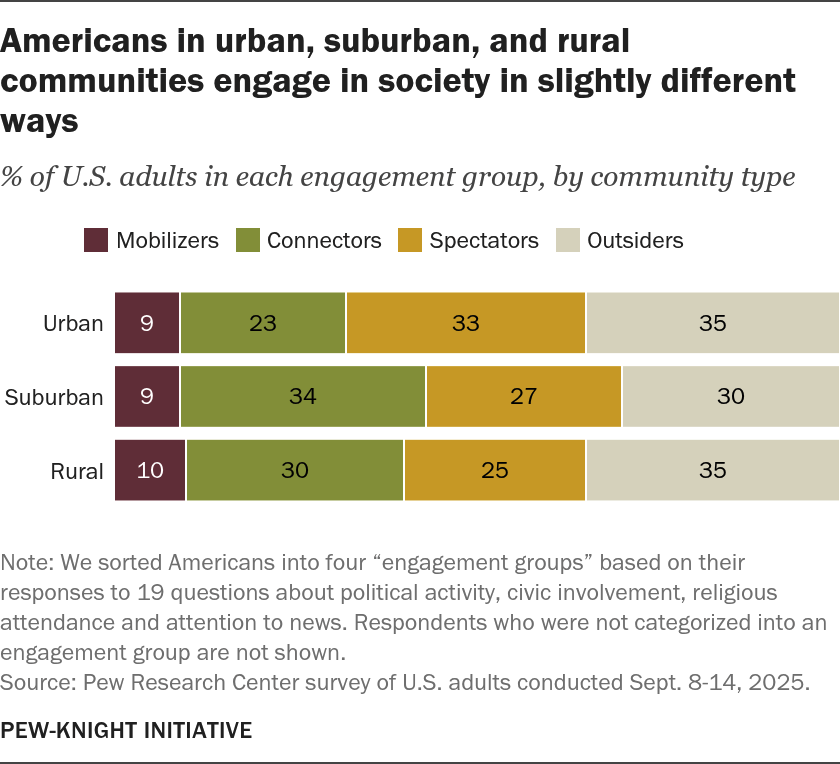
Note: We sorted Americans into four “engagement groups” based on their responses to 19 questions about political activity, civic involvement, religious attendance and attention to news. Respondents who were not categorized into an engagement group are not shown.
Source: Pew Research Center survey of U.S. adults conducted Sept. 8-14, 2025.
PEW-KNIGHT INITIATIVE
Americans in urban, suburban, and rural communities engage in society in slightly different ways
% of U.S. adults in each engagement group, by community type
| Community type | Mobilizers | Connectors | Spectators | Outsiders |
|---|---|---|---|---|
| Urban | 9 | 23 | 33 | 35 |
| Suburban | 9 | 34 | 27 | 30 |
| Rural | 10 | 30 | 25 | 35 |
Note: We sorted Americans into four “engagement groups” based on their responses to 19 questions about political activity, civic involvement, religious attendance and attention to news. Respondents who were not categorized into an engagement group are not shown.
Source: Pew Research Center survey of U.S. adults conducted Sept. 8-14, 2025.
PEW-KNIGHT INITIATIVE
Suburban residents are somewhat more likely than urban or rural residents to be classified as Connectors – the type of people who tend to be engaged in their community by volunteering, donating and participating in groups or clubs, but who are less engaged in political action. Urban Americans, meanwhile, are more likely than suburban or rural Americans to be Spectators – the group engaged mainly as news consumers rather than as active participants.
Mobilizers – the small share of Americans who are highly active across nearly every measure of civic, political, news and religious engagement in this analysis – make up about the same share of urban (9%), suburban (9%) and rural (10%) Americans. Similarly, Outsiders, who are the least engaged in civic and political life, make up roughly a third of Americans in each setting (35% of urban residents, 30% of suburban residents and 35% of rural residents).
Differences between Americans living in cities, the suburbs and rural areas are often small in survey research. People of all ages, incomes, races, ethnicities and political identities live in all three types of places, and these traits often predict how people think or behave better than community type does. But along with the differences by engagement group, there are a few specific ways people in various types of communities engage in civic life differently.
About this researchThis analysis is part of a research project from the Pew-Knight Initiative that investigates how Americans engage in public life across a range of activities, including politics, civic and community involvement, news consumption and religious participation. This analysis explores how Americans in urban, suburban and rural communities engage in their communities in different ways.
Why we did thisPeople participate in public life in different ways – from voting and volunteering to following the news and taking part in religious or community activities. But researchers often study these behaviors separately, making it difficult to see how they come together in people’s day-to-day lives. We did this project to show how the public engages in civic life more broadly.
How we did thisThis analysis from the Pew-Knight Initiative draws on two Pew Research Center surveys.
The main data is from Wave 179 of the American Trends Panel (ATP), a nationally representative survey of U.S. adults. We surveyed 5,195 adults by web and phone from Sept. 8 to 14, 2025.
We also used data from the Cross‑Sectional Engagement Survey to classify Americans into engagement groups, based on a cluster analysis using 19 measures of civic participation. Read “How we measured Americans’ engagement in public life” for more details.
The Cross‑Sectional Engagement Survey surveyed 5,393 adults from July 9 to Dec. 5, 2025. We designed this survey to help reach Americans who may be less likely to engage in public life. People could respond online, on paper or by telephone, and we reached out multiple times to people who didn’t initially respond. Read the methodology for more details.
Many questions in these surveys asked about the activities Americans took part in “in the past 12 months,” which for most people included the 2024 presidential election. Political activity in particular may look somewhat different at other points in the election cycle.
Here are the survey questions used for this analysis, the detailed responses and the methodology.
This is a Pew Research Center report from the Pew-Knight Initiative, a research program funded jointly by The Pew Charitable Trusts and the John S. and James L. Knight Foundation. Find related reports online at https://www.pewresearch.org/pew-knight/.
 Mobilizers: Doing it all. This group is the smallest and the most active across politics, civics, news and religion.
 Connectors: Involved, but less political. This group is larger than the Mobilizers and also highly engaged in many ways – including joining groups and making donations – but much less likely than the Mobilizers to be heavily involved in political activities.
 Spectators: Keeping an eye on things. They follow the news at high rates but are much less likely than the more engaged groups to participate directly in other ways.
 Outsiders: Less involved in most ways. This group is less likely than others to report taking part in most of the activities we asked about – including voting, volunteering and following the news.
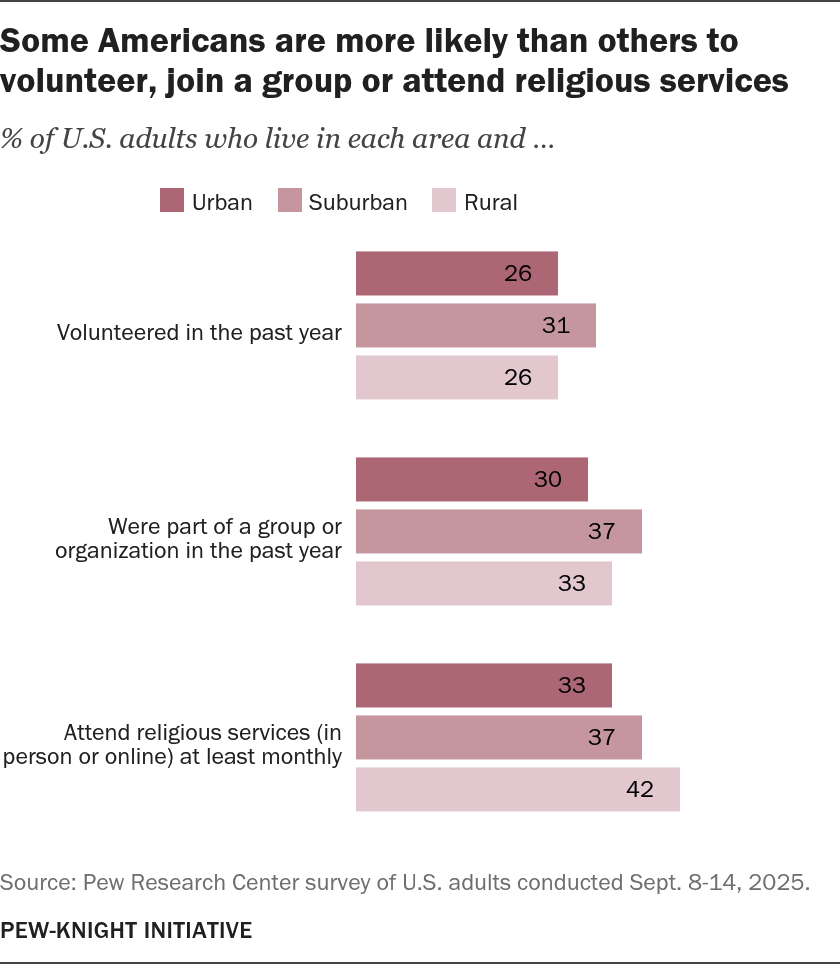
Some Americans are more likely than others to volunteer, join a group or attend religious services
% of U.S. adults who live in each area and …
Source: Pew Research Center survey of U.S. adults conducted Sept. 8-14, 2025.
PEW-KNIGHT INITIATIVE
Some Americans are more likely than others to volunteer, join a group or attend religious services
% of U.S. adults who live in each area and …
| Activity | Urban | Suburban | Rural |
|---|---|---|---|
| Volunteered in the past year | 26 | 31 | 26 |
| Were part of a group or organization in the past year | 30 | 37 | 33 |
| Attend religious services (in person or online) at least monthly | 33 | 37 | 42 |
Source: Pew Research Center survey of U.S. adults conducted Sept. 8-14, 2025.
PEW-KNIGHT INITIATIVE
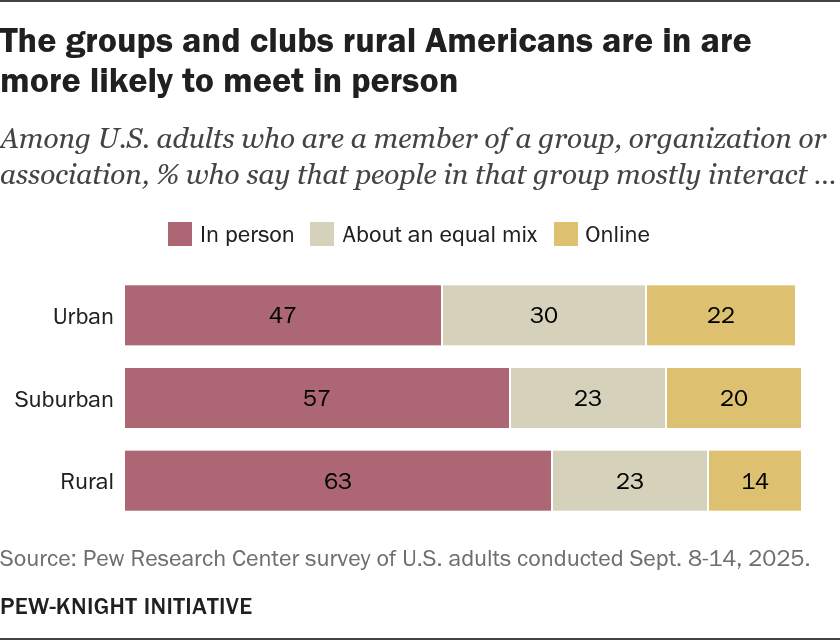
Suburban Americans are slightly more likely than those living in urban or rural areas to have volunteered in the past year and to be a part of a group or organization. But the groups rural Americans belong to are more likely than urban Americans’ groups to interact mostly in person, rather than mostly online or through an equal mix of the two. And urban Americans are more likely than rural Americans to say their groups meet mostly online.
(Even though rural residents are slightly older than urban residents, these differences persist across age groups.)
The groups and clubs rural Americans are in are more likely to meet in person
Among U.S. adults who are a member of a group, organization or association, % who say that people in that group mostly interact …
Source: Pew Research Center survey of U.S. adults conducted Sept. 8-14, 2025.
PEW-KNIGHT INITIATIVE
The groups and clubs rural Americans are in are more likely to meet in person
Among U.S. adults who are a member of a group, organization or association, % who say that people in that group mostly interact …
| Community type | In person | About an equal mix | Online |
|---|---|---|---|
| Urban | 47 | 30 | 22 |
| Suburban | 57 | 23 | 20 |
| Rural | 63 | 23 | 14 |
Source: Pew Research Center survey of U.S. adults conducted Sept. 8-14, 2025.
PEW-KNIGHT INITIATIVE
Rural Americans are more religious overall than those who live in cities and suburbs, so it’s not surprising that they also tend to be more religiously engaged. They are more likely to attend religious services, whether in person or online: 42% of rural Americans say they do this at least monthly, compared with 37% of those in suburban areas and 33% of those in urban areas. Rural Americans are also more likely to say they pray several times a day.
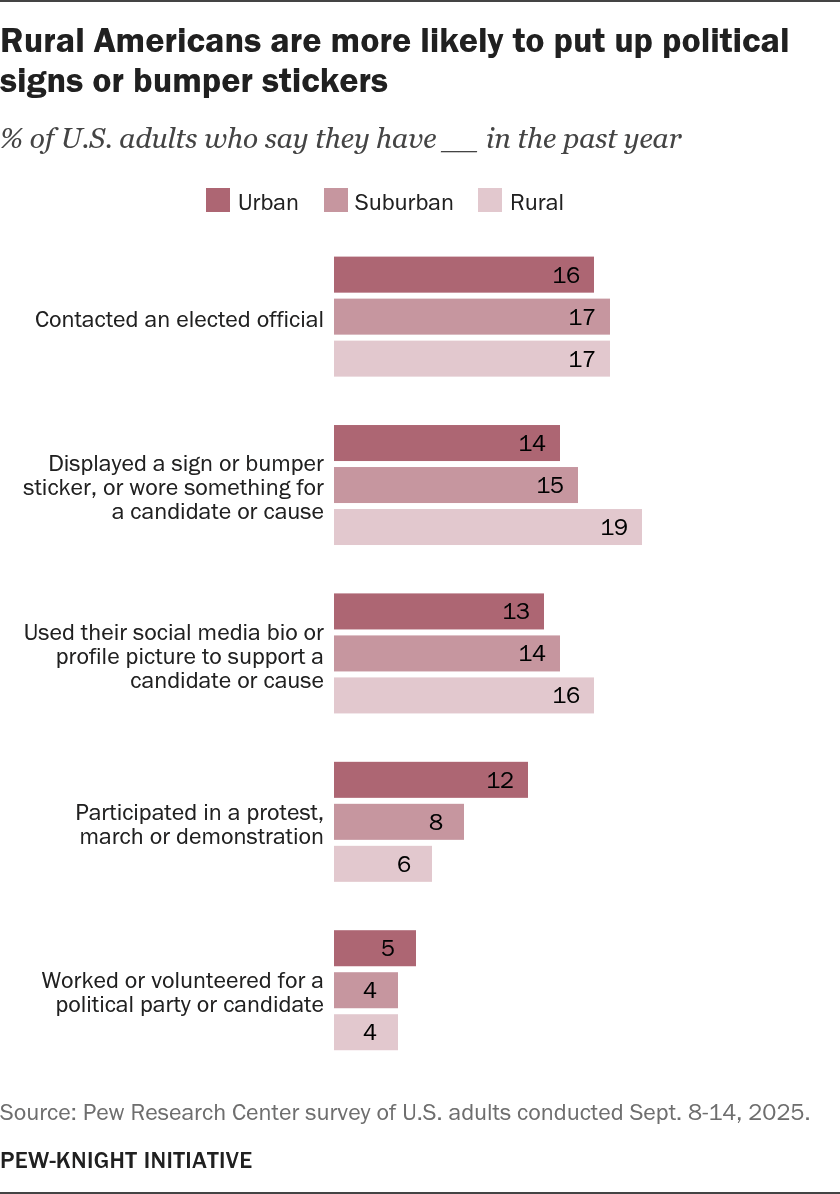
Political engagementAmericans in urban, suburban and rural areas are about equally likely to be politically active. About a third in each group have taken at least one of five political actions we asked about. But the likelihood of taking specific actions differs depending on where they live.
Rural Americans are more likely to put up political signs or bumper stickers
% of U.S. adults who say they have __ in the past year
Source: Pew Research Center survey of U.S. adults conducted Sept. 8-14, 2025.
PEW-KNIGHT INITIATIVE
Rural Americans are more likely to put up political signs or bumper stickers
% of U.S. adults who say they have __ in the past year
| Activity | Urban | Suburban | Rural |
|---|---|---|---|
| Contacted an elected official | 16 | 17 | 17 |
| Displayed a sign or bumper sticker, or wore something for a candidate or cause | 14 | 15 | 19 |
| Used their social media bio or profile picture to support a candidate or cause | 13 | 14 | 16 |
| Participated in a protest, march or demonstration | 12 | 8 | 6 |
| Worked or volunteered for a political party or candidate | 5 | 4 | 4 |
Source: Pew Research Center survey of U.S. adults conducted Sept. 8-14, 2025.
PEW-KNIGHT INITIATIVE
People in rural areas are more likely than those in urban areas to display signs or bumper stickers, regardless of party.
Americans living in urban areas, on the other hand, were more likely to have attended a march or protest in the year leading up to our survey. This is because more Democrats live in urban areas, and Democrats were more likely to have taken part in a march or protest than Republicans during that time period. The survey was fielded in September 2025, a few months after several “No Kings” protests against the Trump administration took place around the country.
Note: Here are the survey questions used for this analysis, the detailed responses and the methodology.
| # | Наименование новости | Тональность | Информативность | Дата публикации |
|---|---|---|---|---|
| 1 | Trump’s immigration crackdown divides rural voters as midterms approach, AP-KFF poll finds | 0 | 8.6 | 05-10-2026 |
| 2 | Lifelong Latter-day Saints are more religious than both former members and converts | 0 | 8.84 | 22-09-2026 |
| 3 | From cash to credit, how Americans’ payment methods have changed in the past decade | 0 | 12.24 | 30-09-2026 |
| 4 | Report: 9 of the top 10 best places to live in the US are red states | 0 | 10.91 | 22-05-2026 |
| 5 | Rural voters support MAHA movement, but feel little impact, poll finds | 0 | 8.36 | 30-09-2026 |
| 6 | Nine out of top 10 cities to live in the US in red states as new report reveals the one bearable Democrat-run enclave | 0 | 10.97 | 22-05-2026 |
| 7 | Americans reveal the places they’re sick of seeing pets: survey | 0 | 8.54 | 11-09-2026 |
| 8 | Latter-day Saints are highly religious, though not uniformly so | 0 | 7.27 | 22-09-2026 |
| 9 | A Five-Year ‘Rollercoaster’ for Urban Growth | 0 | 11.04 | 15-09-2026 |
| 10 | How To Vote from Spain as an American | 0 | 17.47 | 03-09-2026 |