Просмотр новости
Найдите то, что Вас интересует
 Спутники
 РН
РН SpaceX
 Роскосмос
 NASA
NASA
СпутникиРНSpaceXРоскосмосNASAThe post How to Use CI & NE in Italian: 6 Cheat Codes You Need appeared first on The Intrepid Guide
CI and NE are two tiny Italian words that can replace almost anything you say. They’re so versatile that Italians…
The post How to Use CI & NE in Italian: 6 Cheat Codes You Need appeared first on The Intrepid Guide.
The Intrepid Guide contains affiliate links. At no cost to you, I will earn a commission which helps reduce the ever-increasing costs of keeping this site active. Thank you for your support.
CI and NE are two tiny Italian words that can replace almost anything you say. They’re so versatile that Italians use them all the time. But textbooks often overcomplicate them, leaving you more confused than before.So, in this guide, I’ll show you six cheat codes that reveal exactly when to use each one, plus the ONE place you should never put them and what to do instead.
Pronti? Iniziamo!
Keep practising!
The 6 Cheat Codes you NEED to Master CI & NE in Italian
(Free PDF Cheat-Sheet)
Don't let the learning stop here. Download your free PDF guide with 6 cheat codes to finally master CI and NE. Includes BONUS tips and quiz. Impariamo insieme! (Let's learn together!)
I promise not to spam you. You can unsubscribe at any time.
Invalid email address
CI and NE are tiny Italian words that replace information you’ve already mentioned, so you don’t have to repeat yourself. The key is not to ask “What do they mean?” but “What are they replacing?”
Word order: With a normal conjugated verb, CI and NE usually go before the verb: Ci penso, Ne parlo. With an infinitive, they can either go before the conjugated verb or attach to the infinitive: Ne voglio parlare or Voglio parlarne.
The biggest shortcut: Use CI when you are replacing a place, idea, situation or “us”. Use NE when you are replacing di + something or talking about a quantity of something already mentioned.
First, there’s one thing you need to know about CI and NE, because if you don’t understand this, none of these cheat codes will help you speak more confidently without second-guessing yourself.
Most learners ask: “What does CI mean? What does NE mean?” But they don’t have just ONE meaning in English. And that’s exactly what makes them so incredibly versatile and why Italians use them so often.
Think of them as handy linguistic shortcuts. Instead of repeating a whole phrase or object you already mentioned, you use CI and NE to replace entire parts of a sentence and avoid needless repetition.
We do this in English too with words like “it”, “there” and “some”.
For example:
Are you going to Marco’s place tonight? Yes, I’m going there.
You don’t have to say, “Yes, I’m going to Marco’s place tonight.” “There” does all the work for us.
CI and NE are called pronominal particles, and this is exactly what they do. They stand in for something already mentioned.
On their own, they don’t have one fixed meaning. It’s the context around them that gives them meaning.
So, instead of asking, “What do they mean?” ask:
“What are they REPLACING?”
Once you know what they’re replacing, choosing between them becomes much easier.
Attenzione! NE without an accent is the pronominal particle we’re learning in this lesson. But NÉ with an accent is a completely different word and means “neither” or “nor”.
For example:
Non mangio né carne né pesce. — I eat neither meat nor fish.
Now let me show you the six cheat codes to master CI and NE.
1. Use CI in Italian to Replace a PlaceThe first cheat code will help you sound more natural and less like a robot repeating the same words.
Imagine asking a friend:
Sei mai stata a Firenze? — Have you ever been to Florence?
Instead of her saying:
Sì, sono stata a Firenze tre volte. — Yes, I have been to Florence three times.
She answers:
Sì, ci sono stata tre volte. — Yes, I’ve been there three times.
A Firenze has been replaced with CI.

So, cheat code number one is: CI replaces a place that’s already been mentioned.
Here’s how to remember it: the C in CI reminds you of City, and a city is a PLACE.

That place is usually introduced by the prepositions a, in, su or da.
So the rule isn’t “CI means there”. It’s that CI can replace a place already introduced by prepositions such as a, in, su or da.
CI → City → a place.
Are you enjoying this lesson? Don’t let the learning stop here. Make sure you download your free PDF cheat-sheet for this lesson, which includes 6 BONUS tips to master CI and NE, plus a quiz to practise what you’ve learned. To get your copy, enter your email below.
Keep practising!
The 6 Cheat Codes you NEED to Master CI & NE in Italian
(Free PDF Cheat-Sheet)
Don't let the learning stop here. Download your free PDF guide with 6 cheat codes to finally master CI and NE. Includes BONUS tips and quiz. Impariamo insieme! (Let's learn together!)
I promise not to spam you. You can unsubscribe at any time.
Invalid email address
Next, I’ll share the cheat code that helps when you go blank mid-sentence because you don’t know how to say “it” without repeating yourself.
Imagine your friend tells you her plan to quit her job and move to Italy. Later, she asks:
Hai pensato al mio piano? — Have you thought about my plan?
You could answer:
Sì, ho pensato al tuo piano. — Yes, I’ve thought about your plan.
But you’re repeating information you both already know. Instead, you can say:
Sì, ci ho pensato. — Yes, I’ve thought about it.
Al tuo piano has disappeared. CI has taken its place again, but this time it’s not a physical place.

So, cheat code number two is: CI can also replace an idea, plan or situation that’s already been mentioned.
Here’s how to remember it: the first two letters of CIrcumstance are CI. CI = CIrcumstance.

You’ll see this with verbs followed by prepositions such as prepositions a, in or su.
This next cheat code fixes one of the most common mistakes, because getting it wrong changes who you’re talking about.
Imagine you want to say, “My parents are visiting us this weekend.”
You might translate it word for word:
I miei genitori visitano noi questo weekend.
While this is possible for emphasis, it sounds unnatural as the neutral way to say the sentence. Instead, Italians would normally say:
I miei genitori ci visitano questo weekend. — My parents are visiting us this weekend.
Noi has disappeared. CI has taken its place again, but this time it’s not a place or an idea.

So, cheat code number three is: CI can also mean us.
Here’s how to remember it: think of CI here as CIrcling back to us. CI = Us.

CI can cover three different jobs here: a direct object, where the action happens to us; an indirect object, where something is done to or for us; and a reflexive pronoun, where we do something to ourselves.
So, if CI is standing in for us in any of these three ways, remember: CI = Us.
4. Use NE in Italian to Replace DI + SomethingThis next cheat code solves one of the most common mistakes learners make, and there’s a simple clue hidden in plain sight that reveals exactly which of these two words you should use.
Imagine someone asks:
Hai bisogno di aiuto? — Do you need help?
You could repeat the whole thing:
Sì, ho bisogno di aiuto. — Yes, I need help.
Instead, Italians can say:
Sì, ne ho bisogno. — Yes, I need it.
Di aiuto has disappeared. NE has taken its place.

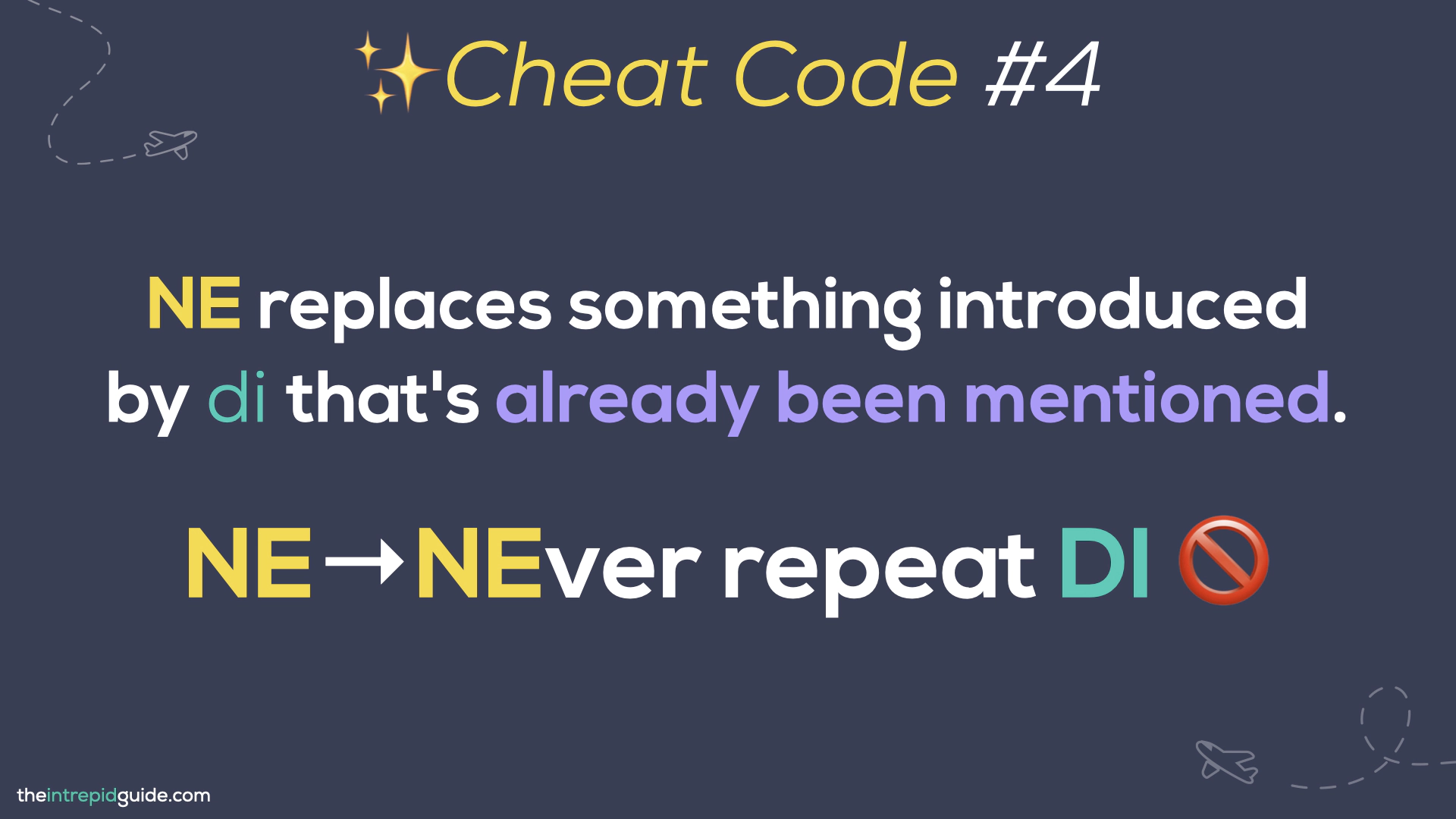
So, cheat code number four is: NE replaces something introduced by di that’s already been mentioned.
Here’s how to remember it: the first two letters of NEver are NE.
NE = NEver repeat DI.
So whenever you hear a verb or expression followed by di, ask yourself: has that di + something already been mentioned? If yes, NE can often replace it.
This next cheat code is especially useful when ordering, shopping or talking about amounts. It’ll help you sound much more natural because, without NE, some answers can sound incomplete to Italian ears.
Imagine someone asks:
Quanti cornetti vuole? — How many croissants would you like?
You want one of them. You could repeat the whole thing:
Voglio un cornetto. — I want one croissant.
Instead, Italians can say:
Ne voglio uno. — I want one of them.
Cornetto has disappeared. NE has taken its place.

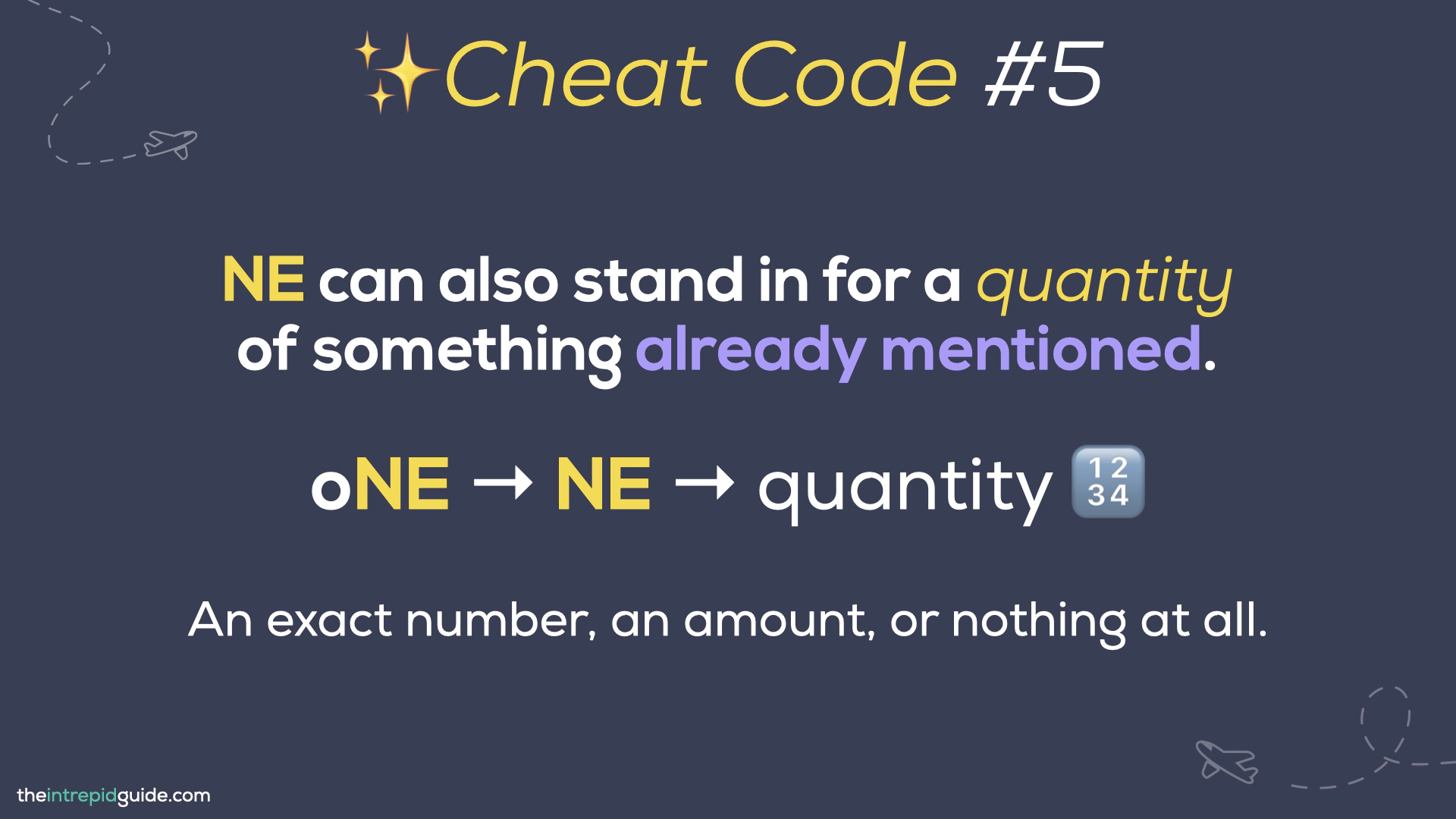
So, cheat code number five is: NE can stand in for a quantity of something already mentioned.
Here’s how to remember it: NE is hiding inside the English word oNE.
oNE → NE → quantity.
You can use it with an exact number, an amount, or no stated quantity at all.
So whenever you’re talking about how many or how much of something already mentioned, remember: oNE → NE → quantity.
Are you enjoying this lesson? Don’t let the learning stop here. Make sure you download your free PDF cheat-sheet for this lesson, which includes 6 BONUS tips to master CI and NE, plus a quiz to practise what you’ve learned. To get your copy, enter your email below.
Keep practising!
The 6 Cheat Codes you NEED to Master CI & NE in Italian
(Free PDF Cheat-Sheet)
Don't let the learning stop here. Download your free PDF guide with 6 cheat codes to finally master CI and NE. Includes BONUS tips and quiz. Impariamo insieme! (Let's learn together!)
I promise not to spam you. You can unsubscribe at any time.
Invalid email address
This next cheat code will save you from trying to translate Italian word for word and ending up even more confused. Once you understand this, you’ll start recognising some of the most useful everyday Italian expressions.
Take this sentence:
Quanto tempo ci vuole? — How long does it take?
The verb looks like volere, which means “to want”. But the expression used here is actually volerci, which means “to take” or “to be needed”.
If you try to translate it piece by piece, the sentence doesn’t make much sense.
So, cheat code number six is: some verbs have CI or NE built into them, and the meaning can change significantly from the original verb.
These are called pronominal verbs. The best strategy is to learn them as complete expressions rather than trying to translate each individual piece.
There are lots of common pronominal verbs with CI and NE. Here are some you’ll hear frequently:
| Pronominal Verb | Meaning | Example |
|---|---|---|
| volerci | to take / be needed | Quanto tempo ci vuole? — How long does it take? |
| metterci | to take a certain amount of time | Ci metto dieci minuti. — It takes me ten minutes. |
| tenerci | to care about something | Ci tengo molto. — I care about it a lot. |
| starci | to be up for it / agree | Ci stai? — Are you in? |
| provarci | to try / give it a try | Ci provo. — I’ll try. |
| andarsene | to leave / go away | Me ne vado. — I’m leaving. |
| non poterne più | to not be able to take it anymore | Non ne posso più. — I can’t take it anymore. |
| valerne la pena | to be worth it | Ne vale la pena. — It’s worth it. |
The important thing is to treat these verbs as idiomatic expressions and learn each one as a fixed phrase.

Now I’ll show you where CI and NE go in a sentence and the one position you should avoid.
You now know six cheat codes for CI and NE. But knowing which word to use is only half the job. You also need to know where it goes.
Before the verb? After the verb? Attached to it?
With a normal conjugated verb, CI and NE normally go BEFORE the verb.

But with an infinitive, such as after volere, potere or dovere, you have two choices.
1. You can put CI or NE before the conjugated verb:

2. Or you can attach it to the end of the infinitive. When you do this, the final -e of the infinitive disappears:

Both are correct.
CI and NE can also attach to affirmative commands and gerunds:
And here’s the one place they can NEVER go: separately after the verb with nothing attached.
| Incorrect | Correct |
|---|---|
| Vado ci. | Ci vado. — I go there. Vado lì. — I go there. |
| Parlo ne. | Ne parlo. — I talk about it. |
| Use | CI or NE? | Cheat Code | Example |
|---|---|---|---|
| Replace a place | CI | CI → City → Place | Ci vado. — I go there. |
| Replace an idea or situation | CI | CI → CIrcumstance | Ci penso. — I think about it. |
| Replace “us” | CI | CI → CIrcling back to us | Ci adora. — He/she adores us. |
| Replace DI + something | NE | NE → NEver repeat DI | Ne parlo. — I talk about it. |
| Replace a quantity | NE | oNE → NE → Quantity | Ne voglio due. — I want two of them. |
| Pronominal verbs | CI / NE | Learn the whole expression as one unit | Ci vuole. / Ne vale la pena. |
Even though you now know these cheat codes for CI and NE, none of it matters if you can’t put together the sentences you’re using them in. So read this guide next, where I’ll show you the ONLY 3 Italian tenses you need to speak Italian.
 Are you a beginner or an intermediate Italian learner? Got a trip coming up or want to communicate with your Italian partner or relatives in Italian? Learn Italian with my unique 80/20 method
Registrations are now open to join Intrepid Italian, my new series of online video courses that use my unique 80/20 method. You’ll go from a shy, confused beginner to a proficient and confident intermediate speaker, with me as your trusty guide.
You’ll finally be able to connect with your Italian partner, speak to your relatives and enjoy authentic travel experiences in Italy that you’ve always dreamed of, and so much more.
As a native English speaker who learned Italian as an adult, I know what it’s like to feel hopeless and lack the confidence to speak. I know what it’s like to start from scratch and to even go back to absolute basics and learn what a verb is!
Intrepid Italian was created with YOU in mind. I use my working knowledge of the English language to help you get into the ‘Italian mindset’ so you can avoid the common pitfalls and errors English speakers make – because I made them once too! I break everything down in such a way that it ‘clicks’ and just makes sense.
No matter what your level is, there is an Intrepid Italian course for you, including:
You can join 1, 2, 3 or all 4 courses, it’s entirely up to you. The best part is that you have lifetime access so you learn anytime, anywhere and on any device.
As your guide, I walk you through each lesson, step-by-step, using my unique 80/20 method. My approach is different from traditional methods because I teach you the most important 20% of the language right from the beginning so you can start to speak straight away.
Each course includes video lessons, audio exercises, downloadable worksheets, bonus guides, a private support community, and lifetime access all designed to streamline your learning while having fun.
It even comes with my famous “Celebrate with a Spritz Guarantee”. After 30 days of using Intrepid Italian, if you don’t want to celebrate your new-found Italian skills with an Aperol Spritz, you don’t have to pay a penny! Cheers! 🥂 Join Intrepid Italian here and start learning today! Ci vediamo lì! (chee veh-DYAH-moh lee) (See you there!)
Like it? Pin it for later!

Did you enjoy this lesson? Do you have a question? Let me know using the comments section below or join me on social media @intrepidguide or @intrepiditalian to start a conversation.
Thanks for reading and I hope you enjoyed this post.
Like what you see? Subscribe using the form below to have all of my posts delivered directly to your email.
| # | Наименование новости | Тональность | Информативность | Дата публикации |
|---|---|---|---|---|
| 1 | Italian Cognates: Steal THIS Cheat Code to Learn Italian Fast | 0 | 4.53 | 26-08-2026 |
| 2 | Italian Articles: 7 Cheat Codes to Choose the Right One Every Time | 0 | 6.41 | 26-08-2026 |
| 3 | Italian Compound Words: The ONE Trick That Makes Them Impossible to Forget | 0 | 5 | 01-10-2026 |
| 4 | 6 Italian Grammar Rules Beginners Can Ignore (and Still Sound Natural) | 0 | 5.43 | 01-10-2026 |
| 5 | 7 Italian Phrases You Need to Speak Without Freezing | 0 | 5.67 | 26-08-2026 |
| 6 | The ONLY 3 Italian Verb Tenses You Need To Speak Italian | 0 | 6.29 | 26-08-2026 |
| 7 | Come pubblicare un libro: tutte le strade e i costi reali | 0 | 6.66 | 28-09-2026 |
| 8 | CARBURANTI: effetto Eni, prezzi calano, ma molto poco | 0 | 12.2 | 28-09-2026 |
| 9 | ENI: tetto al prezzo dei carburanti e cosa cambia per i consumatori | 0 | 3.57 | 28-09-2026 |
| 10 | Here are the best Italian wine launches to look out for this autumn | 0 | 7.09 | 21-09-2026 |