Просмотр новости
Найдите то, что Вас интересует
 Спутники
 РН
РН SpaceX
 Роскосмос
 NASA
NASA
СпутникиРНSpaceXРоскосмосNASAPlus, the Second Amendment Foundation's Bill Sack explains a new settlement the group got over an illegal gun search of a high schooler's car on the podcast.
Gun businesses have achieved their first injunction against a sales ban on one of the most popular pistol types in the country.
After an early setback in the fight against California’s version of the ban a few months back, Glock and its allies secured a preliminary block on Connecticut’s iteration this week. A federal judge ruled the ban likely does violate the Second Amendment. I explain for Reload Members what he saw that the California judge didn’t.
Then Reload Contributor Julie Miller explains how Flock cameras have become a growing concern among gun-rights activists nationwide. I detail how a recent New York Times piece on AR-15s exemplifies one of the biggest problems with major media gun coverage as well as what’s causing it. And gun-rights lawyer Kostas Moros details how history casts doubt on the constitutionality of special taxes on common guns.
Plus, the Second Amendment Foundation’s Bill Sack explains a new settlement the group got over an illegal gun search of a high schooler’s car on the podcast. And we have a bunch more stories down in the links, including a new conviction stemming from a pay-for-play scheme under California’s old may-issue gun-carry permitting law.
 Glock Perfection display table at the 2022 NRA Annual Meeting / Stephen Gutowski
Federal Judge Temporarily Blocks Connecticut ‘Glock Ban’
By Alejandra O’Connell-Domenech
A judge just enjoined a law restricting the sale of popular semi-automatic pistols that critics claim can be too easily converted into machine guns, hours before it was set to take effect.
US District Judge Kari A. Dooley issued a preliminary injunction Wednesday against Connecticut’s Public Act 26-41. She found plaintiffs in two lawsuits challenging the law were likely to succeed on their Second Amendment claims. The law was scheduled to take effect on Thursday, but won’t go into effect unless and until the injunction is lifted.
“The statute is presumptively unconstitutional, and Defendants have not met their burden of demonstrating that the statute is consistent with our nation’s history of firearms regulation,” Judge Dooley wrote in Glock v. Griffin.
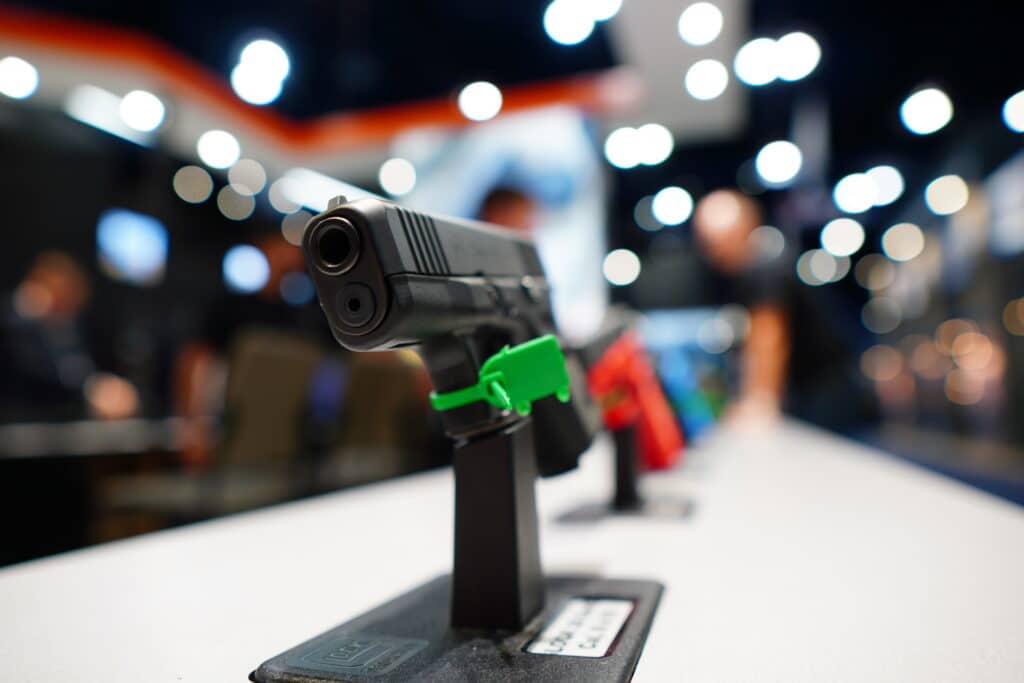 A Glock pistol on display at the 2022 NRA Annual Meeting / Stephen Gutowski
Analysis: Why Connecticut’s ‘Glock Ban’ Was Blocked After California’s Wasn’t [Member Exclusive]
By Stephen Gutowski
A federal judge has issued the first injunction against a “Glock ban” just a few months after another declined to do so.
On Wednesday, US District Judge Kari A. Dooley issued a preliminary injunction against Connecticut’s Public Act 26-41. That comes about two and a half months after US District Judge Monica Ramirez Almadani decided against granting a temporary restraining order against California’s Assembly Bill 1127. The two laws are nearly identical, as are the arguments in the two suits.
So, what were the key differences in the two rulings?
If you’re a Reload Member, click here to read the rest. If not, buy a membership today for exclusive access!
 Photo by Giant Asparagus on Pexels
Gun Advocates Raise Alarm Over Flock Cameras
By Julie Miller
The increasing prevalence of surveillance cameras, especially the automated license plate readers operated by Flock Safety and its competitors, has raised privacy concerns across the country. The concern is not limited to gun owners, but many are particularly worried about cameras at gun ranges and gun shops that have the potential to track them specifically–possibly even to create de facto registries of gun owners.
The cameras don’t only record license plates, notes Taylor Rhodes, executive director and vice president of the National Association for Gun Rights. “They log make, color, body type, any accessories you have on your vehicle…it tracks bumper stickers,” he told The Reload. “How many gun group stickers are on the back of cars? How many Glock stickers are on trucks?”
“The state can ask for everyone who has been to this shooting range, this gun store,” he said, and then “they have a de facto list of gun owners.”
 Pistols on sale at a 2023 gun show in Virginia / Stephen Gutowski
Analysis: History Shows There’s No Tradition of Special Taxes on Common Guns
By Konstadinos Moros
Governor Gavin Newsom (D.) has called it a “sin tax.”
Recently, California layered an 11% retail excise tax on top of ordinary sales tax for firearms, precursor parts, and ammunition. Colorado followed with a 6.5% version. Both sit beside the longstanding federal Pittman-Robertson manufacturer’s excise tax (11% on most firearms, 10% on handguns), and California’s already expensive firearm transfer fees.
For these sorts of taxes to survive under the Supreme Court’s Second Amendment test from New York State Rifle & Pistol Association v. Bruen, the government must show a special tax on common firearms comports with our Nation’s historical tradition of firearm regulation.
A close look at that tradition, from the colonial period through 1900, shows the opposite: this country did not build a habit of singling out common firearms and ammunition for special taxes.

Podcast: High School Admits Gun Search Was Clearly Illegal (Ft. SAF’s Bill Sack)
By Stephen Gutowski
This week, we’re looking at a Fourth Amendment case out of New Hampshire.
To do that, we have the Second Amendment Foundation’s (SAF) Bill Sack with us to describe how his group secured a settlement with Hillsboro-Deering High School over the search of a student’s car. He said school officials decided to search then-18-year-old Jack Harrington’s car for a gun despite not having permission or a good reason to believe there was one inside.
Sack said the officials concluded Harrington might have a gun because he’d told a friend on the baseball team about a traffic stop that had happened more than a week earlier. Harrington described how he’d been pulled over while legally carrying his pistol, and the stop went forward without issue. He wasn’t arrested or charged or even accused of doing anything illegal, and the stop didn’t happen near the school.
Sack said school officials pulled Harrington from class to demand permission to search his car after hearing about the traffic stop. He said they did not have any reason to think Harrington had brought the gun to school or any accusation that he’d made any threats to the school. Still, they pressed him to search his car.
Harrington refused to give permission for the search, but the school officials conducted it anyway. Sack said they found there was no gun in the car. That’s where the SAF suit came in. They helped Harrington sue, alleging the school violated his Fourth Amendment rights. The school settled and admitted the search was illegal, which Sack said SAF plans to use as a bulwark against similar situations around the country.
You can listen to the show on your favorite podcasting app or by clicking here. Video of the episode is available on our YouTube channel. An auto-generated transcript is available here. Reload Members can listen on Sunday, as always. Everyone else can listen on Monday.
Plus, in a shortened and early update, I detail the Ninth Circuit’s decision to uphold novel Hawaiian gun-buying restrictions by using a “carve-out” it identified in the Supreme Court’s Bruen decision. Then I explain the latest poll to look at what Americans think the Supreme Court should do in its upcoming AR-15 case. I also discuss an interesting argument that the Court should look at Revolutionary-Era privateers for answers on that case. And I cover the Department of Justice’s new opinion on handgun sales to 18-to-20-year-olds.
 The New York Times headquarters / Photo by David Smooke on Unsplash
Analysis: New York Times Gun Reporting Mistakes Indicative of Industry Issue [Member Exclusive]
By Stephen Gutowski
A recent piece from The New York Times is a good example of what major media outlets get wrong when covering guns and why.
It’s not the most egregious piece I’ve seen, and it doesn’t make the most mistakes I’ve seen in a major media piece. It doesn’t rise to the level of “full semi-auto” or the chainsaw bayonet. But it does encapsulate many of my long-running critiques of the journalism industry, including the ones I spoke about this weekend during AMM-Con.
The piece, titled Tracking Assault Weapons Bans Across the Country, was published last Saturday. As the name implies, the thrust of the piece details how many “assault weapons” bans exist ahead of the Supreme Court’s Viramontes v. Cook County case that’s set to decide their fate by next summer. It gets that basic count right, at least.
However, the piece has numerous assertions that are either dubious or outright false.
If you’re a Reload Member, click here to read the rest. If not, buy a membership today for exclusive access!
Outside The Reload
DOJ Now Targeting Another Bizarre California Gun Law | Bearing Arms | By Cam Edwards
Carrying Care | Vital City | By Margaret Kelley
Queens Without Castles | Vital City | By Michael R. Ulrich
The Recent Rise of Women Gun Owners | Vital City | By Rosanna Smart & Andrew R. Morral
How Do You Count Guns When No One Is Keeping Track? | Light Over Heat | By David Yamane
That’s it for this week in guns.
I’ll see you all next week.
Thanks,
Stephen Gutowski
Founder
The Reload