Просмотр новости
Найдите то, что Вас интересует
 Спутники
 РН
РН SpaceX
 Роскосмос
 NASA
NASA
СпутникиРНSpaceXРоскосмосNASAIn the TMA Method, Motives indicate what pushes a person to perform in a professional environment. It specifically looks at their "engine" for growth: Do they want to be recognized (Status), do they want to do different things (Variety), or do they just want to win (Ambition)? Drives vs. Motives Psychological research shows that [...]
In the TMA Method, Motives indicate what pushes a person to perform in a professional environment. It specifically looks at their “engine” for growth: Do they want to be recognized (Status), do they want to do different things (Variety), or do they just want to win (Ambition)?
Drives vs. MotivesPsychological research shows that Drives are the building blocks of personality. In other words, drives define personality. Drives have a major influence on people’s behavior and (potential) development. The TMA Assessment measures 22 research-based Drives to define personality and measure individual talents. Talents are determined based on a person’s need or preference for each drive. The 22 talents are grouped into six Dimensions, one of which is Motives.
You can think of Drives as the person’s “DNA,” while the Motives Dimension is the specific “Current” that directs that DNA toward specific career goals. The ‘Motives’ dimension within the TMA assessment specifically measures an individual’s core drives related to need for status, variety, and ambition and challenges. This dimension consolidates these three specific concepts into a single category to give a broader picture of what compels someone to succeed and find satisfaction at work.
As a measurement component, the Motives dimension is defined by three scales:
| Component | Definition as a Measurement |
|---|---|
| Need for Status | Measures the extent to which a person needs to be held in high esteem and desires recognition for their work. |
| Variety | Measures the extent to which a person needs change, new environments, and diverse tasks versus routine. |
| Ambition & Challenges | Measures the extent to which a person is competitive, looks for challenges, and strives for success. |
Individual talents in each of these areas strongly influence team dynamics. Managers who understand how these talents work together can better leverage the strengths of their team members to drive success.
Example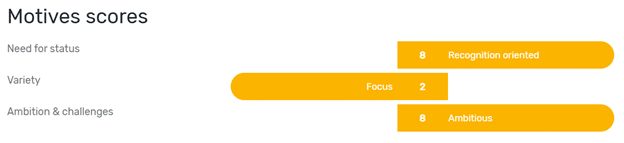
Understanding Motives and the drives of Status, Variety, and Ambition is the key to unlocking sustainable performance. Because these represent a person’s inner “why,” they act as the fuel for long-term engagement.
| Modest | Need for Status The extent to which the person needs to be held in high esteem and desires recognition for work and achievements. | Recognition Oriented |
In the TMA Method, the Need for Status is a drive that measures the extent to which an individual needs to be held in high esteem and desires recognition for their work and achievements.
It is not a measurement of “arrogance,” but rather how a person derives their sense of value and how they prefer to be perceived by the outside world. This drive results in two distinct talent poles: Modest (low score) and Recognition Oriented (high score).
Below is an explanation of these talents, their characteristics, and their potential pitfalls:
1. The “Modest” Talent (Low Score)Individuals with this talent do not have a strong need to be in the spotlight. They are often content letting the results of their work speak for themselves and do not require external titles or public accolades to feel successful.
Individuals with this talent have a high Need for Status. They value being seen as successful, professional, and high-achieving. They are often very conscious of their reputation and the “image” they project to others.
Understanding where a team member falls on the Need for Status scale allows a leader to provide the right kind of feedback:
| Focus | Variety The extent to which the person needs variety and fresh perspectives. | Diverse |
In the TMA Method, Variety is the drive that measures the extent to which an individual needs change, new environments, and diverse tasks versus a predictable, stable routine.
This drive identifies how much “newness” a person requires to stay energized. Within the Motives dimension, this results in two distinct talents: Focus (low score) and Diverse (high score).
1. The “Focus” Talent (Low Score)Individuals with the Focus talent prefer a high degree of predictability. They gain energy from diving deep into specific topics and prefer to finish one task thoroughly before moving on to the next.
Individuals with the Diverse talent have a high need for Variety. They are energized by new projects, different people, and changing environments. They often find repetitive work soul-crushing.
A leader’s greatest success is pairing individuals with Focus and Diverse talents. Manage the “hand-off” by having the Diverse talent scout for new opportunities or design the initial prototype, and then having the Focus talent take over to refine the details and ensure long-term stability. This prevents the Diverse person from getting bored and the Focus person from feeling overwhelmed by the initial chaos.
Keys for managing Focus and Diverse talents:| Management Action |
For the Focus Talent | For the Diverse Talent |
|---|---|---|
| Delegation | Give one large, deep task. | Give three different, shorter tasks. |
| Meetings | Provide a clear agenda in advance. | Encourage brainstorming and "what if" scenarios. |
| Feedback | Praise their accuracy and persistence. | Praise their adaptability and resourcefulness. |
| Change | "We are refining the current plan." | "We are starting a brand new approach." |
| Satisfied | Abition & Challenges The extent to which the person wants to succeed, seeks challenges, and thrives on competition. | Abitious |
In the TMA Method, the Ambition & Challenges drive measures the extent to which a person is competitive, looks for challenges, and is willing to strive for success. This drive determines a person’s “internal motor” for achievement and whether they are driven by the pursuit of the goal itself or by the stability of their current situation. Within the Motives dimension, this drive produces two talent poles: Satisfied (low score) and Ambitious (high score).
1. The “Satisfied” Talent (Low Score)Individuals with this talent are generally content with the current state of affairs. They do not feel a constant internal pressure to “win” or to constantly climb to the next level. They value a healthy work-life balance and stability.
Individuals with this talent are naturally competitive and goal-oriented. They gain energy from overcoming obstacles, hitting targets, and being “the best.”
A leader’s success depends on balancing the high-octane energy of the achiever with the reliable stability of the satisfied employee.
How to Lead “Satisfied” Talents:In the modern workplace, sustainable performance isn’t just about what employees can do, but what they are naturally driven to do. The TMA Method defines the Motives dimension through three core pillars: Need for Status, Variety, and Ambition & Challenges. These drives act as the internal “engine” of an individual, determining how they seek recognition, respond to change, and pursue goals. By moving beyond surface-level skills and tapping into these intrinsic forces, organizations can move from a culture of compliance to one of true engagement. Understanding these talents allows for a sophisticated approach to professional development that benefits everyone from the individual contributor to the executive suite.
1. For the Individual: Self-Management & EnergyFor an individual, knowing your motives is about alignment. If you have a high need for Variety but are stuck in a repetitive administrative role, you will eventually experience “bore-out.”
A team is a collection of diverse “engines.” If a team understands each other’s motives, they can move from friction to synergy.
For a leader, motives are the “remote control” for employee engagement. You cannot motivate everyone the same way.
Ultimately, the power of the Motives dimension lies in its ability to turn human diversity into a strategic advantage. When an organization honors the distinction between a Modest specialist and a Recognition-focused leader, or balances the steadiness of Focus with the agility of Diverse thinkers, it creates a more resilient and empathetic work environment. By applying these insights, leaders can move away from one-size-fits-all management and instead build “job-crafted” roles where employees don’t just work but thrive. Leveraging these talents is the final step in creating an organization that is happy and performing.
Recent Posts