Просмотр новости
Найдите то, что Вас интересует
 Спутники
 РН
РН SpaceX
 Роскосмос
 NASA
NASA
СпутникиРНSpaceXРоскосмосNASABRASILIA (VINnews) — Brazil’s Superior Electoral Court has rejected a request to extend voting hours in the country’s October 4 general election, which falls during the Jewish holiday of Simchat Torah, meaning observant Jewish voters will be unable to cast their ballots during the regular voting period. The petition was filed about four months ago […]
BRASILIA (VINnews) — Brazil’s Superior Electoral Court has rejected a request to extend voting hours in the country’s October 4 general election, which falls during the Jewish holiday of Simchat Torah, meaning observant Jewish voters will be unable to cast their ballots during the regular voting period.
Subscribe to our Daily Roundup Email
The petition was filed about four months ago by São Paulo attorney Monica Rosenberg Breizt, who is also running for the state legislature. She asked the court to keep polling stations near Jewish population centers open for an additional three hours, until 8 p.m., or alternatively to establish a special voting arrangement for Jewish voters who register in advance.
The court’s president, Justice Nunes Marques, rejected the request, ruling that Brazil’s voting hours are established by law and electoral regulations and cannot be changed through an administrative decision.
Brazil’s Superior Electoral Court, known as the TSE, has confirmed that voting in the October 4 election will take place from 8 a.m. to 5 p.m., Brasília time, nationwide. The same hours will apply if a second round is held on October 25.
The court also cited practical and legal difficulties with creating a special arrangement only weeks before the election. Brazil’s electoral system does not record voters’ religious affiliation, which is considered sensitive personal information. Establishing special polling stations for Jewish voters would therefore require changes to electoral systems, staffing, security arrangements and privacy procedures.
The court said, however, that voters who are unable to participate because of religious observance may submit an individual justification for their absence after the election. Such requests will be considered by an electoral judge. A permanent solution for future elections would require legislative changes and advance planning.
More than 7,000 people signed a petition supporting Rosenberg’s request. According to Rosenberg, about half of the signatories are not Jewish.
Following the ruling, Rosenberg said she did not regard the decision as a defeat, arguing that the legal proceedings had brought the issue of religious observance and voting rights to public attention and could provide a basis for changes in future elections.
The conflict stems from the fact that Simchat Torah begins on the evening of October 3 and continues through October 5, preventing observant Jews from traveling to polling stations, handling money or operating electronic equipment during the holiday.
The election date was established as October 4 as part of Brazil’s regular electoral calendar. More than 155 million Brazilians are expected to be eligible to vote in the first round, when voters will elect the president, governors, senators, federal deputies and state or district legislators.
Brazil’s electoral authorities have previously emphasized the uniformity of voting hours across the country. The current schedule was established by the TSE in accordance with legislation and applies nationwide, rather than allowing individual polling stations to set their own hours.
Brazil has one of the largest Jewish communities in Latin America. The Times of Israel estimates the country’s Jewish population at approximately 90,000, making it the second-largest Jewish community in South America after Argentina.
For observant Jewish citizens, the ruling creates a practical problem because the entire voting period overlaps with the religious holiday. While Brazilian law provides mechanisms for voters to justify an absence, the court’s decision means there will be no special voting hours for observant Jews in this election.
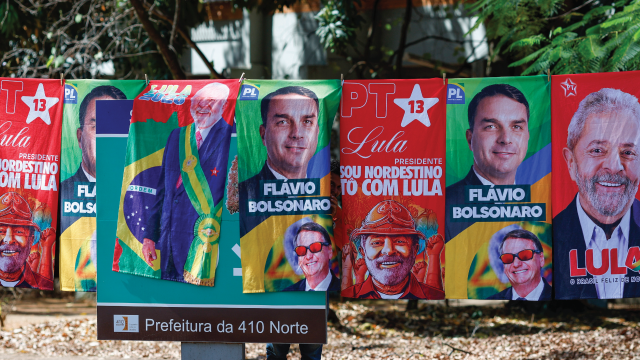
The issue comes as Brazil prepares for a closely contested presidential election. President Luiz Inácio Lula da Silva is seeking another term, while Senator Flávio Bolsonaro, son of former President Jair Bolsonaro, is among his main challengers.
Recent Brazilian polling has shown a highly competitive race. A Datafolha survey released September 17 put Lula at 39% and Flávio Bolsonaro at 36% in the first round, within the poll’s margin of error. In a potential runoff, Lula led 46% to 44%, also within the margin of error.
The first round will take place on October 4, with a second round scheduled for October 25 if required.
| # | Наименование новости | Тональность | Информативность | Дата публикации |
|---|---|---|---|---|
| 1 | Satmar Faction to Distribute Millions to Israelis Who Pledge Not to Vote | 0 | 11.66 | 24-09-2026 |
| 2 | Ferocious fight among Brazil’s supreme court erupts on eve of presidential election | 0 | 5.74 | 15-09-2026 |
| 3 | Central Elections Committee Votes to Bar Ofer Cassif From Running in Knesset Election | 0 | 10.96 | 23-09-2026 |
| 4 | Суд в Бразилии отклонил апелляцию защиты Лулы да Силвы на снятие его кандидатуры с выборов | 0 | 0 | 06-09-2018 |
| 5 | Парламент Бразилии отклонил продвигаемую президентом реформу системы голосования | 0 | 0 | 11-08-2021 |
| 6 | Brazil Supreme Court upholds laws that led to downfall of Amazon soy moratorium | 0 | 4.92 | 12-08-2026 |
| 7 | Key Amazon cases reach Brazil’s Supreme Court following Lula's defeats in Congress | 0 | 6.21 | 11-08-2026 |
| 8 | Doorway to Lomdus | 0 | 16.34 | 23-09-2026 |
| 9 | Key Amazon cases reach Brazil’s Supreme Court following Lula's defeats in Congress | 0 | 6.21 | 11-08-2026 |
| 10 | Jewish Leaders Reject Meeting With Tory Candidate Jailed for Antisemitism | 0 | 16.8 | 05-08-2026 |