Просмотр новости
Найдите то, что Вас интересует
 Спутники
 РН
РН SpaceX
 Роскосмос
 NASA
NASA
СпутникиРНSpaceXРоскосмосNASACan a $500 e-bike actually be a good bike? That’s the question I brought with me to the GoTrax E-Fold. I have to be honest: I came in skeptical. Adding a motor, battery, controller, and display to a folding frame at this price point usually means something suffers. The question is whether what suffers matters […]
The post GoTrax E-Fold Review: Is a $500 Folding E-Bike Actually Worth It? appeared first on Electric Bike Review.
70
A lightweight, zippy folding e-bike priced at $498!
Rating MatricOur Rating
6
5
5.5
5
5
View Bike Specs
Can a $500 e-bike actually be a good bike? That’s the question I brought with me to the GoTrax E-Fold. I have to be honest: I came in skeptical. Adding a motor, battery, controller, and display to a folding frame at this price point usually means something suffers. The question is whether what suffers matters enough to count it out.
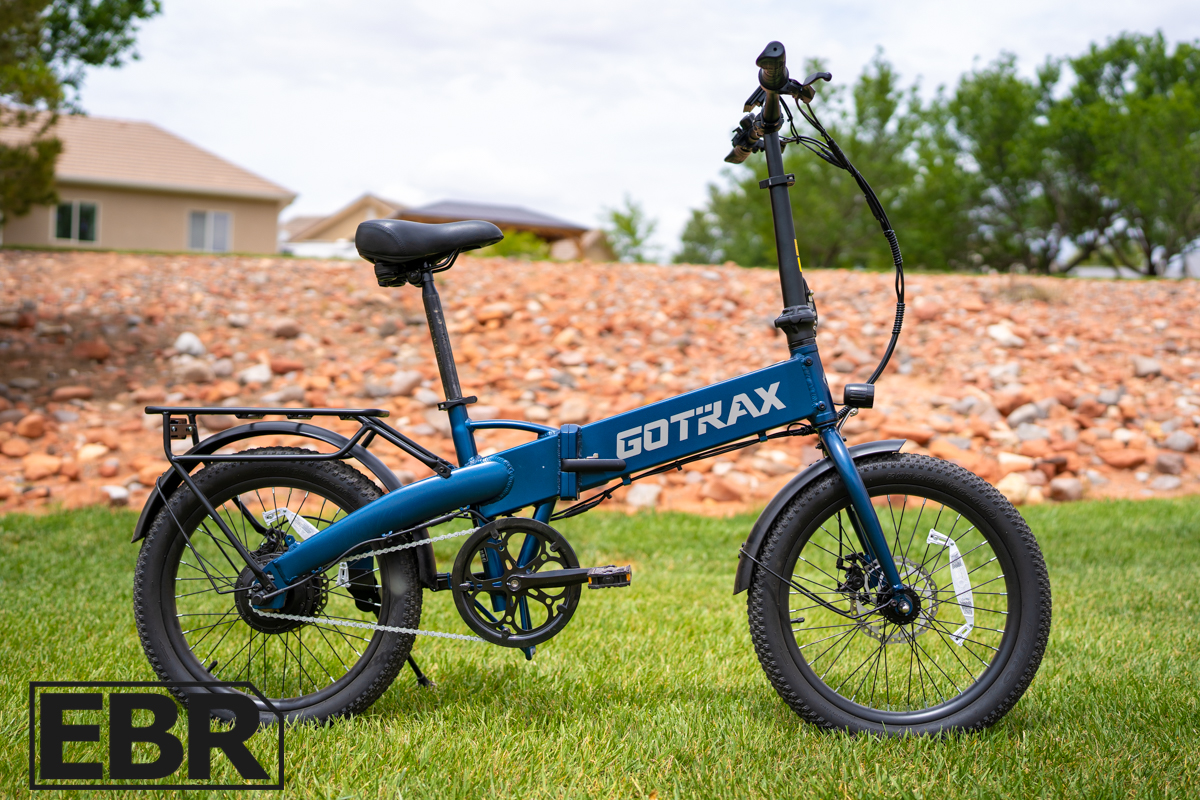
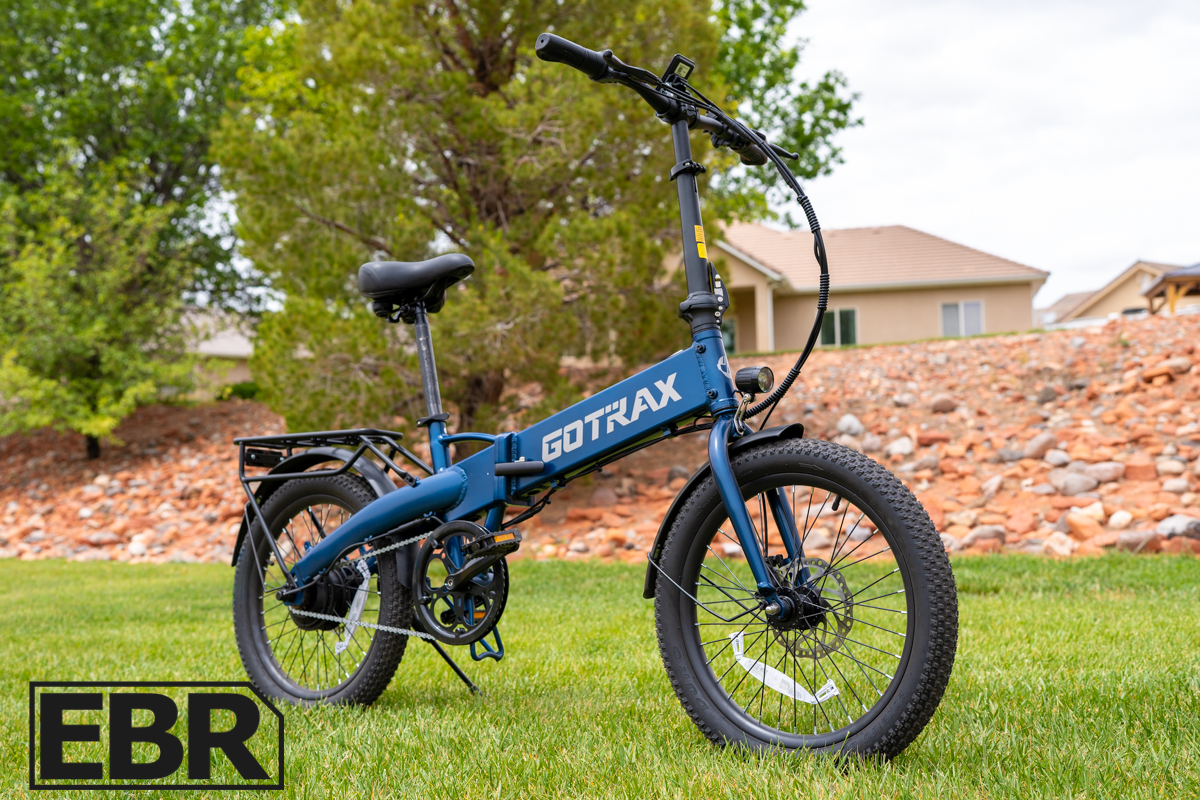
Short answer: no, it doesn’t. The E-Fold surprised me. It’s a decent bike when you put it in context of a sub $600 price (currently the pricing is around $500). The frame is stiff, the motor is peppier than the wattage suggests, and the overall package gives you everything you need to ride around town.
There are some tradeoffs, of course. These include a single gear vs a 7-speed, mechanical brakes instead of disc brakes, and a motor that’s going to struggle on serious hills if you’re over 220 lbs (it climbed just fine for me).
If your budget is around $500-$600 and you’re looking for a folding e-bike for commuting, errands, or casual riding, the E-Fold is a good option.
One of the first things I noticed when I swung a leg over the E-Fold was how much adjustability GoTrax packed into the bike. The saddle drops low enough for shorter riders to stand flatfoot and rises high enough that at 5’11” I was getting real leg extension. We had people in the office up around 6’3″ who felt comfortable on it too.
The adjustable stem gives you similar flexibility with your handlebar height. Reach felt good even though the stem is canted forward a little bit. You’re not too stretched out over the front, and you’re not crammed up against the bars either. For a single-size folding bike, the fit range here is better than I expected.
On the road, the E-Fold is more zippy than expected. The lighter weight bike (52 lbs with the battery) has a nimble, responsive feel. Overall, the E-fold doesn’t feel like a cheap bike. There’s not too much flex or wobble, and there wasn’t any of the normal creaking I tend to find on cheap bikes.
The single-speed drivetrain is part of what makes this bike as approachable as it is. You get on, you pedal, the motor helps, and you ride away. No shifting, no derailleur to adjust after you knock it on a doorframe. The gearing is set up to prioritize low-end climbing, which is probably the right call given the 350W motor.
The trade-off is that once you’re above about 15-16 mph, you start to feel the cadence get ahead of the drivetrain (i.e. ghost pedaling). You’re spinning your legs without much engagement with the gears. It’s not terrible, but at PAS 5 heading toward 20 mph you’re pedaling more like you’re in a spin class than on a real bike. I found myself spending most of my time in PAS 3 and 4, where the bike clips along at a comfortable 13-16 mph.
The bike doesn’t have a suspension fork, which is fine given it has slightly wider 2.6″ tires. I felt the bumps and big cracks on the pavement, but not any more than expected. If you want the tires to absorb a little more of the bumps, you can always run the tire pressure a bit lower. A suspension seat post is a reasonable upgrade as well.
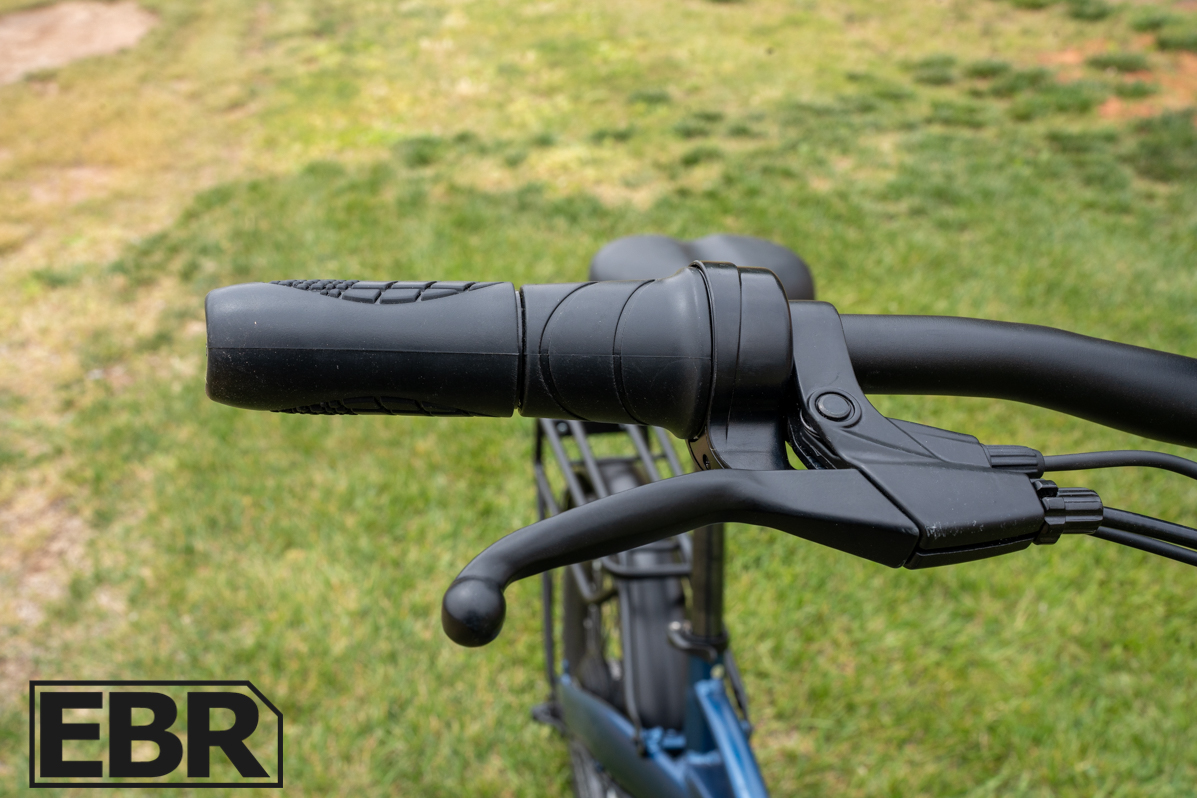
One thing worth pointing out is the throttle engagement: there’s a slight delay before it engages, and once it does kick in, there isn’t a lot of modulation. It’s more of an on/off switch than other twist throttles are.
I actually don’t mind that as a safety feature on a lighter bike like this, since it reduces the risk of accidentally whiskey-throttling. Pedaling wise, you have to almost fully pedal one time around before the motor kicks in, and there is about a quarter to half a second of motor overrun after you stop pedaling. While this is standard for a cadence sensor e-bike at this price point, I’d love to see that programming improved by GoTrax.
The E-Fold has a 350W rear hub motor. While I don’t know how much it peaks above 350, I will say that the way GoTrax programmed the controller makes the motor feel almost like a 500W motor. It felt more peppy and powerful than I expected from those 350 watts.
On our standard Black Hill test, the E-Fold completed the climb in 2:00, averaging 10.4 mph on pedal assist. That result is about what you’d expect from a 350W entry-level motor paired with a single gear. It’s not going to charge up the hill, but it’ll get you there. The limiting factor was more the gearing than the motor.
On throttle, the bike didn’t make it up the hill. It stopped on the steepest (and final!) section of the trail (keep in mind that the test is pretty intense, especially for sub-500 watt motors).
If hills are a regular part of your commute, manage your expectations with this motor. If your route is mostly flat with average sized hills, you’ll be fine.
The battery is a 48V, 7.8Ah pack and has a total capacity of 375Wh. It’s removable, which is normal for a folding e-bike, and you don’t have to keep the key inserted when riding. I’m still confused as to why the more expensive GoTrax F2 requires the key to be inserted, so I was happy when I realized that the E-Fold is better in that regard.
The charger is a 1.5A unit, which is maybe slightly below average at this point in time. Two years ago a 1.5A charger would have been average, but most bikes are shipping with 2A+ chargers now.
The bike is also UL 2849 certified, which covers the full electrical system: motor, battery, charger, and wiring.
Min Assist: 40 Miles
Max Assist: 18 Miles
Our real-world range results came in at about 18 miles on maximum assist (PAS 5) and 40 miles in eco mode (PAS 1).
Our MIN (PAS 1) test was also a little different than most, if not all, tests we have done in the past 1-2 years. GoTrax has programmed the bike to go about 9mph on PAS 1. Since I naturally pedal the bike on flat ground at 10-11 mph, we had to unnaturally slow down our pedal cadence to make sure the motor was doing the work we expect it to.
The good thing about this is that if your riding is on mostly flat trails and roads, then you can get more than 40 miles of range if you’re willing to pedal the flats without that assistance.
However, if your someone who wants to have assistance all the time (it is an e-bike afterall), then you are likely going to be pedaling in PAS 2 or 3 most of the time and will need to adjust your range expectations down accordingly.
The 18-miles we got on the MAX (PAS 5) test was what I expected from the 375Wh battery and 350W motor. 18 miles is longer than most people think, but plan on charging the bike more frequently if you like to power around in PAS 5.
If you’re the type who forgets to charge your bike and needs a quick recharge, you’ll need to remember that with a 1.5A charger, the bike will take just over 5 hrs to fully charge.
At a sub-$500 price point, you’re going to make some sacrifices on components. GoTrax has done a pretty good job of deciding which areas to save $$ on while making sure the components are good enough quality to earn our recommendation.
The single-speed drivetrain is the right call for this bike. A 52T chainring up front and a 16T cog in the rear gives you a gear range that balances hill climbing and flat-ground riding as well as a single gear bike paired with a 350W motor can. You’ll ghost pedal a bit above 15-16 mph, but you will also be able to pedal up steep hills.
You will also have less maintenance issues because you won’t have a derailleur. Keep the chain clean and this drivetrain will just work.
The folding pedals are nice. They fold flat, which makes the bike more compact and keeps the pedal from catching on things when you’re carrying it.
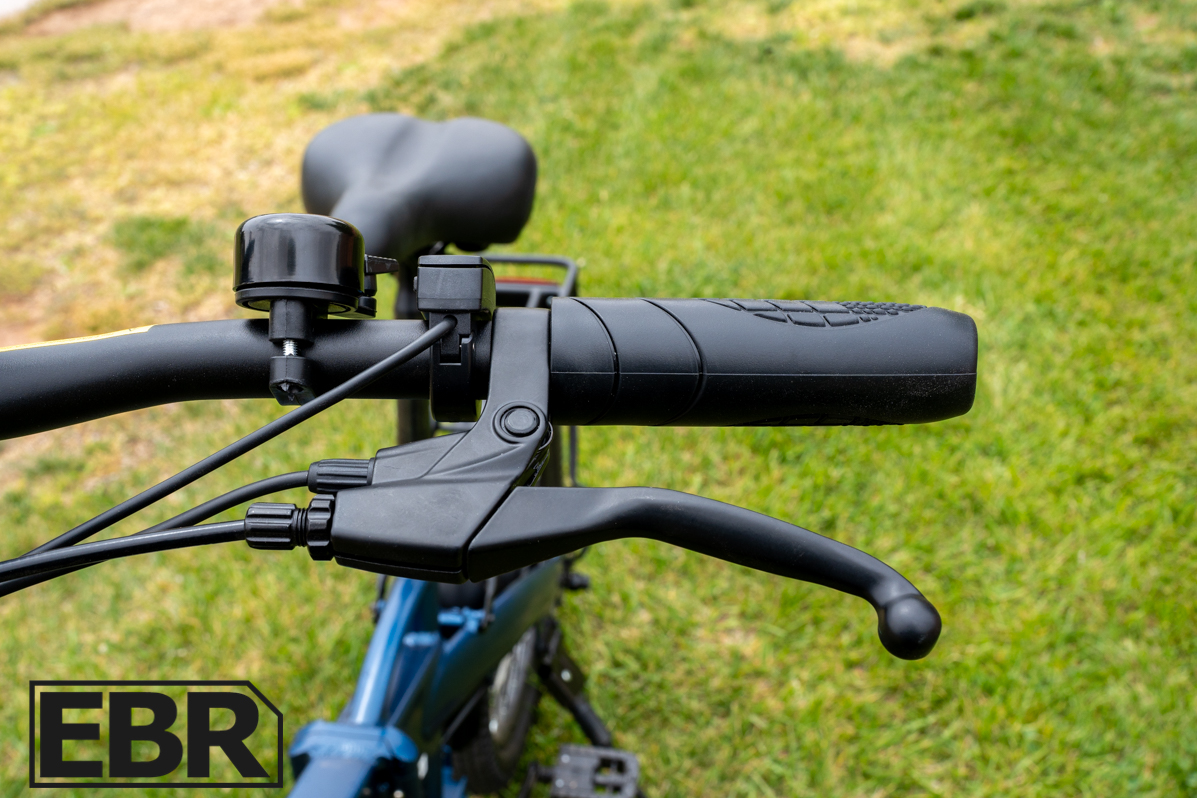
The brakes are mechanical disc with 160mm rotors front and rear, at 1.8mm thickness. While they don’t have the same stopping power as hydraulic brakes, the system is tried and true: it’s a system that’s been used on bikes for decades, and a backyard mechanic can adjust with basic tools since the brakes don’t require a brake bleed. On the road, stopping power was adequate and I felt comfortable. They did make a little noise when I grabbed them hard at speed, but nothing that felt unsafe. If you want more bite, GoTrax offers the F2 and a few other models with hydraulic disc brakes, but you will have to pay $100+ more for that.
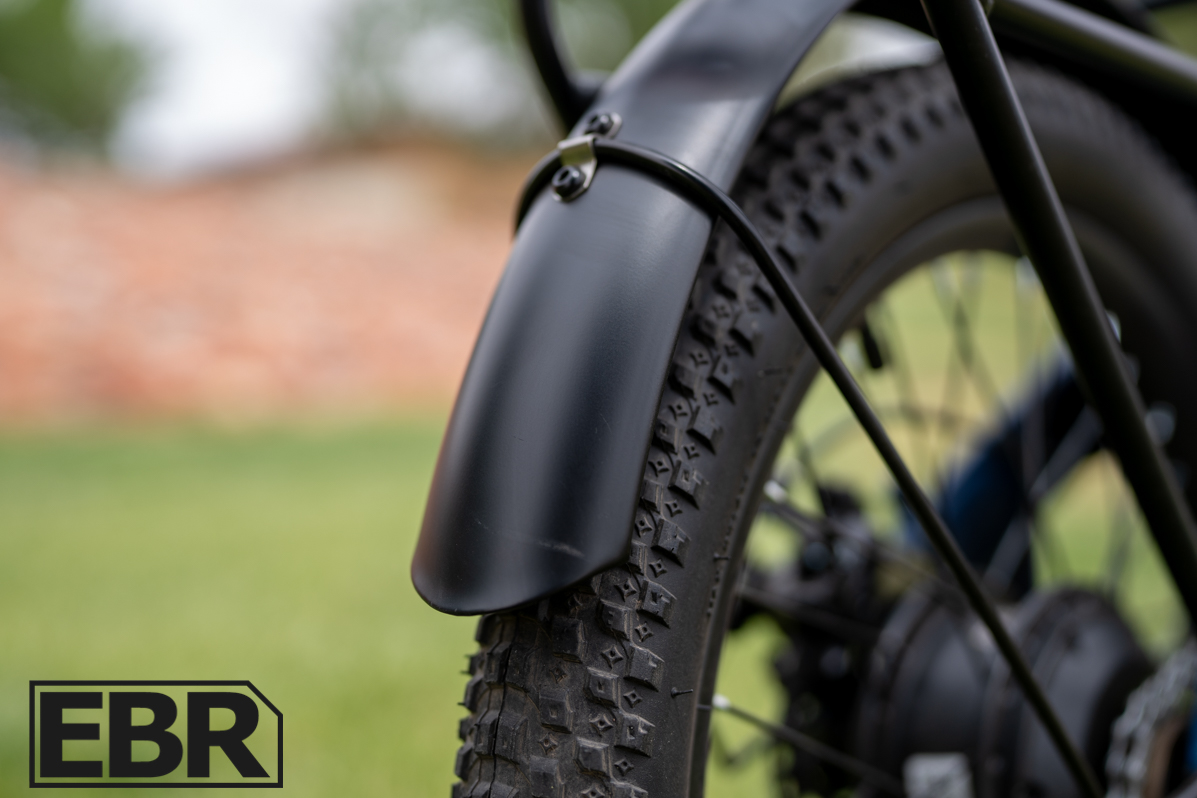
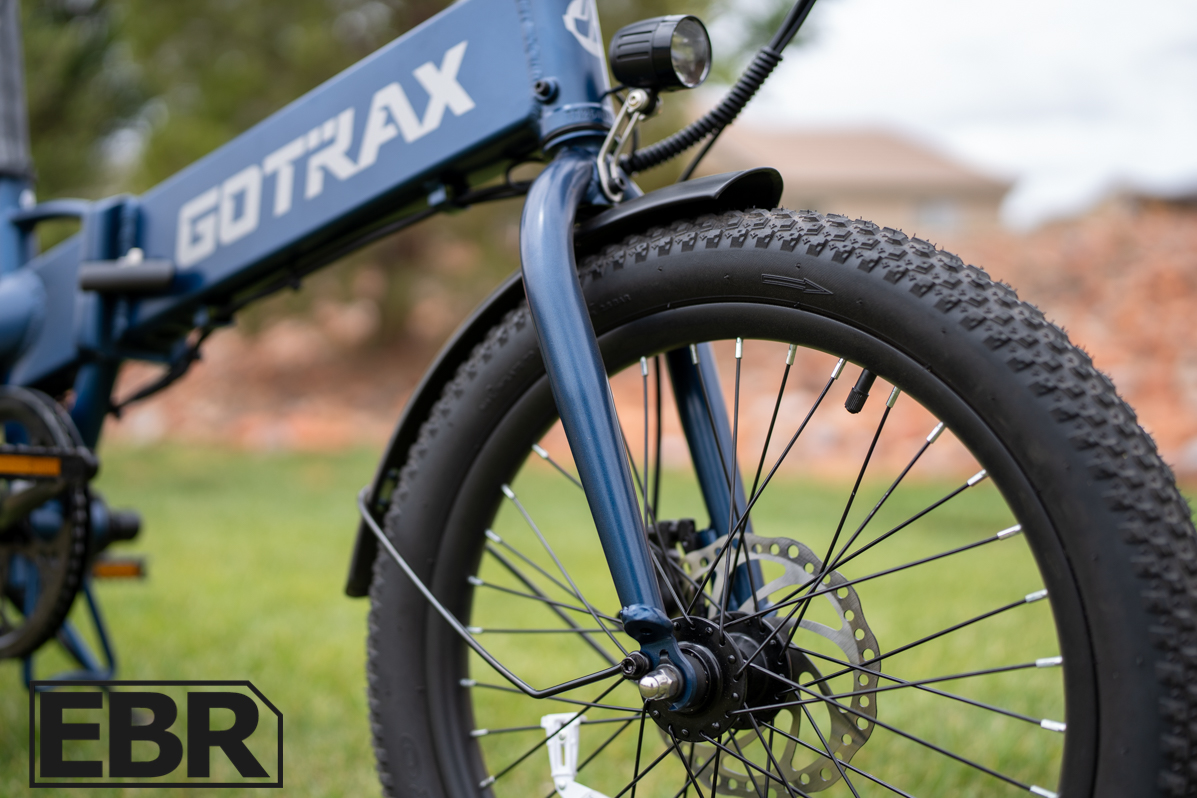
The 20″ x 2.6″ tires sit between a standard commuter tire and a true fat tire. They have enough volume to absorb bumps in the road and light gravel, but they’re not going to be as plush as a suspension fork would be – although I don’t think you need that on this style of bike in general (personal opinion). The knobby tread pattern gives you some confidence on light dirt or wet pavement.
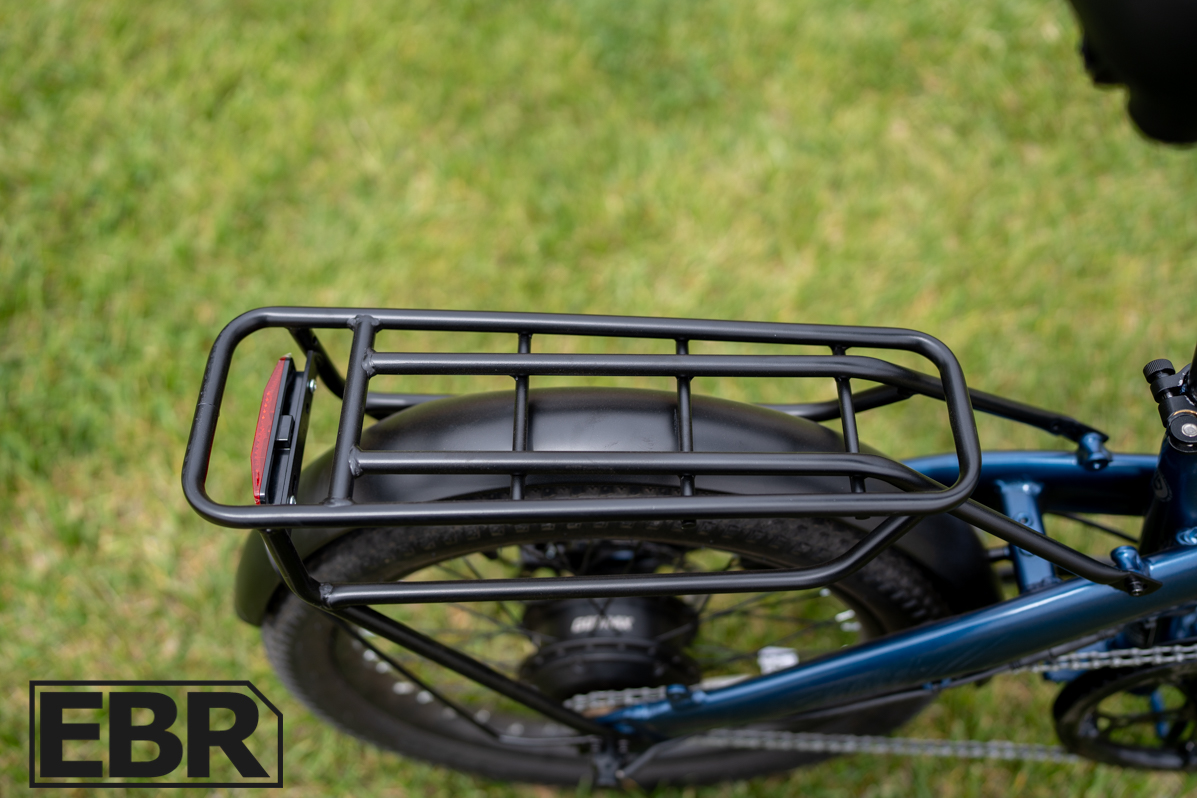
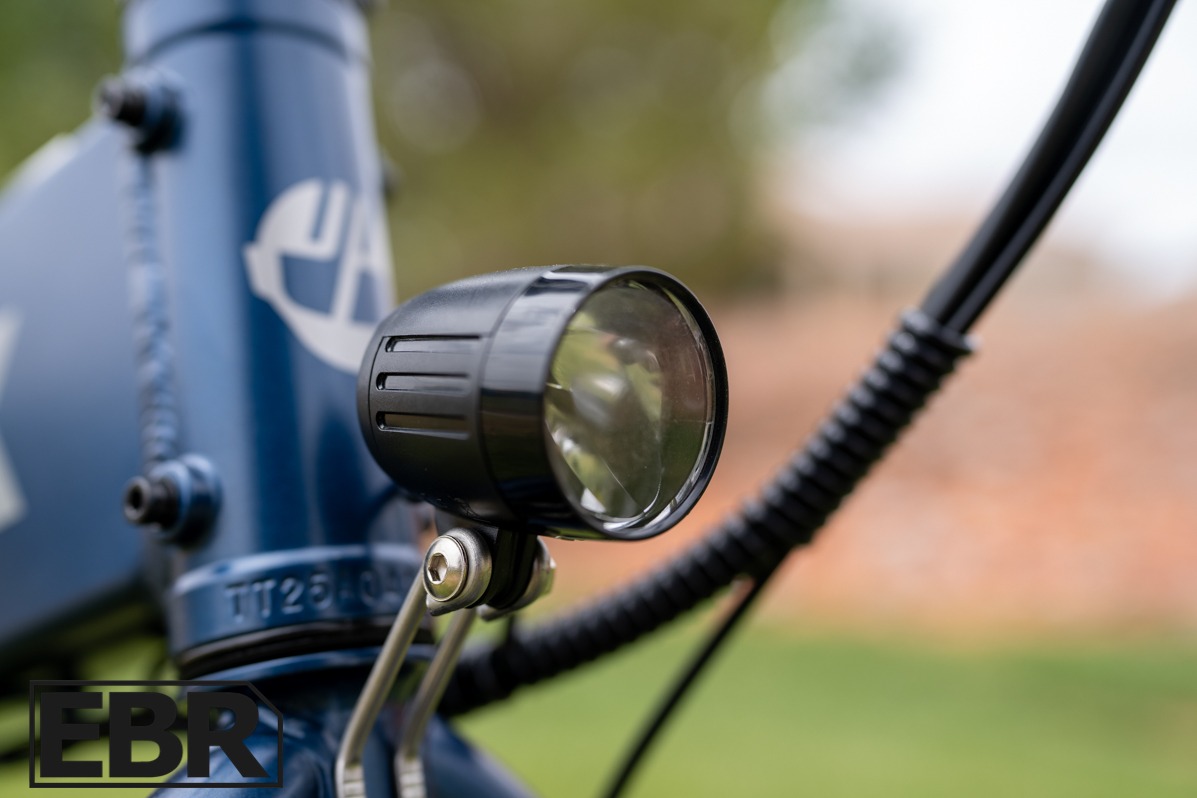
The rest of the package is better than expected for what this bike costs. You get front and rear metal fenders (I’d prefer a hard plastic over metal, but at least you don’t have to pay more for them), a rear cargo rack, a front LED headlight, a rear LED taillight, a kickstand, and a bell. Basically, you can throw a bag of groceries on the rack and ride home from the store without any add-ons.
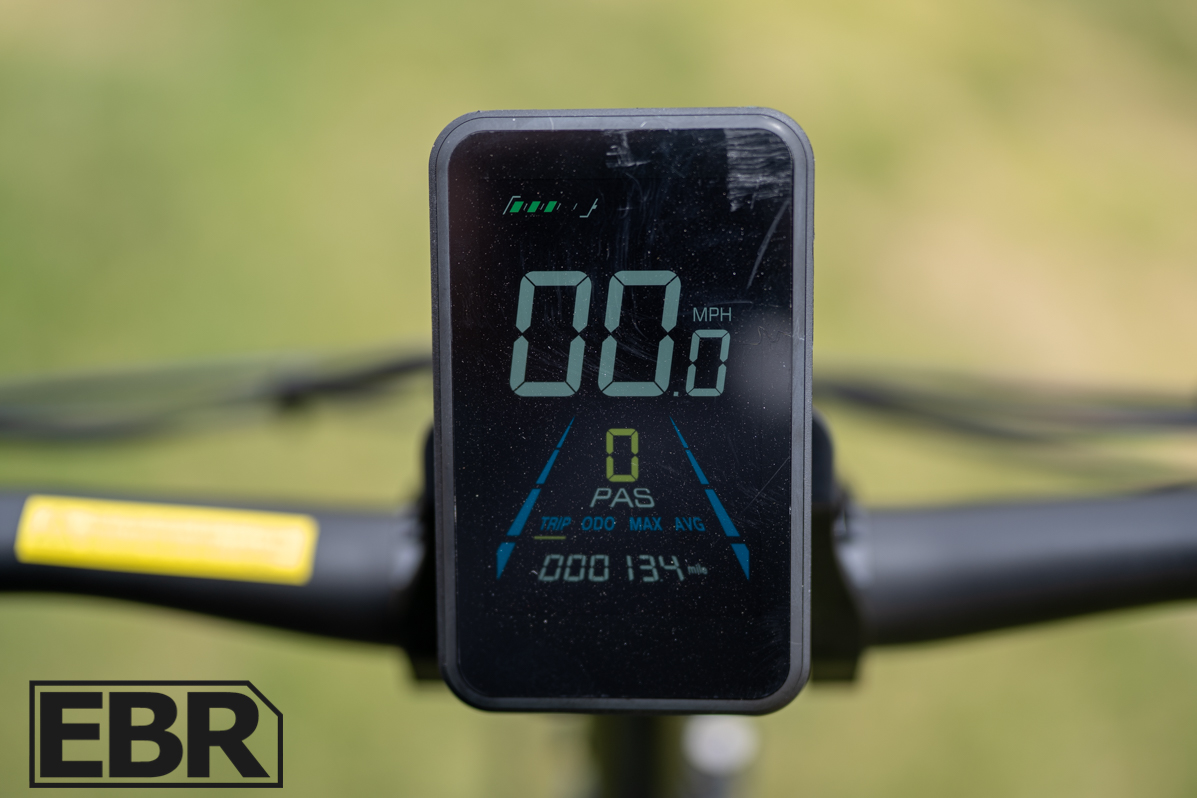
I have to give GoTrax some credit here: I like the color display on the E-Fold. It’s center-mounted on the handlebar, easy to read from the saddle, and is easy to see even in bright daylight. The display shows your speed, assist level, trip odometer, and a battery bar indicator. You can cycle through max speed and average speed with the top right button on the control pod.
The display does what you need it to do at this price. It’s not a TFT with Bluetooth or real-time wattage readout, and there’s no companion app, but those are expectations you bring from a $1,000-$1,500 bike. That being said, I’d still like to see GoTrax (and all budget-level brands) find a way to spec their bikes with accurate percentage battery readouts instead of the 5-bar readout.
While the readout was reasonably accurate through most of the range test, it dropped off faster than expected near the end, which made it harder to gauge exactly how much battery was left.
Navigating the settings is straightforward. You hold the plus and minus buttons to enter the advanced menu, which lets you change the display language, the number of assist levels (I’d recommend keeping it at 0-5 rather than 0-3), and the wheel size. One odd note: there is a setting that appears to let you change the top speed from 20 to 25 mph, but it doesn’t actually do anything. The motor still cuts out at 20 mph. It’s a Class 2 bike, so that’s not a problem – just interesting.
GoTrax keeps the E-Fold lineup simple with one size, one color (blue), and only one frame style. What you see is what you get. For a brand trying to keep costs down and deliver a complete bike at $500, that model simplification makes sense.
The rider height range is also pretty good for a single-size bike. Between the seat post adjustability (very low to quite high) and the adjustable stem, GoTrax has made the fit work for a broad range of riders. Based on my testing and with our taller colleagues in the office, I’d say roughly 5’3″ to 6’3″ can find a comfortable fit. Those on the edges of course won’t have a perfect leg extension and reach, but it’s still better than many other single-size bike options.
Plot spoiler: yes, I think it is, for the right buyer.
The E-Fold is built for someone whose budget tops out around $500, who wants a folding e-bike for casual riding, commuting around town, throwing it in the car or RV for camping, but who isn’t expecting a high-performance e-bike.
If that’s you, GoTrax has put together a more impressive package than most brands manage at this price. The frame feels decently stiff and solid, the motor has more pep than a 350W spec would suggest, it ships complete with fenders, rack, lights, and bell, and the fit range works for a wide range of riders. At 47 lbs without the battery, it fits on most 60-lb bike racks. And it folds in under a minute.
Where it falls short is predictable: a single gear means ghost pedaling at higher speeds, the mechanical brakes aren’t quite as powerful as hydraulic, and the slow 1.5A charger is going to test your patience if you’re forgetful about plugging in. None of those are hidden flaws. They’re the direct result of building a real e-bike at a $500-$600 price point.



Can a $500 e-bike actually be a good bike? That’s the question I brought with me to the GoTrax E-Fold. I have to be honest: I came in skeptical. Adding a motor, battery, controller, and display to a folding frame at this price point usually means something suffers. The question is whether what suffers matters enough to count it out.
Short answer: no, it doesn’t. The E-Fold surprised me. It’s a decent bike when you put it in context of a sub $600 price (currently the pricing is around $500). The frame is stiff, the motor is peppier than the wattage suggests, and the overall package gives you everything you need to ride around town.
There are some tradeoffs, of course. These include a single gear vs a 7-speed, mechanical brakes instead of disc brakes, and a motor that’s going to struggle on serious hills if you’re over 220 lbs (it climbed just fine for me).
If your budget is around $500-$600 and you’re looking for a folding e-bike for commuting, errands, or casual riding, the E-Fold is a good option.
One of the first things I noticed when I swung a leg over the E-Fold was how much adjustability GoTrax packed into the bike. The saddle drops low enough for shorter riders to stand flatfoot and rises high enough that at 5’11” I was getting real leg extension. We had people in the office up around 6’3″ who felt comfortable on it too.
The adjustable stem gives you similar flexibility with your handlebar height. Reach felt good even though the stem is canted forward a little bit. You’re not too stretched out over the front, and you’re not crammed up against the bars either. For a single-size folding bike, the fit range here is better than I expected.
On the road, the E-Fold is more zippy than expected. The lighter weight bike (52 lbs with the battery) has a nimble, responsive feel. Overall, the E-fold doesn’t feel like a cheap bike. There’s not too much flex or wobble, and there wasn’t any of the normal creaking I tend to find on cheap bikes.
The single-speed drivetrain is part of what makes this bike as approachable as it is. You get on, you pedal, the motor helps, and you ride away. No shifting, no derailleur to adjust after you knock it on a doorframe. The gearing is set up to prioritize low-end climbing, which is probably the right call given the 350W motor.
The trade-off is that once you’re above about 15-16 mph, you start to feel the cadence get ahead of the drivetrain (i.e. ghost pedaling). You’re spinning your legs without much engagement with the gears. It’s not terrible, but at PAS 5 heading toward 20 mph you’re pedaling more like you’re in a spin class than on a real bike. I found myself spending most of my time in PAS 3 and 4, where the bike clips along at a comfortable 13-16 mph.
The bike doesn’t have a suspension fork, which is fine given it has slightly wider 2.6″ tires. I felt the bumps and big cracks on the pavement, but not any more than expected. If you want the tires to absorb a little more of the bumps, you can always run the tire pressure a bit lower. A suspension seat post is a reasonable upgrade as well.
One thing worth pointing out is the throttle engagement: there’s a slight delay before it engages, and once it does kick in, there isn’t a lot of modulation. It’s more of an on/off switch than other twist throttles are.
I actually don’t mind that as a safety feature on a lighter bike like this, since it reduces the risk of accidentally whiskey-throttling. Pedaling wise, you have to almost fully pedal one time around before the motor kicks in, and there is about a quarter to half a second of motor overrun after you stop pedaling. While this is standard for a cadence sensor e-bike at this price point, I’d love to see that programming improved by GoTrax.
The E-Fold has a 350W rear hub motor. While I don’t know how much it peaks above 350, I will say that the way GoTrax programmed the controller makes the motor feel almost like a 500W motor. It felt more peppy and powerful than I expected from those 350 watts.
On our standard Black Hill test, the E-Fold completed the climb in 2:00, averaging 10.4 mph on pedal assist. That result is about what you’d expect from a 350W entry-level motor paired with a single gear. It’s not going to charge up the hill, but it’ll get you there. The limiting factor was more the gearing than the motor.
On throttle, the bike didn’t make it up the hill. It stopped on the steepest (and final!) section of the trail (keep in mind that the test is pretty intense, especially for sub-500 watt motors).
If hills are a regular part of your commute, manage your expectations with this motor. If your route is mostly flat with average sized hills, you’ll be fine.
The battery is a 48V, 7.8Ah pack and has a total capacity of 375Wh. It’s removable, which is normal for a folding e-bike, and you don’t have to keep the key inserted when riding. I’m still confused as to why the more expensive GoTrax F2 requires the key to be inserted, so I was happy when I realized that the E-Fold is better in that regard.
The charger is a 1.5A unit, which is maybe slightly below average at this point in time. Two years ago a 1.5A charger would have been average, but most bikes are shipping with 2A+ chargers now.
The bike is also UL 2849 certified, which covers the full electrical system: motor, battery, charger, and wiring.
Min Assist: 40 Miles
Max Assist: 18 Miles
Our real-world range results came in at about 18 miles on maximum assist (PAS 5) and 40 miles in eco mode (PAS 1).
Our MIN (PAS 1) test was also a little different than most, if not all, tests we have done in the past 1-2 years. GoTrax has programmed the bike to go about 9mph on PAS 1. Since I naturally pedal the bike on flat ground at 10-11 mph, we had to unnaturally slow down our pedal cadence to make sure the motor was doing the work we expect it to.
The good thing about this is that if your riding is on mostly flat trails and roads, then you can get more than 40 miles of range if you’re willing to pedal the flats without that assistance.
However, if your someone who wants to have assistance all the time (it is an e-bike afterall), then you are likely going to be pedaling in PAS 2 or 3 most of the time and will need to adjust your range expectations down accordingly.
The 18-miles we got on the MAX (PAS 5) test was what I expected from the 375Wh battery and 350W motor. 18 miles is longer than most people think, but plan on charging the bike more frequently if you like to power around in PAS 5.
If you’re the type who forgets to charge your bike and needs a quick recharge, you’ll need to remember that with a 1.5A charger, the bike will take just over 5 hrs to fully charge.
At a sub-$500 price point, you’re going to make some sacrifices on components. GoTrax has done a pretty good job of deciding which areas to save $$ on while making sure the components are good enough quality to earn our recommendation.
The single-speed drivetrain is the right call for this bike. A 52T chainring up front and a 16T cog in the rear gives you a gear range that balances hill climbing and flat-ground riding as well as a single gear bike paired with a 350W motor can. You’ll ghost pedal a bit above 15-16 mph, but you will also be able to pedal up steep hills.
You will also have less maintenance issues because you won’t have a derailleur. Keep the chain clean and this drivetrain will just work.
The folding pedals are nice. They fold flat, which makes the bike more compact and keeps the pedal from catching on things when you’re carrying it.
The brakes are mechanical disc with 160mm rotors front and rear, at 1.8mm thickness. While they don’t have the same stopping power as hydraulic brakes, the system is tried and true: it’s a system that’s been used on bikes for decades, and a backyard mechanic can adjust with basic tools since the brakes don’t require a brake bleed. On the road, stopping power was adequate and I felt comfortable. They did make a little noise when I grabbed them hard at speed, but nothing that felt unsafe. If you want more bite, GoTrax offers the F2 and a few other models with hydraulic disc brakes, but you will have to pay $100+ more for that.
The 20″ x 2.6″ tires sit between a standard commuter tire and a true fat tire. They have enough volume to absorb bumps in the road and light gravel, but they’re not going to be as plush as a suspension fork would be – although I don’t think you need that on this style of bike in general (personal opinion). The knobby tread pattern gives you some confidence on light dirt or wet pavement.
The rest of the package is better than expected for what this bike costs. You get front and rear metal fenders (I’d prefer a hard plastic over metal, but at least you don’t have to pay more for them), a rear cargo rack, a front LED headlight, a rear LED taillight, a kickstand, and a bell. Basically, you can throw a bag of groceries on the rack and ride home from the store without any add-ons.
I have to give GoTrax some credit here: I like the color display on the E-Fold. It’s center-mounted on the handlebar, easy to read from the saddle, and is easy to see even in bright daylight. The display shows your speed, assist level, trip odometer, and a battery bar indicator. You can cycle through max speed and average speed with the top right button on the control pod.
The display does what you need it to do at this price. It’s not a TFT with Bluetooth or real-time wattage readout, and there’s no companion app, but those are expectations you bring from a $1,000-$1,500 bike. That being said, I’d still like to see GoTrax (and all budget-level brands) find a way to spec their bikes with accurate percentage battery readouts instead of the 5-bar readout.
While the readout was reasonably accurate through most of the range test, it dropped off faster than expected near the end, which made it harder to gauge exactly how much battery was left.
Navigating the settings is straightforward. You hold the plus and minus buttons to enter the advanced menu, which lets you change the display language, the number of assist levels (I’d recommend keeping it at 0-5 rather than 0-3), and the wheel size. One odd note: there is a setting that appears to let you change the top speed from 20 to 25 mph, but it doesn’t actually do anything. The motor still cuts out at 20 mph. It’s a Class 2 bike, so that’s not a problem – just interesting.
GoTrax keeps the E-Fold lineup simple with one size, one color (blue), and only one frame style. What you see is what you get. For a brand trying to keep costs down and deliver a complete bike at $500, that model simplification makes sense.
The rider height range is also pretty good for a single-size bike. Between the seat post adjustability (very low to quite high) and the adjustable stem, GoTrax has made the fit work for a broad range of riders. Based on my testing and with our taller colleagues in the office, I’d say roughly 5’3″ to 6’3″ can find a comfortable fit. Those on the edges of course won’t have a perfect leg extension and reach, but it’s still better than many other single-size bike options.
Plot spoiler: yes, I think it is, for the right buyer.
The E-Fold is built for someone whose budget tops out around $500, who wants a folding e-bike for casual riding, commuting around town, throwing it in the car or RV for camping, but who isn’t expecting a high-performance e-bike.
If that’s you, GoTrax has put together a more impressive package than most brands manage at this price. The frame feels decently stiff and solid, the motor has more pep than a 350W spec would suggest, it ships complete with fenders, rack, lights, and bell, and the fit range works for a wide range of riders. At 47 lbs without the battery, it fits on most 60-lb bike racks. And it folds in under a minute.
Where it falls short is predictable: a single gear means ghost pedaling at higher speeds, the mechanical brakes aren’t quite as powerful as hydraulic, and the slow 1.5A charger is going to test your patience if you’re forgetful about plugging in. None of those are hidden flaws. They’re the direct result of building a real e-bike at a $500-$600 price point.
July 15th, 2026 04:28 pm
| # | Наименование новости | Тональность | Информативность | Дата публикации |
|---|---|---|---|---|
| 1 | GoTrax F2 Folding E-Bike Review — Surprisingly Good Brakes and Solid Value Under $700 | 0 | 13.23 | 28-06-2026 |
| 2 | Gotrax Mustang electric bike review: Stylish, comfortable, and shockingly practical | 0 | 8.96 | 26-05-2026 |
| 3 | Urtopia Carbon Fold 2 Review 2026: Only 35lbs of Everyday Practicality | 0 | 10.25 | 31-03-2026 |
| 4 | Hynox Trooper X Review: A 100Nm Folding Fat-Tire E-Bike With Real Power | 0 | 10.1 | 31-07-2026 |
| 5 | Ride1Up Vorsa Lite Review: 105 Miles on a Single Charge – And It’s Under $1,500 | 0 | 13.6 | 06-06-2026 |
| 6 | Velotric Tempo review: A lightweight commuter e-bike that gets a lot right | 0 | 14.11 | 05-06-2026 |
| 7 | Here are the best electric bikes you can buy at every price level in August 2026 | 0 | 14.14 | 02-08-2026 |
| 8 | Ride1Up Roadster V3 ST Review – Sleek And Affordable | 0 | 14.31 | 01-02-2026 |
| 9 | Velotric Discover M Review – Comfort, Tech and Mid-Drive Muscle | 0 | 10.8 | 10-02-2026 |
| 10 | Jasion Hunter Pro review: A folding fat tire full-suspension e-bike for cheap | 0 | 15.23 | 06-07-2026 |