Просмотр новости
Найдите то, что Вас интересует
 Спутники
 РН
РН SpaceX
 Роскосмос
 NASA
NASA
СпутникиРНSpaceXРоскосмосNASAEarlier this year, leading scientific journal Nature published an editorial lavishing effusive praise on Wikipedia, writing that it is "an antidote to an increasingly poisoned information ecosystem." Naturally (no pun intended), as co-founder, […]
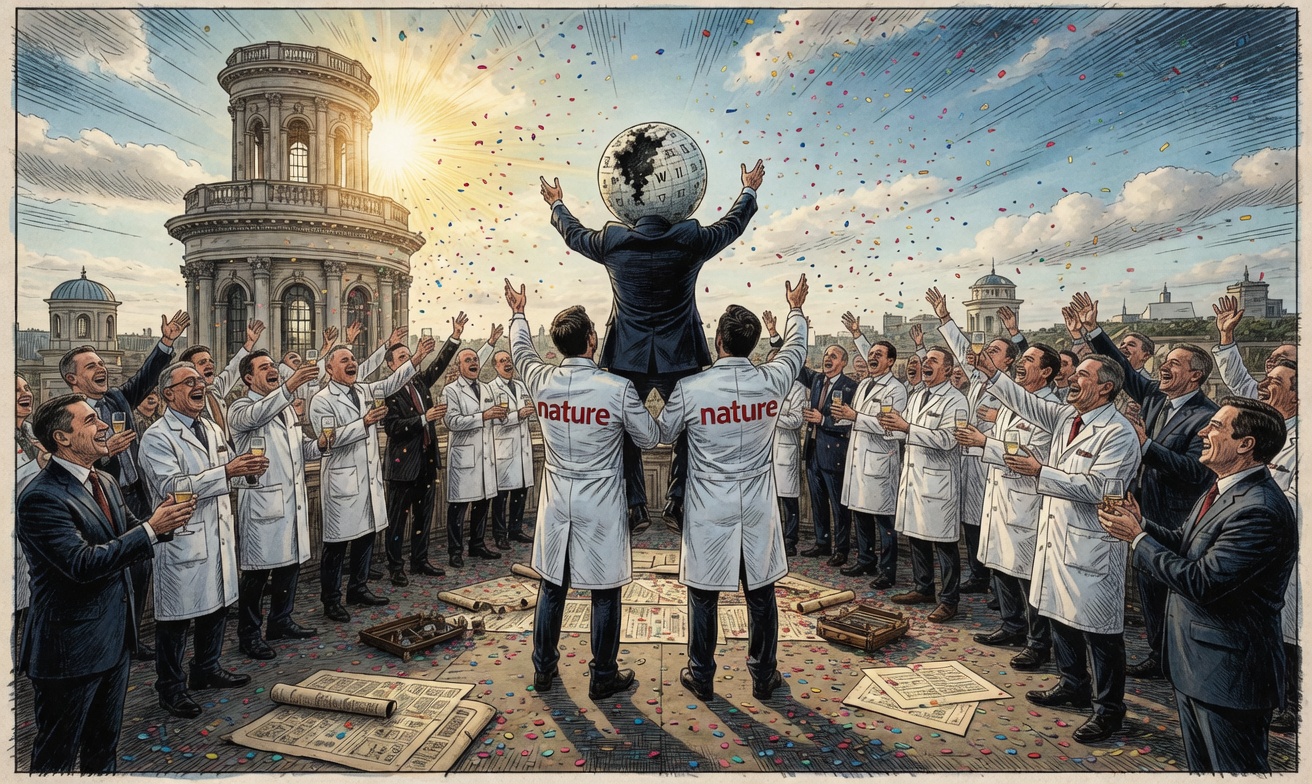
Earlier this year, leading scientific journal Nature published an editorial lavishing effusive praise on Wikipedia, writing that it is “an antidote to an increasingly poisoned information ecosystem.”
Naturally (no pun intended), as co-founder, I had to respond, knowing that Wikipedia is increasingly “poisoned” itself. (I call myself ex-founder; I have been called the Emmanuel Goldstein of Wikipedia.) In February, I pitched a response op-ed column to Nature on the need for reforming Wikipedia for the sake of editorial balance and intellectual integrity. They passed on the idea, but expressed interest in a short letter to the editor “highlighting a few key points.”
In early March, Nature (surprisingly) agreed to publish my letter to the editor. They sent an edited version; I returned my own edits, and Nature agreed to publish it, saying a final proof would be ready soon. Then, nearly a week later, Nature reversed course and declined the letter, citing insufficient evidence.
Remarkably, even though I had published the “Nine Theses on Wikipedia”—a book-length argument with 76 footnotes to fine-grained evidence—just months earlier, that apparently wasn’t enough for Nature.
Their response? Nothing. Their editors decided to ghost me, despite the considerable time and effort that went into writing the LTE and editing it over and over again. Here is the letter:
Wikipedia, After 25 Years, Needs Reform
I co-founded and named Wikipedia 25 years ago; I formulated the original neutrality policy, among others. I am also a Ph.D. philosopher specializing in epistemology. I am writing to flag caveats of the project in its current form. I agree with Nature’s recent editorial that Wikipedia—which is free and has an enormous number of entries—remains useful. And that a broad variety of researchers should edit it.
That said, Wikipedia has not retained its founding values of neutrality1 and openness.
Neutrality once meant not picking sides on controversial issues; it has been turned on its head and now means little more than expressing the views of Establishment sources. Editors can dismiss entire sources in the name of “reliability”—such as the Heritage Foundation and the Anti-Defamation League2—even though honest researchers often disagree about the reliability of sources. This can be wielded as a sledgehammer against minority views in many fields, and serves to impose bias.3
Moreover, Wikipedia’s once laudable openness has disappeared in some important ways. Its editors can declare “consensus” and then use the decision to silence dissent.4 They can act with impunity because they are anonymous—which is the opposite of transparency. Wikipedia is one of the most influential information outlets on the planet. Yet its powerful editors, being anonymous, rarely face real-world consequences for defamation, serious error or editing on behalf of corporations and governments.
Wikipedia needs reform.
It’s a slap in the face, but hardly shocking from Nature—which repeatedly peddled lies and misled people during the COVID-19 pandemic. We deserve much, much more from “the world’s leading multidisciplinary science journal.”
Wikipedia needs reform, and we need a media establishment willing to hear that case rather than ignore it. Shame on Nature.
| # | Наименование новости | Тональность | Информативность | Дата публикации |
|---|---|---|---|---|
| 1 | Letters to the editor | 0 | 10 | 09-07-2026 |
| 2 | Darwin-Drunk Media Competes for Stupid Awards | 0 | 14.55 | 02-08-2026 |
| 3 | Наложенный на Wikimedia штраф стал 21-м с 2022 года | 0 | 0 | 08-07-2025 |
| 4 | Компанию-владельца "Википедии" оштрафовали на 800 тыс. руб. за отказ удалить материал | 0 | 0 | 06-04-2023 |
| 5 | Comment on Clarivate removes hold on mega-journal Heliyon after internal audit, 650+ retractions by Chris Mebane | 0 | 8.88 | 08-08-2026 |
| 6 | Physicist says splashy new cosmology study made ‘elemental’ mistake | -2 | 5 | 09-07-2026 |
| 7 | Sloponomics: who wins and loses in the AI-content flood? | 2 | 7 | 16-10-2025 |
| 8 | Time Magazine’s Site Now Shows Advertisements Only Chatbots Can See | 0 | 7.76 | 06-08-2026 |
| 9 | Cracks are appearing in OpenAI’s dominant façade | 0 | 7 | 19-11-2025 |