Просмотр новости
Найдите то, что Вас интересует
 Спутники
 РН
РН SpaceX
 Роскосмос
 NASA
NASA
СпутникиРНSpaceXРоскосмосNASAYou and all other living things descended from a single organism — our great-grand-germ. Scientists are studying modern genes to learn more about this very distant ancestor.
Scientists want to identify your earliest ancestor. And to do that, they have to look back in time. Way, way back.
Let’s climb up your family tree. The first people we’ll meet are your parents, then your grandparents and their parents. Keep climbing and we’ll meet more parents of parents, and parents of parents of parents.
Eventually we’ll zip through hundreds of thousands of years and ancestors. This tour will cross continents and oceans. Modern humans first walked the planet more than 300,000 years ago, so you have a lot of family to get through.
If we keep going back — say 6 million to 8 million years — we’ll find the first upright-walking creature that’s not only your ancestor, but also the ancestor of other primates living today, such as monkeys, chimps and lemurs. So if you want to plan a family reunion, you’ll need to invite not only every person alive, but also every primate you can track down. (That will be a lot of invitations!)
Further up the family tree, about 180 million years back, you’ll find a creature that probably looked like a mouse. It’s the ancestor of you and every other mammal, from whales to marmots. Ascend that family tree a little higher, and you’ll find a common ancestor to every animal. (You won’t recognize it, though. It won’t look remotely like anyone you know.)
And we’re still not done.
Eventually, if we travel back billions of years, we’ll reach LUCA. It’s just one cell, probably shaped like a rod. Scientists suspect it once lived near a hydrothermal vent at the bottom of an ocean. Every family tree, for any organism, leads to LUCA.
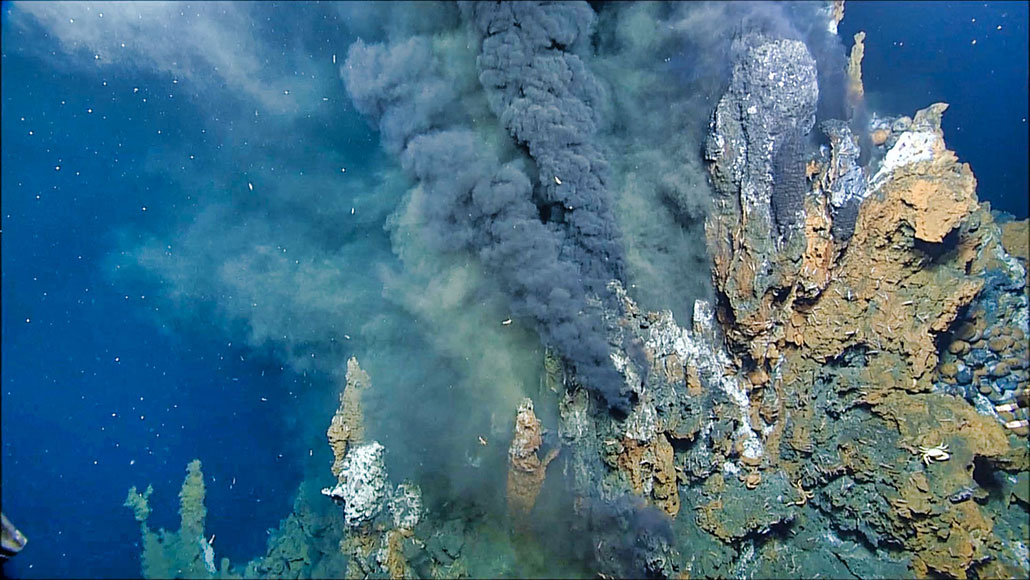 This is a hydrothermal vent on an underwater volcano in the southwest Pacific Ocean. Scientists suspect that LUCA — a microbe and our last universal common ancestor — may have made its home in an extreme environment, such as this one. Coastal and Marine Hazards and Resources Program/USGS
LUCA stands for last universal common ancestor. It wasn’t the first thing that lived on Earth. But LUCA is special, because every living thing on the planet today is related to it through evolution. From people and mushrooms to bacteria and trees — we are all descendants of that one lowly cell.
LUCA’s first offspring were also organisms made of single cells. Some would become the ancestors of bacteria. Others would become archaea, another type of single-celled microbe. Still others, much later, would form clumps, leading to multicellular beings.
Scientists study LUCA for many reasons. Knowing how life evolved on our world might help them recognize early signs of life on other planets. Or “it may help us prepare for understanding how life may change in the future,” says Edmund Moody. He’s an evolutionary biologist at the University of Barcelona in Spain.
Perhaps the biggest reason scientists want to understand LUCA is to see how evolution unfolds. That’s why Tom Williams studies our great-great-grand germs. A biologist at the University of Bath in England, he recently led a project that described LUCA more precisely than ever before. In 2024, Williams, Moody and others reported when they think LUCA lived, how it ate — even what its insides looked like.
“If you want to understand the early evolution of life, then you’re talking about events that happened to microbes,” says Williams. “I think that is quite important.”
The leadup to LUCAEarth formed more than 4.5 billion years ago. It likely started as clumps of gas and dirt swirling around the sun. Life on Earth began about half a billion years after our world was born, though the details remain a great mystery.
“We’re probably never going to fully understand all the mysteries of the origin of life,” admits Michael Lynch. A geneticist, he works at Arizona State University in Tempe.
Scientists have found some clues about the oldest life on Earth. In Australia, they turned up fossils of microbe communities in rocks 3.5 billion years old. Some fossils in Canada may be even older. Scientists aren’t sure, though. “When it comes to fossils of single-celled organisms, they’re very difficult to interpret,” says Williams.
Here’s what we do know: At some point, conditions on Earth were just right for the building blocks of life to come together. Today, some scientists are trying to re-create those conditions in the lab. They hope it will help them figure out how life began.
LUCA was not, however, the planet’s first organism. That’s a misconception Williams often hears. “We often imagine that the origin of life and LUCA would be very close together,” Williams says. But that’s not the case. “They’re really very distinct events, or very distinct organisms.”
Life may have begun when some mix of molecules started making copies of itself. Over time, that first life-form likely gave rise to many different types of descendants. Eventually, simple cells evolved. One of those was LUCA. Researchers like Williams look to organisms alive today for clues about this common ancestor.
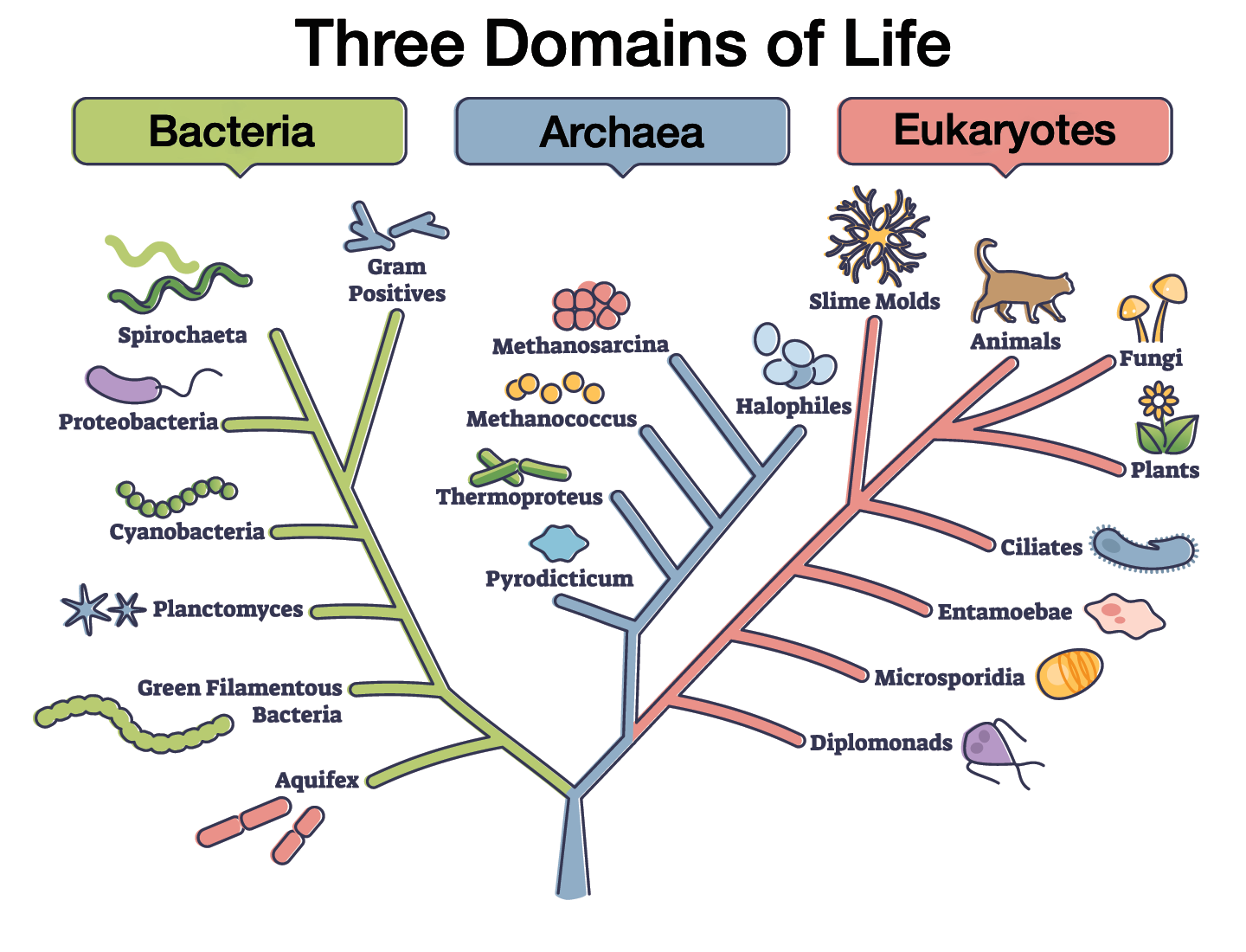 In today’s grand tree of life, all organisms fall into one of three domains, suggested by colored limbs above: bacteria (green), archaea (blue) and eukaryotes, including us (orange).VectorMine/ShutterstockA trio of domains
Everything alive today falls into one of three categories, and they all point back to LUCA. Biologists call these domains.
Bacteria inhabit one domain. Too small to see with the unaided eye, these microbes exist just about everywhere. They’re in soil and water. Many live on your skin and in your intestines. Some of them keep you healthy; others can make you sick. Bacteria can even live in extreme environments, such as inside volcanoes or near vents on the seafloor spewing water and gases at up to 400° Celsius (750° Fahrenheit).
Scientists have identified and named tens of thousands of bacteria, which sounds like a lot. But biologists actually estimate Earth may host more than a trillion types!
Bacteria are all simple. They contain DNA and cell walls that keep their insides from spilling out. Their shapes vary from rods and spheres to spirals. And they’ve been around for a long time. “The first 80 percent of our life’s history is single-celled organisms — exclusively,” says Williams.
Archaea (Ar-KEE-uh) make up the second domain of life. Also single-celled, they’re the size of bacteria and often the same shape. They even look the same under a microscope.
For a long time, scientists thought archaea and bacteria belonged to the same group. That changed in the 1970s, when close studies revealed that the molecules in the cell walls of archaea don’t exactly match the ones in bacterial cell walls. And though archaea also have DNA, their genes differ from those in bacteria.
The third domain includes living things called eukaryotes. More complex than bacteria and archaea, eukaryotes have defined compartments inside their cells. Those are its organelles. Most eukaryotic cells have a nucleus, for example. This holds its genetic material. Neither bacteria nor archaea have nuclei.
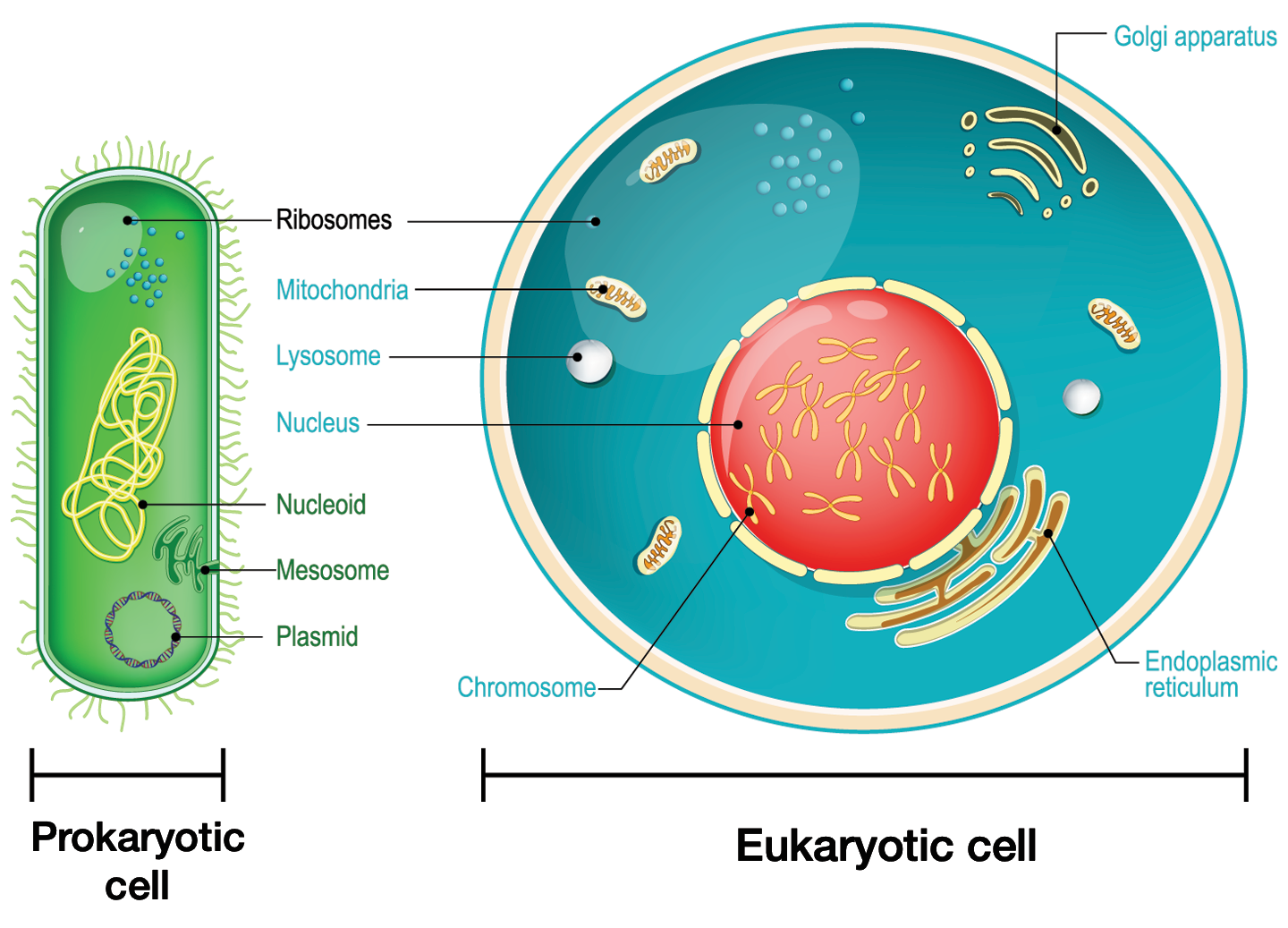 One chief difference between bacteria and archaea (prokaryotes) and all other life (eukaryotes) are organelles. Prokaryotes lack these compartments of cellular machinery (such as the nucleus), while eukaryotes have them. But both have such things as ribosomes and DNA (in plasmids and chromosomes). ttsz/iStock/Getty Images Plus
Some eukaryotes are single-celled organisms. Others are complex, many-celled organisms. Plants are eukaryotes, as are mushrooms and animals — including humans.
Living things in the three domains differ in many ways. Still, “all cellular life forms have certain things in common,” says Williams. Those might include genes or cell parts or processes, like how a cell uses energy. “We try to ask what those features mean about what early life could have been like.”
This may look like a bacterium or archaeon. In fact, this one-celled paramecium actually is part of the same domain — the eukaryotes — as all plants and animals, including us.Namscience/Creatas Video+/Getty Images PlusPortraits of LUCAThe idea that everything on Earth has a common ancestor has been around for a long time. Charles Darwin, who championed the theory of evolution, argued all life came from a single ancestor. “Probably all the organic beings which have ever lived on this Earth have descended from some one primordial form,” he wrote in 1859.
Scientists have been thinking about that primordial form ever since. But today’s ideas about LUCA only started to take shape in 1977. That’s when biologist Carl Woese found that archaea and bacteria represented two different kinds of organisms. He proposed organizing life into the three domains.
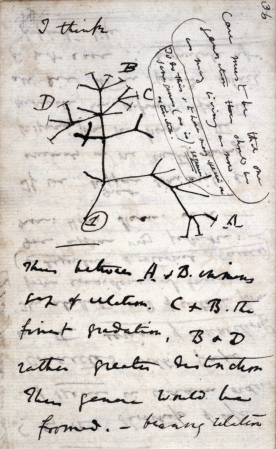 These scribbles from one of Charles Darwin’s notebooks show how he thought all life might have branched out from a common ancestor (labeled “1”). Charles Darwin/Wikimedia Commons (Public Domain)
Woese also argued that the universal ancestor was not even a cell. He proposed it was simpler: a “progenote.” His idea was that progenotes mixed genetic material with each other until, over time, some organized organism emerged.
Two decades later, microbiologist Patrick Forterre coined the acronym LUCA.
The origin of life on Earth always interested Williams, at Bath. He began thinking about common organisms — and their evolution — while he was a college student. After he became a scientist, he turned his focus to LUCA.
“The starting point for trying to reconstruct something like the last universal common ancestor,” he says, “is just to look at … the things that everything or almost everything has.”
All living things have DNA, he notes. So early life would have had some genetic code as well. Inside all living cells, too, are ribosomes. These tiny machines use DNA to build proteins. LUCA must have had something like that. All cells today have some type of outer wall or membrane, he says, “to keep the insides in and keep them separate from the outside world.”
Then there’s the cellular energy source called ATP. “Almost all modern life-forms use that [molecule] … in some way,” Williams says. So LUCA probably had some way to use ATP as well.
“There’s a bunch of features,” Williams says, “that we can say are common in everything.” He made lists of such shared features. Then his team analyzed the genes linked to these. His group also identified features that LUCA likely lacked. For instance, since only eukaryotes have organelles, LUCA probably didn’t have them.
Who was LUCA? Starting 1:59 minutes into this video you’ll learn more, and how Carl Woese’s discovery of archaea launched a genetic treasure hunt to track down our earliest common ancestor.Next, the scientists had to consider what they knew about evolution. It’s messy.
“We know features can be invented, and they can be lost” over time, Williams says. Some features of life today do not trace back to LUCA. And LUCA may have had some that disappeared as organisms evolved over billions of years.
Scientists who study evolution often look for “ancient” genes — ones that have been in an organism’s genome for a long time. Scientists can find hints of these by comparing genes in living things.
These comparisons turned up evidence that LUCA was likely a rod-shaped cell that lived some 4.2 billion years ago. It probably wasn’t as simple as earlier biologists had suggested, Williams says. “LUCA was actually already a rather complex organism.”
LUCA’s age and other questionsWhen it comes to studying LUCA, Williams is just getting started. He still has questions about LUCA’s metabolism — the chemical reactions that would have provided it with energy. “By trying to model those sorts of processes, we can come up with perhaps a more complete reconstruction of LUCA,” he says. Moody, too, studies metabolism and how it’s evolved.
Questions also remain about LUCA’s age. The new study suggests it lived around 4.2 billion years ago. But there are no fossils that old. Even if there were, Williams says, they couldn’t confirm if scientists are right. Recognizing any LUCA fossil would be difficult, he says. “It would probably just look like a little blob or something.”
Submit your question here, and we might answer it an upcoming issue of Science News Explores
Not all scientists agree that LUCA could have lived 4.2 billion years ago. Their reasoning has to do with alien asteroids.
Big craters and scars riddle surfaces of the moon, Mercury and Venus. Many date back some 3.9 billion years. Scientists have pointed to these as evidence of something called the “late heavy bombardment.” The idea is that asteroids streamed into the inner solar system for some 20 million to 200 million years. As they did, they would have smashed into anything in their path. That includes Earth.
Some scientists argue life could never have survived such a cataclysm. That would mean LUCA can’t be as old as Williams predicts.
“If the late heavy bombardment was real, either it wasn’t this kind of planet-sterilizing event,” says Moody, “or it didn’t happen.” But if more evidence suggests that it did occur, he says, scientists will have to recalculate LUCA’s age.
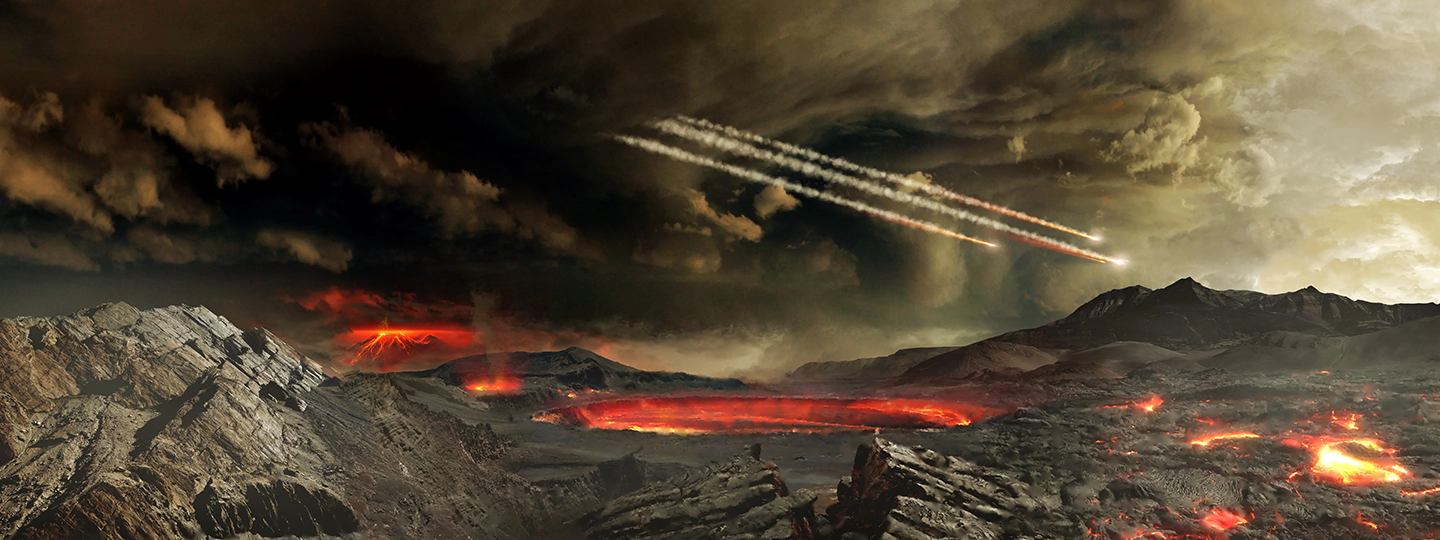 This illustration shows what the late heavy bombardment might have been like. Some scientists think that if such a catastrophic rain of asteroids occurred on Earth, life would not have been able to survive. NASA’s Goddard Space Flight Center Conceptual Image LabEvolutionary what-ifs
What might be most interesting about studying LUCA, Williams says, isn’t learning about how life first emerged on Earth. Rather, it’s how evolution happens in general, leading to more complex life over time.
Life on Earth today represents one way that evolution played out. But maybe it could have gone in a different direction. In its time, LUCA was likely just one of many organisms that had descended from the first living thing. What if one of its neighbors had evolved instead?
In the future, scientists might be able to explore this question, says Julia Schwartzman. She is a biologist at the University of Southern California–Dornsife in Los Angeles. At a recent meeting of the American Society for Microbiology, she raised the possibility of re-creating those other organisms from around the same time as LUCA.
“Can we use synthetic biology to re-synthesize old organisms and see if [they] can re-evolve?” she asked. “There’s a lot of potential.”
Research on LUCA could also aid the search for life on other worlds. If scientists understand the rules of how microbes evolve on Earth, says Williams, they can run experiments to test how that might play out on other planets.
“What are the conditions under which life can occur?” asks Williams. We only have one example, he notes: life on Earth. “Having multiple cases,” he says, might help scientists learn which biological stages can only happen here — and which might unfold somewhere else in the cosmos.
acronym: A word made by combining some of the starting letter or groups of letters from a number of words. For instance, STEM is an acronym for Science, Technology, Engineering and Math. Radar is an acronym for RAdio Detection And Ranging. Even laser is an acronym for Light Amplification by Stimulated Emission of Radiation.
alien: A non-native organism. (in astronomy) Life on or from a distant world.
ancestor: A predecessor. It could be a family forebear, such as a parent, grandparent or great-great-great grandparent. Or it could be a species, genus, family or other order of organisms from which some later one evolved. For instance, ancient dinosaurs are the ancestors of today's birds. (antonym: descendant)
ape: A group of rather large primates, all of which lack a tail. They include gorillas, chimpanzees, bonobos, orangutans, gibbons and humans. Most people tend to group humans into their own separate subcategory owing to a number of special traits. These include a larger brain, greater mental abilities (including being able to talk) and their ability to walk on two legs.
archaea: (singular: archaeon) One of the three domains of life on Earth. This group consists of single-celled prokaryotes — organisms without a cell nucleus. Archaea are best known for living in extremely harsh environments, such as very salty water or highly acidic or hot places.
asteroid: A rocky object in orbit around the sun. Most asteroids orbit in a region that falls between the orbits of Mars and Jupiter. Astronomers refer to this region as the asteroid belt.
ATP: Short for adenosine triphosphate. Cells make this molecule to power almost all of their activities. Cells use oxygen and simple sugars to create this molecule, the main source of their energy. The small structures in cells that carry out this energy-storing process are known as mitochondria. Like a battery, ATP stores a bit of usable energy. Once the cell uses it up, mitochondria must recharge the cell by making more ATP using energy harvested from the cell’s nutrients.
bacteria: (singular: bacterium) Single-celled organisms. These dwell nearly everywhere on Earth, from the bottom of the sea to inside other living organisms (such as plants and animals). Bacteria are one of the three domains of life on Earth.
biology: The study of living things. The scientists who study them are known as biologists.
cataclysm: An enormous, violent, natural event. A meteor hitting Earth and wiping out most living species would qualify as a cataclysmic event.
cell: (in biology) The smallest structural and functional unit of an organism. Typically too small to see with the unaided eye, it consists of a watery fluid surrounded by a membrane or wall. Depending on their size, animals are made of anywhere from thousands to trillions of cells. Most organisms, such as yeasts, molds, bacteria and some algae, are composed of only one cell.
chemical: A substance formed from two or more atoms that unite (bond) in a fixed proportion and structure. For example, water is a chemical made when two hydrogen atoms bond to one oxygen atom. Its chemical formula is H2O. Chemical also can be an adjective to describe properties of materials that are the result of various reactions between different compounds.
chemical reaction: A process that involves the rearrangement of the molecules or structure of a substance, as opposed to a change in physical form (as from a solid to a gas).
common ancestor: Also known as shared ancestor. It's an ancestor that two or more descendants have in common. Two siblings share a parent as a common ancestor. This also applies on the level of species and groups of organisms. Two or more species can share a common ancestor at the genus level. Two or more genera can share a common ancestor at the family level, and so on. Tigers and lions have a common ancestor, as do humans and Neandertals.
continent: (in geology) The huge land masses that sit upon tectonic plates. In modern times, there are six established geologic continents: North America, South America, Eurasia, Africa, Australia and Antarctica. In 2017, scientists also made the case for yet another: Zealandia.
crater: A large, bowl-shaped cavity in the ground or on the surface of a planet or the moon. They are typically caused by an explosion or the impact of a meteorite or other celestial body. Such an impact is sometimes referred to as a cratering event.
descendant: A blood relative of a person who lived during a previous time.
digest: (noun: digestion) To break down food into simple compounds that the body can absorb and use for growth. Some sewage-treatment plants harness microbes to digest — or degrade — wastes so that the breakdown products can be recycled for use elsewhere in the environment.
diversity: A broad spectrum of similar items, ideas or people. In a social context, it may refer to a diversity of experiences and cultural backgrounds. (in biology) A range of different life forms or a range of traits within the population of some species.
DNA: (short for deoxyribonucleic acid) A long, double-stranded and spiral-shaped molecule inside most living cells that carries genetic instructions. It is built on a backbone of phosphorus, oxygen, and carbon atoms. In all living things, from plants and animals to microbes, these instructions tell cells which molecules to make.
environment: The sum of all of the things that exist around some organism or the process and the condition those things create. Environment may refer to the weather and ecosystem in which some animal lives, or, perhaps, the temperature and humidity (or even the placement of things in the vicinity of an item of interest).
eukaryote: Any organism whose cells have a nucleus. Eukaryotes include all multicellular creatures (such as plants, animals and fungi) as well as certain types of single-celled microorganisms.
evolution: (v. to evolve) A process by which species undergo changes over time, usually through genetic variation and natural selection. These changes usually result in a new type of organism better suited for its environment than the earlier type. The newer type is not necessarily more “advanced,” just better adapted to the particular conditions in which it developed.
evolutionary biologist: Someone who studies the adaptive processes that have led to the diversity of life on Earth. These scientists can study many different subjects, including the microbiology and genetics of living organisms, how species change to adapt, and the fossil record (to assess how various ancient species are related to each other and to modern-day relatives).
family: A taxonomic group consisting of at least one genus of organisms.
focus: (in physics) The point at which rays (of light or heat for example) converge sometimes with the aid of a lens. (In vision, verb, "to focus") The action a person's eyes take to adapt to light and distance, enabling them to see objects clearly. (in behavior) To look or concentrate intently on some particular point or thing.
fossil: Any preserved remains or traces of ancient life. There are many different types of fossils: The bones and other body parts of dinosaurs are called “body fossils.” Things like footprints are called “trace fossils.” Even specimens of dinosaur poop are fossils. The process of forming fossils is called fossilization.
gene: (adj. genetic) A segment of DNA that codes, or holds instructions, for a cell’s production of a protein. Offspring inherit genes from their parents. Genes influence how an organism looks and behaves.
genetic: Having to do with chromosomes, DNA and the genes contained within DNA. The field of science dealing with these biological instructions is known as genetics. People who work in this field are geneticists.
genome: The complete set of genes or genetic material in a cell or an organism. The study of this genetic inheritance housed within cells is known as genomics.
hydrothermal vent: An opening at the bottom of the ocean or a lake where hot water emerges from deep inside Earth. The water is rich in minerals and chemicals that can nourish ecosystems of worms, clams, microbes and other organisms.
infection: A disease that can spread from one organism to another. It’s usually caused by some type of microbe.
mammal: An animal distinguished by possessing hair or fur, the secretion of milk by females for the feeding of their young, and (typically) the bearing of live young. They also are warm-blooded (or endothermic).
membrane: A barrier which blocks the passage (or flow through) of some materials depending on their size or other features. Membranes are an integral part of filtration systems. Many serve that same function as the outer covering of cells or organs of a body.
Mercury: (in astronomy and here the term is capitalized) The smallest planet in our solar system and the one whose orbit is closest to our sun. Named after a Roman god (Mercurius), one year on this planet lasts 88 Earth days, which is shorter than one of its own days: Each of those lasts 175.97 times as long as a day on Earth.
metabolism: (adj. metabolic) The set of life-sustaining chemical reactions that take place inside cells and bigger structures, such as organs. These reactions enable organisms to grow, reproduce, move and otherwise respond to their environments.
microbiology: The study of microorganisms, principally bacteria, fungi and viruses. Scientists who study microbes and the infections they can cause or ways that they can interact with their environment are known as microbiologists.
microscope: An instrument used to view objects — such as bacteria or the single cells of plants or animals — that are too small to be visible to the unaided eye.
model: A simulation of a real-world event (usually using a computer) that has been developed to predict one or more likely outcomes. Or an individual that is meant to display how something would work in or look on others.
molecule: A group of atoms that represents the smallest possible amount of a chemical compound. Molecules can be made of single types of atoms or of different types. For example, the oxygen in air is made of two bound oxygen atoms (O2). Water is made of two hydrogen atoms and one oxygen atom (H2O).
morph: Short for metamorphose, it means to change or transform from one form to another (such as from a caterpillar to a butterfly) or from one shape to another. Or it can mean to evolve or mutate, where one or more parts of the genome undergo some sort of change in their chemistry — and potentially in their function. (in non-living systems) It refers to a thing, policy or activity that has undergone change, becoming something that looks or seems new and different.
multicellular: Having or consisting of many cells. This includes all animals and plants, and many types of fungus.
nucleus: Plural is nuclei. (in biology) A dense structure present in many cells. Typically a single rounded structure encased within a membrane, the nucleus contains the genetic information. (in astronomy) The rocky body of a comet, sometimes carrying a jacket of ice or frozen gases. (in physics) The central core of an atom, containing most of its mass.
organelle: Specialized structures, such as mitochondria, found within a cell.
organic: (in chemistry) An adjective that indicates something is carbon-containing; also a term that relates to the basic chemicals that make up living organisms.
organism: Any living thing, from elephants and plants to bacteria and other types of single-celled life.
primate: The order of mammals that includes humans, apes, monkeys and related animals (such as tarsiers, the Daubentonia and other lemurs).
primordial: An adjective that refers to something that goes back to the beginning of time or to the earliest existence of something.
progenitor: Ancestor, parent or originator. (in biology) Some individual — or thing (perhaps even a cell) — from which all others descend.
protein: A compound made from one or more long chains of amino acids. Proteins are an essential part of all living organisms. They form the basis of living cells, muscle and tissues; they also do the work inside of cells. Antibodies, hemoglobin and enzymes are all examples of proteins. Medicines frequently work by latching onto proteins.
scenario: A possible (or likely) sequence of events and how they might play out.
sea: An ocean (or region that is part of an ocean). Unlike lakes and streams, seawater — or ocean water — is salty.
solar system: The eight major planets and their moons in orbit around our sun, together with smaller bodies in the form of dwarf planets, asteroids, meteoroids and comets.
synthetic biology: A research field in which scientists work on developing custom life forms in the lab. Because they make synthetic organisms, scientists who work in this field are known as synthetic biologists.
system: A network of parts that together work to achieve some function. For instance, the blood, vessels and heart are primary components of the human body's circulatory system. Similarly, trains, platforms, tracks, roadway signals and overpasses are among the potential components of a nation's railway system. System can even be applied to the processes or ideas that are part of some method or ordered set of procedures for getting a task done.
theory: (in science) A description of some aspect of the natural world based on extensive observations, tests and reason. A theory can also be a way of organizing a broad body of knowledge that applies in a broad range of circumstances to explain what will happen. Unlike the common definition of theory, a theory in science is not just a hunch. Ideas or conclusions that are based on a theory — and not yet on firm data or observations — are referred to as theoretical. Scientists who use mathematics and/or existing data to project what might happen in new situations are known as theorists.
trillion: A number representing a million million — or 1,000,000,000,000 — of something.
Venus: The second planet out from the sun. Just as Earth does, it has an iron core and a rocky mantle and crust. Volcanoes on the planet’s surface spewed high levels of carbon dioxide, which built up in the planet’s atmosphere. Today the air pressure at the planet’s surface is 100 times greater than on Earth, and the atmosphere now keeps the surface of Venus a brutal 460° Celsius (860° Fahrenheit).
Journal: E.R.R. Moody et al. The emergence of metabolisms through Earth history and implications for biospheric evolution. Philosophical Transactions of the Royal Society B, Biological Sciences. Vol. 380, August 7, 2025, p. 20240097. doi: 10.1098/rstb.2024.0097.
Meeting: V. Cooper et al. Early microbial life – how learning about the origin of life informs us about the future. ASM Microbe 2025. June 20, 2025. Los Angeles, California.
Journal: P. Forterre. The last universal common ancestor of ribosome-encoding organisms: Portrait of LUCA. Journal of Molecular Evolution. Vol. 92, October 2024, p. 550. doi: 10.1007/s00239-024-10186-9.
Journal: E. Moody et al. The nature of the last universal common ancestor and its impact on the early Earth system. Nature Ecology & Evolution. Vol. 8, September 2024, p. 1654. doi: 10.1038/s41559-024-02461-1.
Journal: A Harish and C. Kurland. Akaryotes and eukaryotes are independent descendants of a universal common ancestor. Biochimie. Vol. 138, July 2017, p. 168. doi: 10.1016/j.biochi.2017.04.013.
Journal: K.J. Locey and J.T. Lennon. Scaling laws predict global microbial diversity. Proceedings of the National Academy of Sciences. Vol. 113, May 2, 2016, p. 5970. doi: 10.1073/pnas.1521291113.
Journal: P. Forterre et al. The nature of the last universal ancestor and the root of the tree of life, still open questions. Biosystems. Vol. 28, 1992, p. 15. doi: 10.1016/0303-2647(92)90004-I.
Journal: C.R. Woese and G.E. Fox. Phylogenetic structure of the prokaryotic domain: The primary kingdoms. Proceedings of the National Academy of Sciences. Vol. 74, November 15, 1977, p. 5088. doi: 10.1073/pnas.74.11.5088.
Journal: C.R. Woese and G.E. Fox. The concept of cellular evolution. Journal of Molecular Evolution. Vol. 10, September 20, 1977, p. 1. doi: 10.1007/BF01796132.
Stephen Ornes lives in Nashville, Tenn., and his family has two rabbits, six chickens and a cat. He has written for Science News Explores since 2008 on topics including lightning, feral pigs, big bubbles and space junk.
| # | Наименование новости | Тональность | Информативность | Дата публикации |
|---|---|---|---|---|
| 1 | Everyone alive may carry DNA from a ‘ghost lineage’ of human ancestors | 0 | 10.41 | 30-07-2026 |
| 2 | Как узнать, какой была жизнь на Земле до древнейшего известного предка? | 0 | 7 | 10-03-2026 |
| 3 | Могли ли мы не заметить целый мир, существующий параллельно с ... | 0 | 7 | 09-07-2026 |
| 4 | Scientists found two mysterious ‘ghost’ ancestors hiding in our DNA | 0 | 7.86 | 01-08-2026 |
| 5 | Призраки в нашей ДНК. В геноме человека есть следы двух неизвестных предков | 0 | 6.78 | 03-08-2026 |
| 6 | Могли ли мы не заметить целый мир, существующий параллельно с нашим? | 5 | 7 | 20-06-2026 |
| 7 | Tänder avslöjar genetiskt band till utdöd släkting | 0 | 9 | 17-05-2026 |
| 8 | Last common ancestor of humans and chimpanzees could have been a vertical climber, no matter its feet | 0 | 5.79 | 17-08-2026 |
| 9 | Taiwan Biobank data reveals ongoing natural selection in living humans | 0 | 10 | 24-07-2026 |