Просмотр новости
Найдите то, что Вас интересует
 Спутники
 РН
РН SpaceX
 Роскосмос
 NASA
NASA
СпутникиРНSpaceXРоскосмосNASAThe new microraptor, Jian changmaensis, may have snacked on birds when not gliding through northwestern China some 120 million years ago.
The newly described species may have snacked on birds 120 million years ago
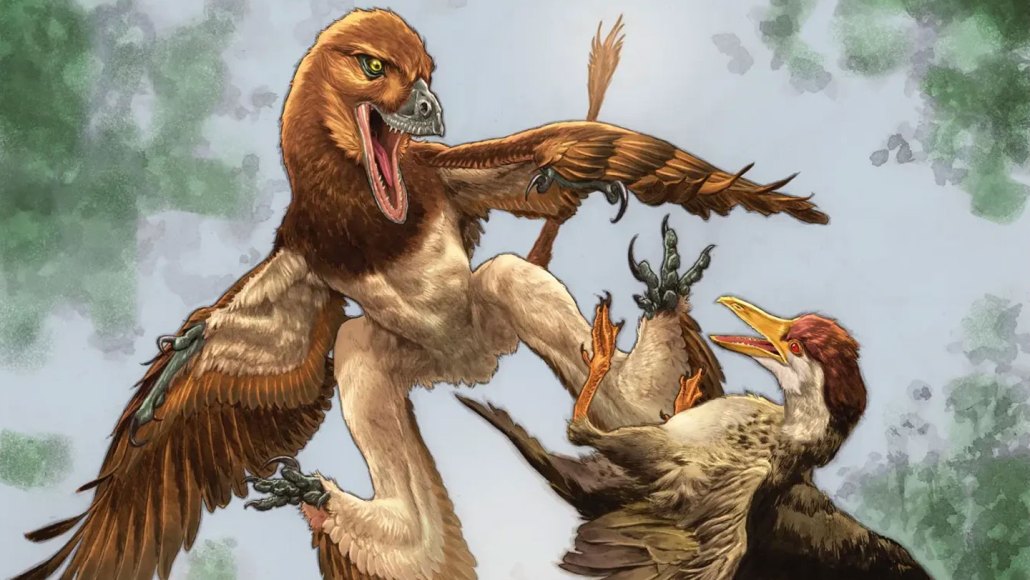
This illustration shows the newly described dinosaur, Jian changmaensis (left) ambushing an early Cretaceous bird, Gansus yumenensus (right). It remains a mystery just how well this gliding predator might have snagged prey in the air.
Illustration by Lewis LaRosa, colorized by Jão Canola.
This is a human-written story voiced by AI. Got feedback? Take our survey . (See our AI policy here .)
The arm and shoulder bones of a gliding dinosaur might have just revealed the solution to a gruesome whodunit.
Since 2002, researchers have unearthed more than 100 prehistoric bird remains in the Changma Basin. It’s a fossil bed in northwestern China. The remains here date back to about 120 million years ago. Some include hacked-up pellets containing broken bones. Those pellets resemble ones coughed up by today’s owls.
Paleontologists long assumed a meat-eating dinosaur was to blame. But fossil evidence of the predator has been hard to find — until now.
A new species of dinosaur sporting wing feathers on its arms and legs may be to blame. Researchers used shoulder and upper arm bones found in the same fossil bed to identify the new species. Named Jian changmaensis, it belonged to a group of dinosaurs known as microraptors. These small, speedy dinos were cousins of the famed velociraptor.
The team shared its findings June 4 in the Annals of Carnegie Museum.
Like other more well-known microraptors, the newfound dino likely used its “wings” to take to the air. This would have helped it glide like a flying squirrel, the researchers say.
Microraptors weren’t birds — though they were close relatives. And several birdlike features may have allowed J. changmaensis to glide better than other microraptors, says Jingmai O’Connor. At the Field Museum in Chicago, Ill., this vertebrate paleontologist studies how birds evolved.
O’Connor’s team spotted one notable feature on the new dino’s upper arm bone, or humerus. Rounded protrusions on the bone, called condyles, help form the elbow. These formed differently in J. changmaensis than in other microraptors.
A structure in the shoulder called the coracoid was also longer in J. changmaensis. “These features are very birdlike,” O’Connor says.
This predator would have dwarfed the early birds it feasted on, the team says. With an estimated 1.22-meter (4-foot) wingspan, the new dino is among the largest microraptors found so far. Its wingspan is about as large as a barn owl’s.
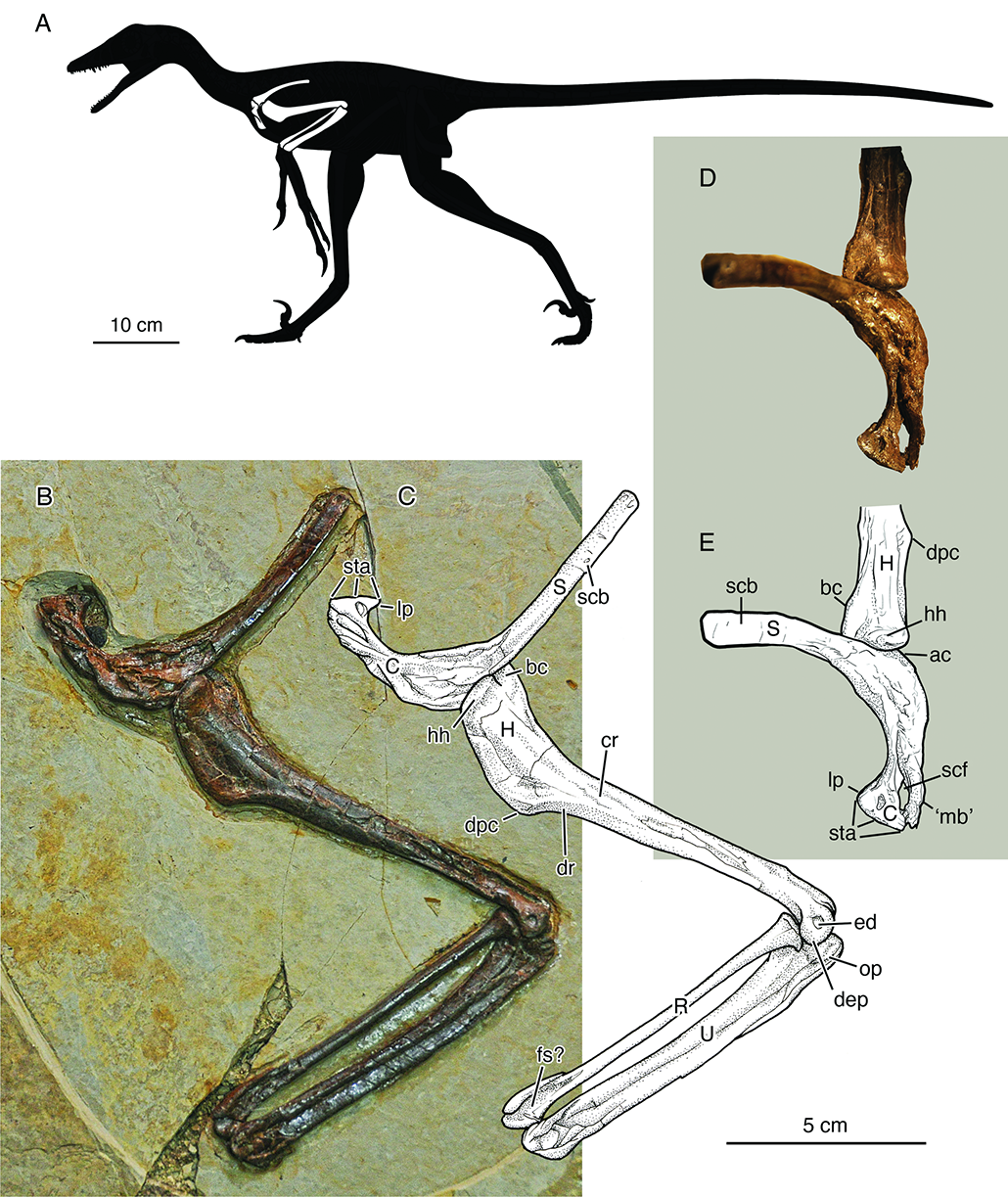 Researchers used newfound fossils to tease out the identity of a new gliding dinosaur (size shown in Figure A). The crucial fossils were the arm and shoulder bones (photographed Figure B, drawn in C). Figures D and E show the shoulder and upper arm bones. The bone measurements suggest the gliding dino would’ve had a 1.2-meter (4-foot) wingspan, or about the size of today’s barn owls.Zhou et al/Annals of Carnegie Museum 2026Understanding ancient ecosystems
The find doesn’t just solve who snacked on the early birds of Changma Basin. It marks the first nonbird dinosaur remains found in the region.
“It’s a new record from that particular ancient ecosystem, which is exciting,” says Michael Pittman. Before this discovery, all microraptors from the same era had been found at sites in northeastern China. Pittman is a paleontologist at the Chinese University of Hong Kong. He did not take part in the new research, but he does study how animals evolved flight.
Teasing out how well this predator ambushed prey while gliding is a bit tricky, O’Connor says. The birds it feasted on would’ve been more powerful and agile flyers. But the new fossil can help researchers better understand how flight evolved.
Fossils like J. changmaensis show that birds weren’t unique in getting airborne, says Pittman. The find shows what roles microraptors took on in other ecosystems. “It’s such a special ability to be able to fly,” he says. “But there’s still a lot we don’t understand.”
Submit your question here, and we might answer it an upcoming issue of Science News Explores
| # | Наименование новости | Тональность | Информативность | Дата публикации |
|---|---|---|---|---|
| 1 | This newly discovered raptor may have hunted like a giant heron | 0 | 8.83 | 29-05-2026 |
| 2 | Новый пернатый динозавр оказался четырехкрылым драконом, который охотился на добычу с деревьев 120 млн лет назад | 5 | 7 | 26-06-2026 |
| 3 | Новый вид динозавра раскрыл происхождение птичьего хвоста | 5 | 7 | 03-07-2026 |
| 4 | Новый вид юрского динозавра раскрыл происхождение птичьего хвоста | 5 | 7 | 03-07-2026 |
| 5 | Нового уникального монстра старше динозавров удалось найти в России | 5 | 7 | 10-07-2026 |
| 6 | Fossil in drawer turns out to be touchstone dinosaur artifact | 0 | 5 | 03-07-2026 |
| 7 | Воссоздан скелет гигантского древнего крокодила, который охотился на динозавров | 0 | 7.9 | 08-08-2026 |
| 8 | "Мумии" утконосых динозавров-гадрозавров указали на наличие у них копыт | 0 | 0 | 23-10-2025 |
| 9 | Families, investigators remain haunted by unsolved Texas yogurt shop murders | -2 | 3 | 29-05-2026 |